
CRM Development
Trehan Sangpriya
CEO & Co-Founder
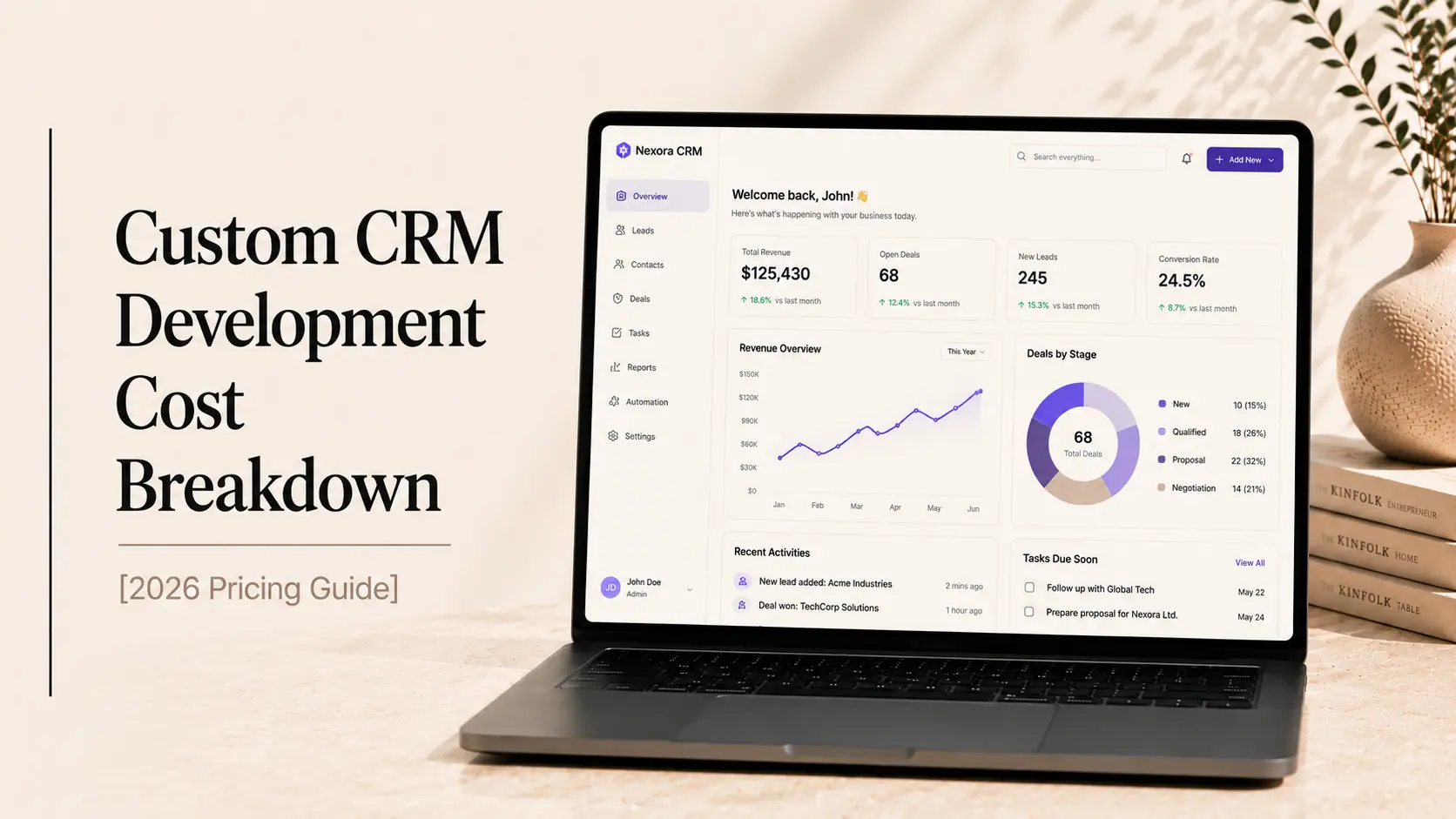
Someone in your business just said "let's build our own CRM", and now you're trying to figure out what that actually costs. Maybe you've outgrown Salesforce. Maybe HubSpot is eating your budget. Maybe your sales process is unique enough that no off-the-shelf tool handles it properly. Whatever brought you here, you want a real number. Not a range so wide it's useless. An honest, broken-down cost picture.
So let's have that conversation.
The global CRM market is worth over $96 billion in 2024 and is growing. Yet a significant number of businesses that use commercial CRM tools end up spending money on workarounds, integrations, and manual processes because the tool doesn't fit how they actually work. According to Nucleus Research, CRM systems return an average of $8.71 for every dollar spent, but only when the system actually matches how the business operates. A tool that fights your workflow is expensive no matter what it costs per seat.
This guide breaks down custom CRM software development cost in real terms, by feature scope, team type, technology decisions, and timeline. By the end, you'll have enough context to understand any quote you receive and know what's reasonable to expect.
Why Businesses Choose to Build a Custom CRM
Before getting into numbers, it's worth understanding the "why", because it directly affects how much you should spend.
The Off-the-Shelf CRM Problem
HubSpot, Salesforce, Zoho, Pipedrive, these are all excellent products for the businesses they were designed for. The problem is that as your business matures, your processes become more specific. And specific processes don't always fit standard templates.
The signals that a custom CRM might make sense:
You're spending more time building workarounds than doing sales
Your team manages data across three or four disconnected tools
You need deep integration with proprietary systems (custom ERP, logistics platform, legacy database)
Your sales process has branching logic that no pipeline tool handles cleanly
You're paying $50–$200 per user per month and the math is becoming uncomfortable
The Case for Custom
Custom CRM software means the system is built around your process, not the other way around. It does exactly what your team needs, integrates with the systems you actually use, and has zero features you don't need cluttering the interface.
The upfront cost is higher. The long-term fit is better. The ROI calculation depends on your specific situation.
What Actually Drives CRM Development Cost
Custom CRM pricing isn't random. Every quote you receive is driven by the same underlying variables. Understanding these helps you ask better questions and evaluate proposals more intelligently.
Feature Scope
This is the biggest variable. A CRM with 10 core features costs fundamentally less than one with 40. The most common CRM features and their relative development weight:
Core features (lower cost, present in almost every build):
Contact and company management
Deal pipeline with stages
Activity logging (calls, emails, meetings)
Task and reminder system
Basic reporting dashboard
User roles and permissions
Advanced features (moderate cost, build when needed):
Email integration (bi-directional sync with Gmail/Outlook)
Workflow automation and triggers
Document management and e-signatures
Custom fields and flexible schemas
Advanced reporting and filters
Mobile application
Complex features (higher cost, specific to your use case):
AI-powered lead scoring
Complex multi-branch pipelines
Deep ERP/inventory integration
Custom client portal
Territory and quota management
Predictive analytics
The honest advice: Build the core first. Launch. Get your team using it. Then identify what's missing from actual use, not from a wishlist created in a meeting room.
Technology Stack
The technology used to build your CRM affects both the development cost and the long-term maintenance cost.
Modern CRM builds typically use:
Frontend: React or Next.js for the dashboard UI
Backend: Node.js, Python (Django/FastAPI), or Ruby on Rails
Database: PostgreSQL for structured relational data; Redis for caching
Authentication: Clerk, Auth0, or custom JWT implementation
Hosting: AWS, GCP, or a managed provider like Railway or Render
Technology choices affect timeline (some stacks move faster), maintenance cost, and how easy it is to hire developers to extend the system later.
Team Type and Location
This is the variable most people underestimate. The same scope of work can vary by 300–400% in cost depending on who builds it.
Team Type | Hourly Rate | Best For |
Junior freelancer (offshore) | $15–$35/hr | Simple builds, tight budgets |
Mid-level freelancer | $40–$75/hr | Defined scope, technical oversight available |
Onshore senior developer | $80–$150/hr | Complex integrations, quality-critical builds |
Offshore agency | $30–$60/hr | Larger teams, structured process |
Specialist studio (full-service) | $80–$180/hr | End-to-end ownership, architecture to deployment |
Choosing the cheapest option is not the same as choosing the most cost-effective option. A junior developer at $25/hr who takes three times as long and requires significant rework costs more in total than a specialist at $120/hr who delivers cleanly.
Custom CRM Pricing Breakdown by Build Tier
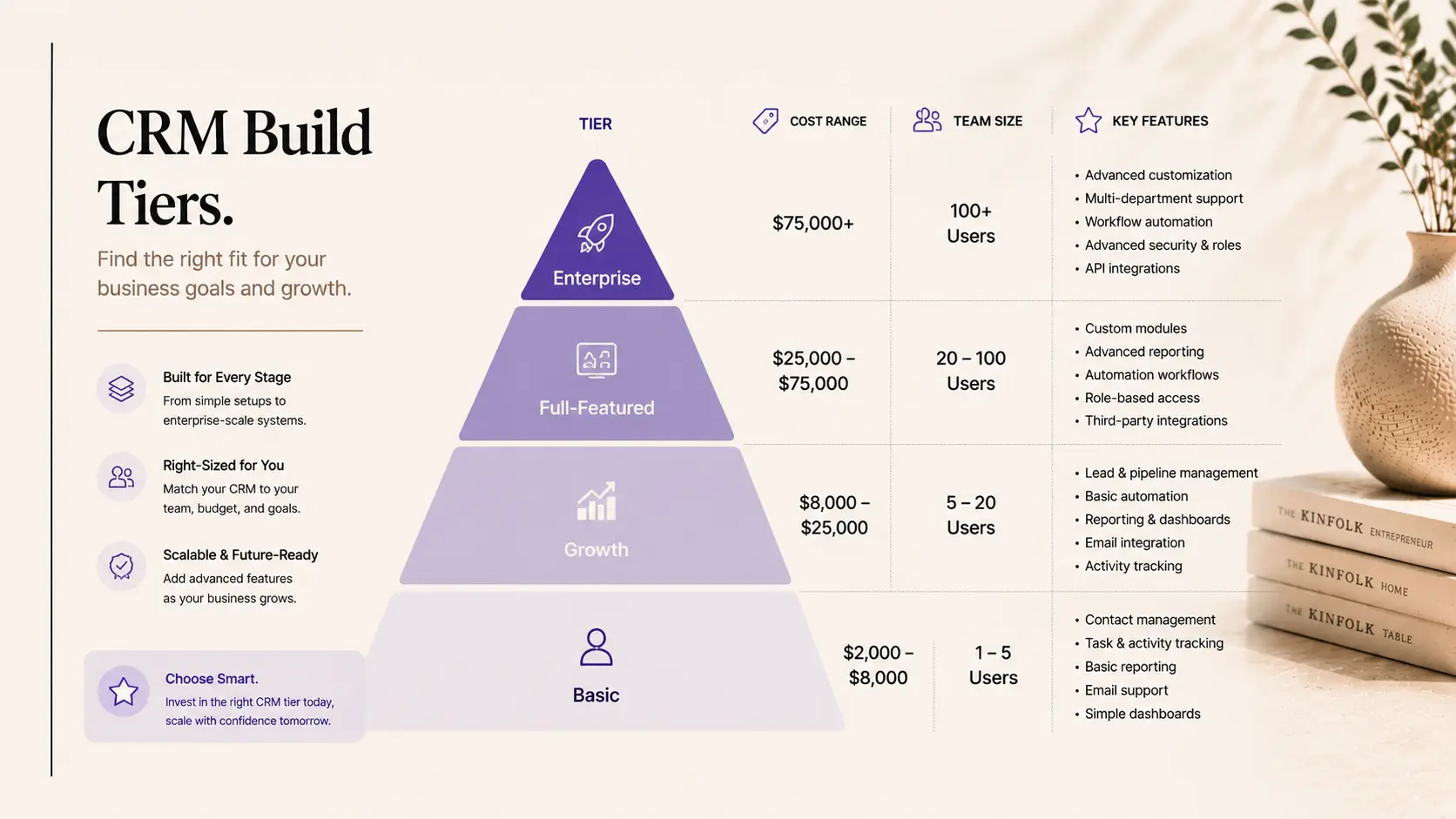
Tier 1, Basic CRM ($15,000 – $35,000)
This tier covers the fundamentals: contact management, a simple pipeline, activity logging, basic reporting, and user authentication. No complex integrations. No automation. No mobile app.
What you get:
Contact and company records
Deal pipeline (3–5 stages)
Notes, tasks, and basic activity log
Simple dashboard with key metrics
Role-based access (admin/user)
Email and password authentication
What you don't get:
Email sync
Workflow automation
API integrations
Mobile app
Best for: Small businesses starting with a clean foundation, teams replacing a spreadsheet-based system, or a starting point for a larger build.
Timeline: 6–10 weeks
Tier 2, Growth CRM ($35,000 – $80,000)
This is the most common build for growing businesses. It adds email integration, workflow automation, better reporting, and the ability to customise the system without a developer.
What you get:
Everything in Tier 1
Gmail/Outlook email sync (bi-directional)
Workflow automation (automated tasks, notifications, stage changes)
Custom fields and flexible record schemas
Advanced filtering and list management
Document upload and management
Import/export functionality
API for integration with other tools
Timeline: 12–18 weeks
Tier 3, Full-Featured CRM ($80,000 – $160,000)
This tier covers businesses with complex sales processes, multiple teams, or deep integration requirements. Includes everything in Tier 2 plus mobile, advanced analytics, and significant third-party integrations.
What you get:
Everything in Tier 2
Mobile application (iOS and/or Android)
Advanced reporting and custom report builder
Deep integration with ERP, accounting, or other proprietary systems
Client portal (external-facing interface for customers)
Lead scoring and qualification rules
Territory management and quota tracking
Multiple pipeline types for different sales tracks
Timeline: 20–32 weeks
Tier 4, Enterprise CRM ($160,000 – $500,000+)
Enterprise-grade CRM development covers complex organisations with multiple business units, advanced compliance requirements, AI features, and deep custom functionality across multiple systems.
What you get:
Everything in Tier 3
AI-powered features (lead scoring, churn prediction, next-best-action)
Multi-tenant architecture (if the CRM serves multiple companies or subsidiaries)
Enterprise SSO (SAML, LDAP, Active Directory)
Advanced security and audit logging
Custom analytics warehouse integration
API-first architecture for ecosystem integration
Timeline: 6–18+ months
The Hidden Costs Most People Forget
The build cost is only part of the picture. Here's what compounds your total CRM software development cost over time.
Infrastructure and hosting: $50–$500/month depending on user count and data volume. Budget $100–$200/month for a 20–50 user CRM on managed infrastructure.
Maintenance and bug fixes: Budget 15–20% of the build cost annually. A $60,000 CRM needs $9,000–$12,000/year in maintenance budget.
Feature additions: Your team will identify missing features after launch. Budget 20–30% of the initial build cost in year one for iterative improvements.
Training and onboarding: A custom CRM needs proper documentation and onboarding for your team. Budget time (and sometimes cost) for this.
Data migration: If you're moving from Salesforce or HubSpot, migrating clean, structured data takes real work. Budget $3,000–$15,000 for complex migrations.
Custom CRM vs. Off-the-Shelf: The 3-Year Math
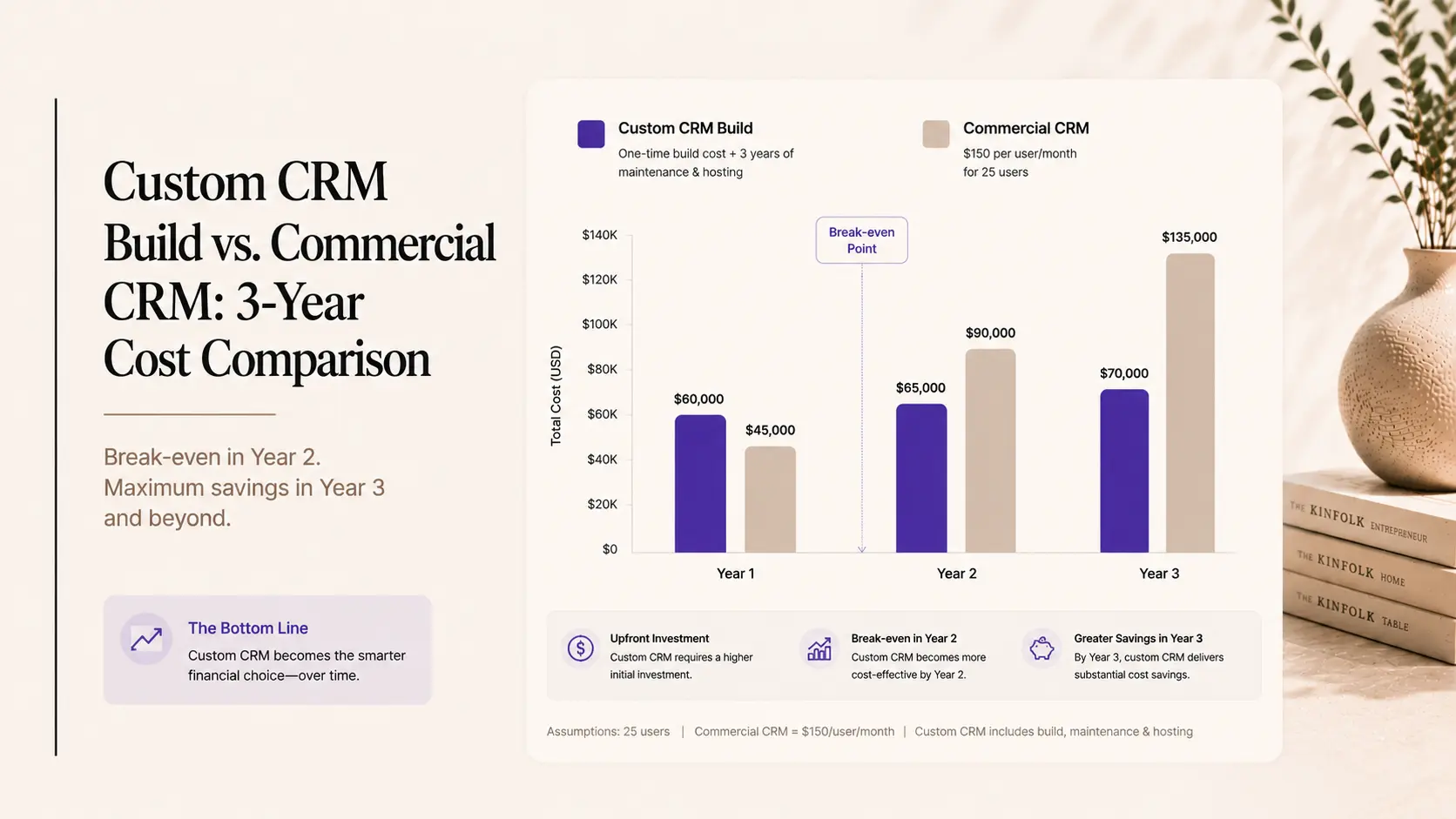
Let's run the numbers for a 25-person sales team comparing a commercial CRM at $150/user/month against a custom build at $60,000.
Cost Item | Commercial CRM (25 users × $150/mo) | Custom CRM ($60K build) |
Year 1 | $45,000 | $60,000 + $8,000 maintenance = $68,000 |
Year 2 | $45,000 | $8,000 maintenance + $15,000 features = $23,000 |
Year 3 | $45,000 | $8,000 maintenance + $10,000 features = $18,000 |
3-Year Total | $135,000 | $109,000 |
By year three, the custom build is cheaper, and by year five, the gap has widened significantly. The commercial CRM also scales upward in cost every time you add users or upgrade plans. The custom CRM doesn't.
The crossover point in this example is around 26–28 months. For businesses where the custom CRM better fits the workflow (reducing admin time and improving deal conversion), the ROI is even stronger.
How Createxp Builds Custom CRM Systems
Createxp has built custom CRM systems for sales teams, service businesses, logistics companies, and enterprises across five continents. The process is built around one observation: the CRM projects that fail almost always fail at the discovery stage, not the development stage.
Here's how the work actually happens:
Process Mapping Before Wireframes: Before any design or development starts, the team maps out the actual sales or service process, not the idealised version from a whiteboard, but how deals actually move from first contact to close. This determines what the pipeline stages should be, what information matters at each stage, and what automations would genuinely save time versus add noise.
Scope Discipline: The most common reason CRM builds go over budget and over time is scope creep, features added mid-project that weren't in the original brief. Createxp works with clients to lock a Tier 1 scope for launch and maintain a documented backlog for future phases. The first version gets used and validated before additional features are built.
Built to Be Extended: A custom CRM that can't be extended without rebuilding half the system is a trap. Createxp builds with a clean API layer, well-documented database schema, and modular architecture. When new requirements come in, as they always do, the foundation doesn't need to be revisited.
Data Migration Included: Moving from Salesforce, HubSpot, Pipedrive, or spreadsheets is part of the delivery. Clean data in the new system from day one. Not a separate project to figure out later.
Training and Documentation: Every CRM delivery includes user documentation and a training session. A custom CRM that your team doesn't know how to use delivers zero of its potential value.
Whether you're a 10-person startup replacing spreadsheets or a 200-person enterprise replacing a commercial CRM that's outgrown its usefulness, the approach is the same: understand the process first, build exactly what's needed, and leave a foundation that grows with the business.
Your CRM Should Work the Way You Do
The right CRM isn't the most popular one. It's the one your team actually uses. And the one your team uses is the one that fits how they work, not the one that requires three workarounds and a weekly Zapier audit to keep running.
If you're ready to talk through what a CRM build would actually look like for your business, let's start there.
Get a Custom CRM Cost Estimate
Key Takeaways
Custom CRM development cost ranges from $15,000 for a basic build to $500,000+ for enterprise systems. Most growing businesses land in the $35,000–$80,000 range for a genuinely useful starting point.
The biggest cost variable is feature scope. Building a focused Tier 1 CRM and iterating based on real use is almost always more cost-effective than over-specifying upfront.
For a 25-person sales team, a $60,000 custom CRM typically becomes cheaper than a $150/user/month commercial tool around month 26–28, with the gap widening every year after.
Hidden costs, maintenance (15–20% of build cost annually), feature additions, hosting, and data migration, can add 30–40% to your total first-year spend.
The team type you choose matters enormously. A specialist studio at $120/hr that delivers cleanly is usually more cost-effective than a junior developer at $25/hr who requires rework.
Never build features you haven't validated the need for. Launch lean, learn from use, then extend.
Data migration from your existing CRM is a real project. Budget $3,000–$15,000 and include it in the scope from the start.
Frequently Asked Questions
How much does it cost to build a custom CRM?
Custom CRM development costs typically range from $15,000 for a basic contact and pipeline system to $500,000+ for enterprise-grade builds with AI features, multi-tenant architecture, and deep integrations. The most common range for a growing business is $35,000–$80,000, covering email integration, workflow automation, custom fields, and solid reporting. The biggest cost driver is feature scope.
Is it cheaper to build a CRM or buy one?
It depends on team size, feature requirements, and time horizon. For small teams (under 10 users), off-the-shelf CRMs are almost always cheaper in the short term. For mid-sized businesses with 20+ users paying $100–$200/user/month, the total cost of a custom CRM often becomes cheaper than the commercial alternative within 2–3 years. The economic case strengthens when the commercial tool requires workarounds that cost additional time and money.
What factors affect custom CRM pricing?
The main factors are: feature scope (the biggest variable), team type and location (a 3–4x cost range depending on developer rate), technology stack choices, integration complexity, the number of users the system needs to serve, and whether a mobile application is required. Timeline also affects cost, a faster build requires more parallel developers and costs more.
How long does it take to build a custom CRM?
A basic CRM takes 6–10 weeks. A growth-tier build with email integration and automation takes 12–18 weeks. A full-featured CRM with mobile and deep integrations takes 20–32 weeks. Enterprise builds can take 6–18 months. Timeline correlates directly with scope, simpler scope means faster delivery.
What features should a custom CRM include?
At minimum: contact and company management, a deal pipeline with stages, activity logging, task management, basic reporting, and user roles. From there, priority features are email sync (bi-directional with Gmail/Outlook), workflow automation, custom fields, and API integration with your other tools. Mobile apps, advanced analytics, client portals, and AI features are typically second-phase additions after the core system is validated.
What is the annual maintenance cost for a custom CRM?
Budget 15–20% of the build cost annually for maintenance, bug fixes, security updates, and minor improvements. For a $60,000 CRM, that's $9,000–$12,000/year. This covers keeping the system running reliably, addressing issues as they surface, and making small adjustments as your process evolves. Feature additions beyond minor adjustments are typically scoped and priced separately.
Can I migrate my data from Salesforce or HubSpot to a custom CRM?
Yes. Data migration from Salesforce, HubSpot, Pipedrive, or other commercial CRMs is a standard part of any reputable custom CRM build. The cost depends on data volume, data quality, and the complexity of the relationships between records. Budget $3,000–$15,000 for migration as a line item in your project. Attempting to migrate data as an afterthought, rather than planning it in the original scope, is the most common cause of migration problems.
Warning: Working With Us May Trigger Unstoppable Momentum