
Software Development
Trehan Sangpriya
CEO & Co-Founder
Here’s a conversation that happens constantly in boardrooms, startup offices, and founder WhatsApp groups: “Should we build this ourselves or just use something that already exists?” It sounds like a simple question. But the answer can determine whether your business scales smoothly, gets stuck in vendor limitations, or burns through budget on the wrong decision.
You’re probably here because you’ve hit a crossroads. Maybe your team is stitching together five different SaaS tools to run one workflow. Maybe you’ve been quoted for a custom software build and you’re wondering if it’s actually worth it. Or maybe you’re starting something new and want to make the right call early, before you’ve committed time, money, and infrastructure to a direction.
The global SaaS market was worth over $270 billion in 2024, and the custom software development market isn’t far behind, sitting at over $35 billion and growing at roughly 22% annually. Both markets are booming. That tells you something: there’s no universal winner. The right answer depends entirely on your specific situation.
This guide breaks down the real differences between custom software vs SaaS, not in theory, but in terms of cost, control, timeline, and long-term fit for your business.
Let’s Define What We’re Actually Comparing
Before we dive into the decision, let’s make sure we’re talking about the same things.
What Is SaaS?
SaaS, Software as a Service, is any software you subscribe to and access over the internet. You don’t own the code. You pay for access, usually monthly or annually. Examples: Salesforce, Slack, HubSpot, Notion, Stripe.
SaaS is built for broad markets. The features, the UX, the logic, all designed to work for thousands of different businesses at once. That’s its strength. It’s also its limitation.
What Is Custom Software?
Custom software, sometimes called bespoke software, is built specifically for your business. You define the requirements, a development team builds it, and you own the result. It does exactly what you need it to do, the way your business actually operates.
Examples: a custom CRM built around your sales process, a proprietary logistics system, a multi-sided marketplace with unique matching logic, an internal tool replacing a stack of disconnected SaaS apps.
The Core Tension
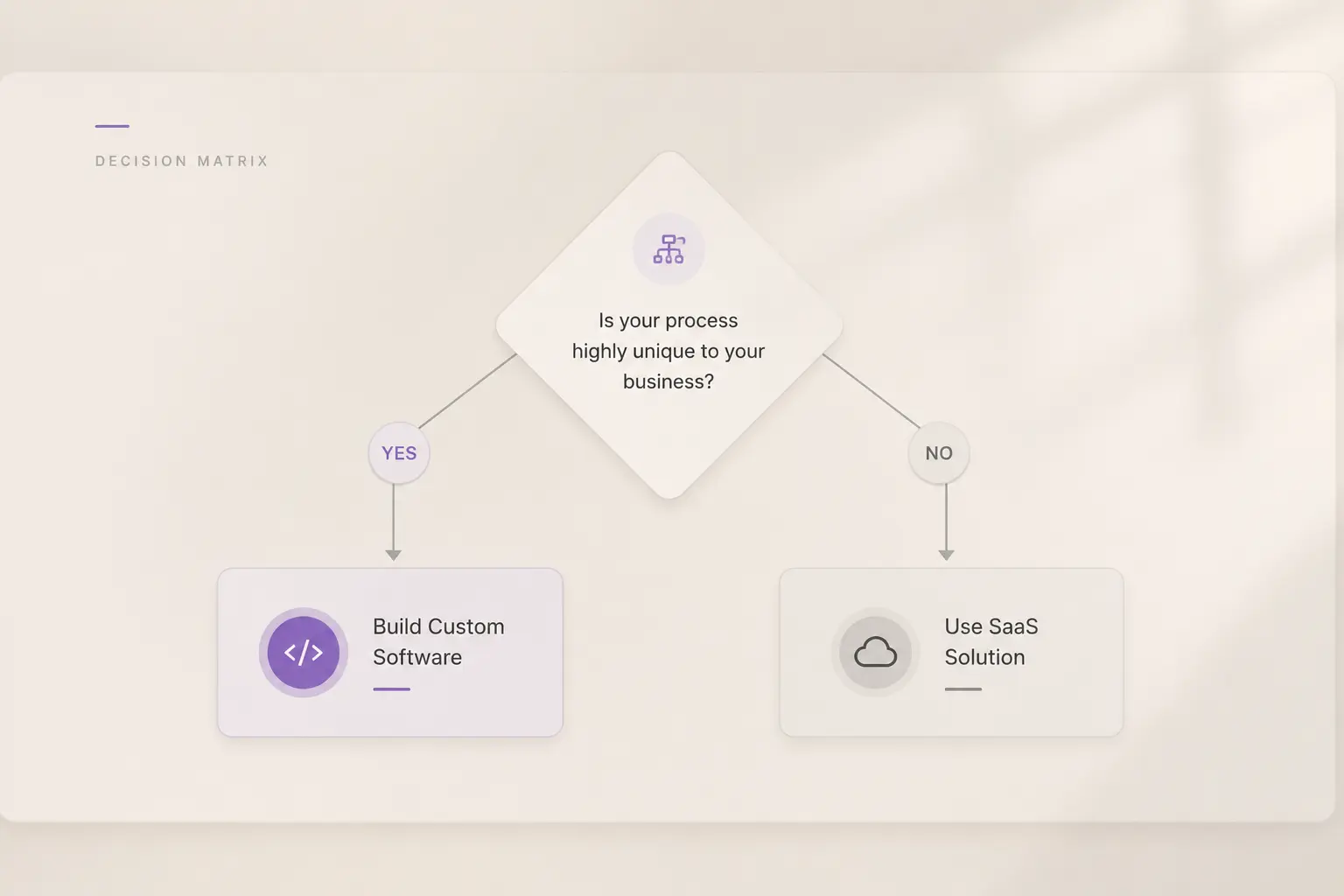
The build vs buy software debate comes down to this: do you adapt your business to fit the tool, or do you build a tool that fits your business?
Neither answer is automatically right. The right answer depends on your stage, your budget, your industry, and how differentiated your processes actually are.
When SaaS Is the Right Call
Let’s be honest about this, for most early-stage businesses and many established ones, SaaS is the smarter choice. Here’s when it wins.
You’re Moving Fast and Need to Validate
If you’re pre-product-market fit, the last thing you need is a 6-month custom development project. SaaS tools let you set up critical business functions in days or weeks. Test your model. Find what works. Then decide what to build.
A startup burning runway on a custom CRM before they’ve figured out their sales process is making a very expensive mistake.
The Problem Is Solved Well Enough by the Market
Not every workflow needs custom software. If an existing SaaS product handles 90% of your needs with minimal workarounds, that’s probably the right call. The 10% gap rarely justifies the cost of a full custom build.
Budget Is Constrained
A SaaS subscription is predictable and manageable. Custom software requires a meaningful upfront investment, typically $30,000 at the low end, often much more. If your budget doesn’t allow for that, SaaS is the practical path.
Maintenance Resources Are Limited
Custom software doesn’t maintain itself. After launch, you need ongoing development support for bug fixes, updates, security patches, and new features. SaaS providers handle all of that for you. That’s genuinely valuable.
When Custom Software Makes More Sense
Here’s where the build vs buy software conversation gets interesting, and where a lot of businesses underestimate their own needs.
Your Process Is a Competitive Advantage
If the way you operate is genuinely different from your competitors, if your workflow, pricing logic, matching algorithm, or service delivery model is part of what makes you better, off-the-shelf software will always create friction.
You end up bending your process to fit the tool. Over time, that friction becomes a cost: workarounds, manual steps, team frustration, and eventually a ceiling on how much you can scale.
Custom software removes that ceiling.
You’re Running Multiple SaaS Tools and Paying for Duplication
This is one of the clearest signals. If your team is using 5 or more SaaS tools that overlap, and you’re spending significant time and budget on integrations, exports, and manual data transfers between them, you might be past the point where SaaS is cost-effective.
A single, well-built custom system that replaces that stack can often be more economical over 2–3 years than the ongoing subscription costs across multiple platforms.
You Have Compliance or Data Requirements That SaaS Can’t Meet
Healthcare, fintech, legal, and government businesses often have data residency, compliance, or security requirements that standard SaaS platforms can’t accommodate. Custom software gives you full control over where data lives, how it’s processed, and who can access it.
You’re Building a Product, Not Just Managing Operations
If software is the product, or a core part of it, then SaaS is not the answer. You’re building something proprietary. It needs to be custom.
Custom Software vs SaaS: The Real Cost Comparison
Cost is where the build vs buy conversation usually gets the most emotional. So let’s look at the numbers honestly.
SaaS Costs
Cost Type | Monthly Range | Annual Range |
CRM (e.g., HubSpot Growth) | $90 – $1,200 | $1,080 – $14,400 |
Project management (Asana, Monday) | $20 – $300 | $240 – $3,600 |
Analytics platform | $50 – $500 | $600 – $6,000 |
Automation tool (Zapier, Make) | $20 – $300 | $240 – $3,600 |
5-tool SaaS stack (typical SMB) | $500 – $3,000+ | $6,000 – $36,000+ |
SaaS costs compound annually. For a growing team, costs scale as you add users and upgrade plans.
Custom Software Costs
Build Type | One-Time Development | Annual Maintenance |
Internal tool / simple workflow | $15,000 – $40,000 | $3,000 – $8,000 |
Mid-complexity business app | $40,000 – $120,000 | $8,000 – $20,000 |
Complex platform / marketplace | $100,000 – $500,000+ | $20,000 – $80,000+ |
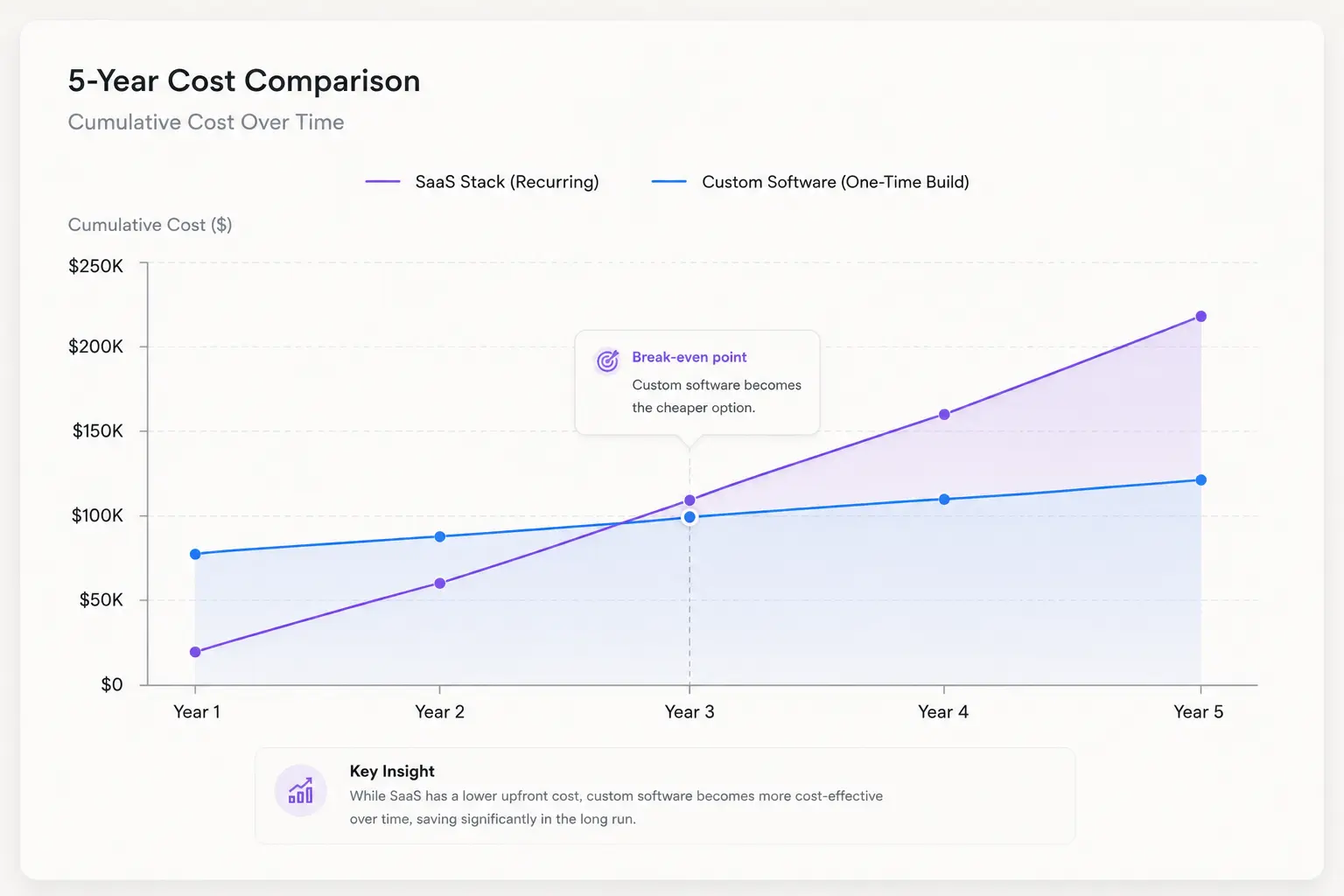
Custom software has a higher upfront cost. But the year-over-year cost is generally lower, because you own the software and you’re not paying per-seat subscription fees that compound with team growth.
The 3-Year Cost Comparison
A mid-sized business running a $2,500/month SaaS stack spends $90,000 over three years. A comparable custom solution built for $60,000 with $12,000/year in maintenance costs $96,000 over three years, but now they own it, it’s tailored to their needs, and there are no user limits.
The economics often flip around years 2–3. Custom software becomes the financially smarter choice as your team scales and your SaaS bills grow.
The Timeline Reality
One reason businesses default to SaaS is speed. And that’s legitimate.
Path | Time to Go Live |
SaaS (out of the box) | Days to weeks |
Custom (simple internal tool) | 6–12 weeks |
Custom (mid-complexity app) | 3–6 months |
Custom (complex platform) | 6–18 months |
For businesses that need to move immediately, SaaS wins on timeline. But “fast” today can mean “constrained” tomorrow. The right question isn’t just “how fast can I get this running?”, it’s “how fast do I need it, and what does the constraint cost me in 12 months?”
Scalability and Control: SaaS vs Custom
Scalability With SaaS
SaaS scales on the vendor’s terms. When you grow, you usually pay more. When you need a feature the platform doesn’t have, you either wait for it to be built, use a workaround, or switch platforms.
You’re on the vendor’s roadmap. That’s fine when your needs align with theirs. It’s frustrating when they don’t.
Scalability With Custom Software
Custom software scales on your terms. You can add features when you need them. You can redesign a workflow without waiting for a vendor update. You can build integrations with the exact systems your business uses.
The trade-off: scaling custom software requires development resources. Either an in-house team or an ongoing relationship with a development partner.
The Decision Framework: Which Is Right for You?
Here’s the clearest way to think through the custom solution vs subscription decision:
✅ Choose SaaS if… • You’re early-stage and still validating your model • The market offers a mature solution covering 85%+ of your needs • Budget for custom development isn’t available yet • You have no need for proprietary, differentiated processes • Your team has no appetite for ongoing software maintenance | 🔧 Choose Custom Software if… • Your process is genuinely differentiated and drives competitive advantage • You’re running multiple SaaS tools and the overhead is becoming a cost problem • You have compliance or data residency requirements • Your 3-year SaaS subscription costs would exceed a custom build • Software is a core part of your product or service delivery |
Most businesses aren’t one or the other. Many use a hybrid approach: SaaS for commodity functions (email, accounting, HR) and custom software for the processes that are unique to how they operate.
How Createxp Helps Businesses Make This Decision
A lot of development studios will tell you to build. That’s not how Createxp operates.
The team at Createxp has worked with startups and enterprises across industries, and the first conversation is almost always about whether custom development is actually the right move. Because sometimes it isn’t. Recommending a $15/month SaaS tool when that genuinely solves the problem is a better outcome than winning a development project.
When custom software is the right call, here’s how Createxp approaches it:
The Discovery Process
Before writing a line of code, the team maps the full scope: current workflows, pain points, integration requirements, data structures, and user roles. This isn’t a box-checking exercise, it’s the foundation of a system that actually works.
Build for What You Need Now, Designed for What You’ll Need Later
A common mistake in custom development is over-engineering for a future that may never arrive. Createxp builds focused, functional systems that solve the current problem well, with architecture designed to extend cleanly as the business grows.
Full Ownership, Full Handover
Every project ends with the client owning the code, the documentation, and the knowledge to manage the system. No dependency on a vendor. No locked-in contracts. The software is yours.
Ongoing Partnership Without Obligation
Post-launch, Createxp offers maintenance and evolution support, but it’s not mandatory. Clients who want to take the system in-house can do so. The goal is your operational independence, not a recurring revenue stream.
Createxp has built internal tools for operations teams, custom CRMs for sales organisations, SaaS platforms for founders, and complex automation systems for enterprises. The common thread: software that actually fits the business it was built for.
Stop Second-Guessing, Start With Clarity One conversation can tell you in 30 minutes what the right path is. That clarity is free. The wrong decision isn’t. |
Key Takeaways
Custom software vs SaaS is not a universal question, it’s a situational one. The right answer depends on your stage, budget, process complexity, and data requirements.
SaaS wins on speed, predictable costs, and low maintenance. It’s the right default for early-stage businesses and commodity functions.
Custom software wins on fit, control, and long-term economics. It makes sense when your process is differentiated, your SaaS stack is growing expensive, or compliance requirements demand it.
The 3-year economics often favour custom software for mid-sized businesses running $2,000+ per month in SaaS subscriptions.
Most businesses use a hybrid approach: SaaS for standard functions, custom for differentiated ones.
Custom software requires ongoing development support. Factor that cost into any build decision.
The build vs buy decision should be revisited as your business grows, the right answer at year one is often different at year three.
Frequently Asked Questions
What is the main difference between custom software and SaaS?
SaaS is pre-built software you subscribe to and share with thousands of other users. Custom software is built specifically for your business, owned by you, and designed around your exact requirements. SaaS is faster and cheaper to start. Custom software is more flexible and often more economical at scale.
When should a business choose custom software over SaaS?
Custom software makes sense when your processes are genuinely differentiated, when your SaaS subscription costs are compounding significantly, when you have compliance or data requirements that standard platforms can’t meet, or when software is a core part of your product. Early-stage businesses with limited budgets and unvalidated models are usually better served by SaaS first.
Is custom software more expensive than SaaS?
Upfront, yes, typically by a meaningful margin. But over a 3–5 year period, custom software often becomes more cost-effective than a growing SaaS stack. The crossover point depends on your current subscription costs and the scope of the custom build.
What does “bespoke software” mean?
Bespoke software is another term for custom software, software built from scratch specifically for one organisation. The term is more common in UK and European markets. It means the same thing: purpose-built, owned, and tailored to your specific business processes.
Can you mix SaaS and custom software?
Absolutely, and most businesses should. A hybrid approach is often the most practical. Use SaaS for commodity functions (email, accounting, HR, communication) and invest in custom development for the processes that differentiate how you operate and serve customers.
How long does it take to build custom software?
Timelines vary widely based on complexity. A simple internal tool or workflow system can be built in 6–12 weeks. A mid-complexity business application takes 3–6 months. Complex platforms or marketplaces can take 6–18 months. Timeline and budget are closely linked, simpler scope means faster delivery.
What are the risks of building custom software?
The main risks are: scope creep during development, choosing an inexperienced development team, underestimating post-launch maintenance needs, and over-engineering for requirements that never materialise. Working with a team that has a structured discovery process and clear contracts significantly reduces all of these risks.
Warning: Working With Us May Trigger Unstoppable Momentum