
E-commerce Development
Akarsh Shrivastava
CMO & Co-Founder

You've decided to build an online store. Or maybe you're rebuilding one that's been underperforming. Either way, you've typed some version of "how much does an e-commerce website cost" into a search bar, and got back answers ranging from $500 to $500,000. Which is... not helpful.
That range exists because e-commerce web development cost genuinely varies that much. A basic Shopify store with a template and a handful of products is a completely different project from a custom-built platform handling thousands of SKUs, multiple currencies, and complex fulfillment logic. Both are e-commerce. The cost difference is enormous.
Here's what most pricing guides skip: global e-commerce sales are expected to hit $8.1 trillion by 2026, according to eMarketer. The competition for that revenue is intense. A store that's slow, hard to navigate, or poorly designed doesn't just underperform, it gets abandoned. Studies show that 88% of online shoppers won't return to a site after a bad experience. Your development budget isn't just an infrastructure cost. It's a competitive decision.
This guide breaks down every cost component, every platform option, and every variable that moves the number, so you can build a budget that actually reflects what you need, not just what sounds reasonable.
The Short Answer (Then the Full Breakdown)
E-commerce website pricing in 2026 ranges from around $2,000 for a basic template-based store to $400,000+ for a fully custom marketplace or enterprise build. For most small-to-mid-size businesses launching or relaunching a serious online store, the realistic budget sits between $8,000 and $75,000 for initial development.
That number changes based on five things: platform choice, design scope, number of products, required integrations, and who you hire to build it. This guide walks through all five.
One thing worth noting upfront: the development cost is not the only cost. Hosting, platform subscriptions, payment processing fees, maintenance, and ongoing marketing tools add up to a significant annual spend on top of what you pay to build the store. The full picture matters for budget planning.
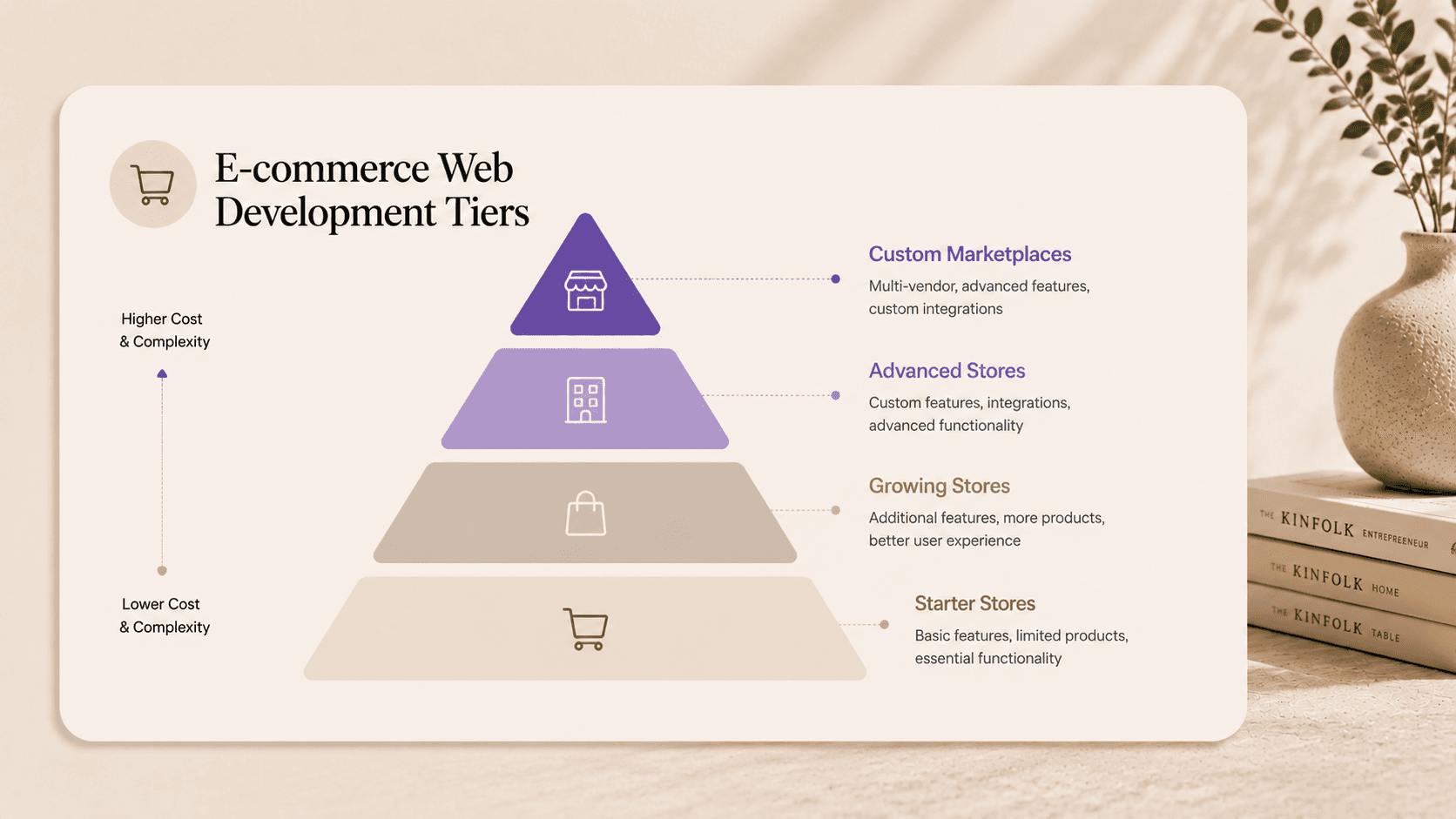
E-commerce Development Cost by Store Type
Before getting into individual components, here's the full range by store tier. This is the starting point for understanding where your project lands.
E-commerce Web Development Cost by Store Tier (2026, USD)
Store Tier | Budget Range (USD) | Timeline | Best For |
Starter / template-based | $2,000 – $8,000 | 2–4 weeks | Side projects, early validation, solo founders |
Small business store | $8,000 – $25,000 | 4–8 weeks | Established small brands, 50–500 SKUs |
Mid-market store | $25,000 – $75,000 | 8–16 weeks | Growing DTC brands, multi-channel, integrations |
Enterprise / custom build | $75,000 – $250,000+ | 16–32 weeks | High-volume, complex catalogue, B2B + B2C |
Marketplace platform | $100,000 – $400,000+ | 24–52 weeks | Multi-vendor, custom checkout logic, advanced UX |
A few things to note here. The starter tier assumes a template-based build on Shopify or WooCommerce with minimal custom design. The mid-market range is where most growing DTC brands land, custom design, multiple integrations, and a developed checkout experience. Enterprise builds involve fully custom UX, complex backend logic, and often multiple development disciplines working in parallel.
Online store development cost also varies significantly by region. A mid-market build with a US agency might cost $50,000–$75,000. The same project with a quality studio in India or Eastern Europe often comes in at $18,000–$35,000. We'll cover the regional breakdown in a later section.
What You're Actually Paying For: The Component Breakdown
Let's go line by line. Understanding what each component costs, and why, is the most useful thing you can take from a guide like this. It helps you make smarter trade-offs.
Cost by Component Across Store Tiers (USD)
Component | Budget Store | Mid-Market Store | Enterprise Store |
UI/UX Design | $1,000 – $4,000 | $8,000 – $20,000 | $20,000 – $60,000 |
Front-end development | $1,500 – $5,000 | $10,000 – $25,000 | $30,000 – $80,000 |
Back-end / platform setup | $500 – $2,000 | $5,000 – $15,000 | $20,000 – $60,000 |
Payment gateway integration | $300 – $800 | $1,000 – $3,000 | $3,000 – $10,000 |
Product catalogue setup | $200 – $1,000 | $1,500 – $5,000 | $5,000 – $20,000 |
Third-party integrations (CRM, ERP) | Minimal | $3,000 – $10,000 | $10,000 – $40,000 |
Performance & SEO optimisation | $300 – $1,000 | $2,000 – $6,000 | $5,000 – $15,000 |
QA & testing | $200 – $800 | $2,000 – $5,000 | $5,000 – $20,000 |
TOTAL (approx.) | $4,000 – $14,600 | $32,500 – $89,000 | $98,000 – $305,000 |
UI/UX Design: The Highest-Leverage Line Item
Design is where a lot of e-commerce budgets get cut, and it's almost always the wrong place to cut. The UX of your product pages, checkout flow, and mobile experience directly drives conversion rates. Baymard Institute research shows that improved checkout UX alone can recover 20–35% of abandoned carts.
For a mid-market store, budget $8,000–$20,000 for design that covers homepage, product listing pages, product detail pages, cart, checkout, and mobile. This isn't a luxury, it's the part of the build most directly connected to revenue.
Front-End Development: What Users Actually See
Front-end development translates the design into a working interface. Speed matters here. A one-second delay in page load time reduces conversions by 7%, according to Akamai research. Front-end development cost scales with the number of custom components, animations, and the complexity of the responsive build across devices.
Back-End and Platform Setup
For Shopify or WooCommerce, this is mostly configuration, theme setup, plugin installation, payment gateway connection, and store settings. For a custom build, this is where the majority of backend cost lives: custom APIs, inventory logic, order management, and database architecture.
Third-Party Integrations
This line item surprises a lot of founders. Connecting your store to a CRM, ERP, email marketing platform, loyalty programme, or warehouse management system adds cost, sometimes significantly. Each integration needs to be planned, built, and tested. Budget for this early if you know these connections matter to your operations.
Platform by Platform: What Each One Costs to Build On
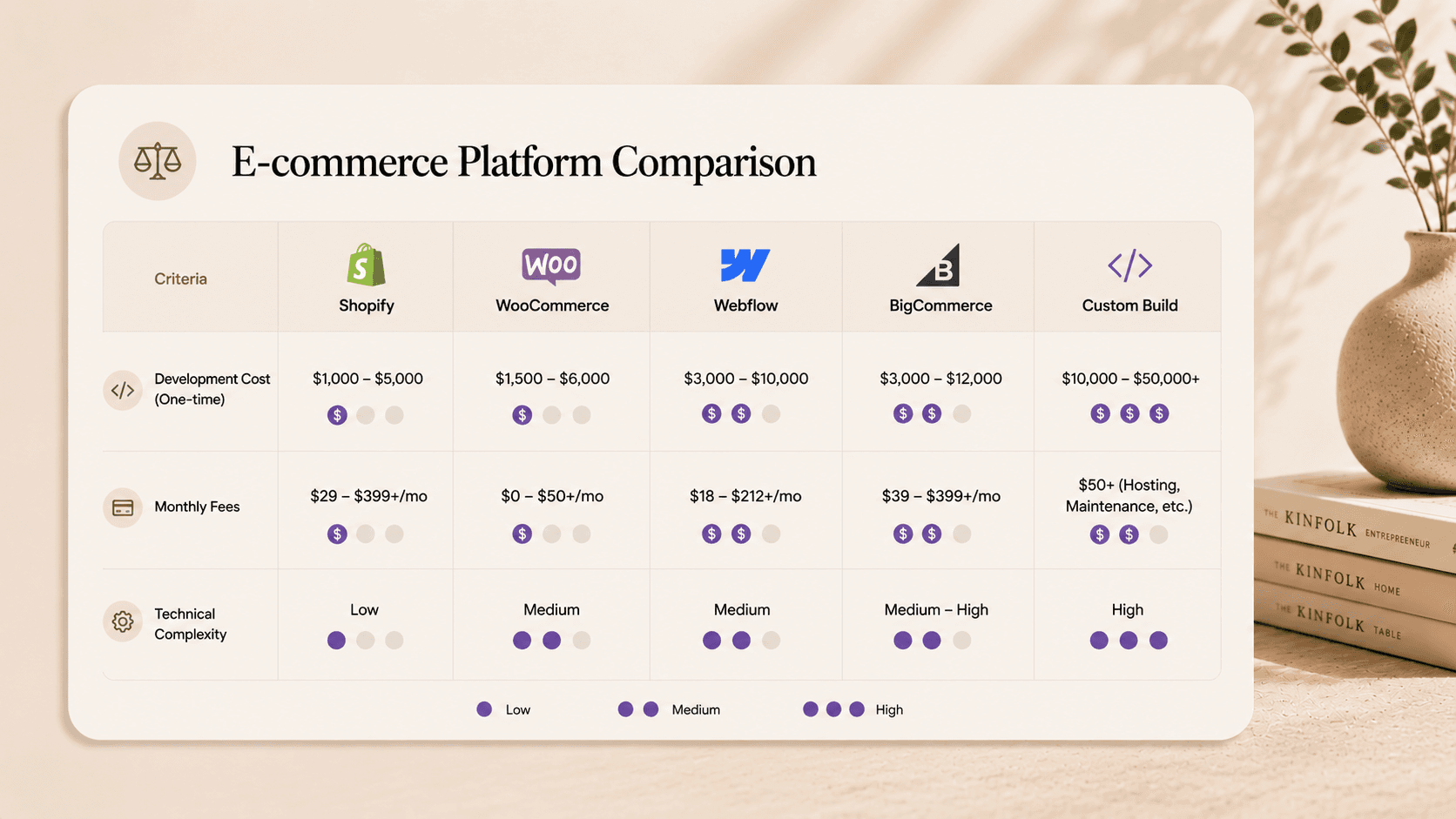
Platform choice is one of the biggest variables in e-commerce website pricing. Here's how the major platforms compare in 2026, not just on licence cost but on total build cost and what you're getting.
E-commerce Platform Comparison: Development Cost & Fit (2026)
Platform | Starting Cost | Monthly Fees | Dev Complexity | Best For |
Shopify | $2K – $15K | $39 – $399/mo | Low–Medium | Fast launch, DTC, small–mid brands |
WooCommerce | $3K – $20K | $10 – $50/mo (hosting) | Medium | WordPress users, content-heavy stores |
Webflow + Commerce | $4K – $18K | $29 – $212/mo | Medium | Design-led brands, marketing-first stores |
Magento / Adobe | $30K – $150K+ | $22K+/yr (licence) | High | Enterprise, complex catalogue, global ops |
Custom build | $50K – $300K+ | Hosting + infra | Very High | Marketplace, unique logic, full control |
BigCommerce | $5K – $30K | $39 – $399/mo | Low–Medium | Mid-market, B2B + B2C hybrid |
Which platform should you choose?
The honest answer is: it depends on your catalogue size, your growth plans, and your team's technical capacity.
Use Shopify if
• You want to launch fast and don't have a developer on staff
• Your catalogue is under 5,000 products with standard variants
• You want a large ecosystem of apps and plugins
• You're a DTC brand focused on marketing and conversion
Use WooCommerce if
• Your site is already WordPress and content is a core part of your brand
• You want lower monthly fees and more control over hosting
• You have a developer available for maintenance
Use a custom build if
• Your business logic doesn't fit into any platform's assumptions
• You're building a multi-vendor marketplace
• You need deep ERP or supply chain integration
• You're operating at enterprise scale and platform fees become prohibitive
What Makes an E-commerce Build More Expensive
This is the section that explains why a quote that looked reasonable at first doubles by the time the project is scoped properly. These are the factors that consistently inflate e-commerce development cost beyond initial estimates.
Scope creep and feature additions
"Can we also add a loyalty programme?" "What about a product recommendation engine?" Each addition sounds small. The development time adds up fast. Define your MVP feature set before you request quotes, and hold the line until v1 is live.
Large or complex product catalogues
Hundreds of products with multiple variants, custom attributes, or configurable options add significant development time. Bulk import tools, catalogue management UX, and filtering logic all need building. Budget for this if your catalogue is large.
Custom checkout logic
Volume discounts, custom shipping rules, subscription billing, gift cards, multiple currencies, any deviation from a standard checkout requires custom development. Map out your checkout requirements in detail before the project starts.
Multiple third-party integrations
Each integration is a separate development task with its own testing requirements. CRM, ERP, accounting software, fulfilment providers, email platforms, analytics, affiliate tracking, list every system your store needs to connect to before you scope the project.
Multi-language and multi-currency support
Internationalisation is a significant development undertaking. If you're selling globally from day one, budget for it properly. Adding it later is almost always more expensive than building it in upfront.
The Costs That Don't Stop After Launch
This is the part of the budget conversation that most agencies skip, and it's the part that catches founders off guard. Online store development cost is just the start. Here's what you'll pay every year to keep the store running.
Annual Ongoing Costs by Store Size (USD)
Ongoing Cost Item | Starter Store | Mid-Market | Enterprise |
Hosting & infrastructure | $100 – $500/yr | $500 – $3,000/yr | $3,000 – $20,000/yr |
Platform subscription | $468 – $1,200/yr | $1,200 – $4,800/yr | $4,800 – $22,000+/yr |
SSL certificate | $0 – $150/yr | $0 – $300/yr | $300 – $1,500/yr |
Payment processing fees | 2.9% + $0.30/txn | 1.5 – 2.9%/txn | Negotiated rates |
Maintenance & updates | $500 – $2,000/yr | $3,000 – $8,000/yr | $8,000 – $30,000/yr |
Marketing & SEO tools | $500 – $2,000/yr | $3,000 – $10,000/yr | $10,000 – $30,000/yr |
TOTAL ANNUAL (approx.) | $1,568 – $5,850 | $7,700 – $26,100 | $26,100 – $103,500 |
Payment processing is worth highlighting separately. If you're on Shopify and not using Shopify Payments, you pay an additional 0.5–2% transaction fee on every sale. At scale, this adds up to a significant annual cost. Platform choice affects your ongoing economics, not just your build cost.
Maintenance is the other line item people underestimate. Plugins get outdated. Platform updates require compatibility checks. Security patches need applying. For a WooCommerce or custom build especially, budget for at least 4–6 hours of developer time per month to keep things running cleanly.
How Geography Affects Your Development Budget
If you're flexible about where your development team is based, location is one of the highest-leverage cost variables available to you.
Development rates by region (2026, hourly)
• United States / Canada: $100 – $200/hr
• Western Europe: $80 – $160/hr
• Eastern Europe: $40 – $90/hr
• India (quality studios): $25 – $65/hr
• Southeast Asia: $20 – $55/hr
A mid-market e-commerce build that costs $55,000 with a US agency might cost $18,000–$28,000 with a quality studio in Bangalore. The key word is quality. Rates don't tell you everything, portfolio, process, and client reviews tell you far more. Verified platforms like Clutch.co let you see actual client outcomes, not just agency self-promotion.
The global shift toward remote-first development has made cross-continent engagements standard practice for smart e-commerce founders. Many of the world's best-performing online stores are built by distributed teams with no US footprint.
How CREATEXP Approaches E-commerce Development
E-commerce projects at CREATEXP start with a business conversation, not a features list. Before any line gets drawn in Figma or any platform gets chosen, the team wants to understand what the store needs to achieve commercially, what conversion rate justifies the investment, what the customer journey looks like, and where current friction is costing money.
Platform decisions at CREATEXP are recommendation-driven, not template-driven. The studio has built on Shopify, WooCommerce, Webflow, and fully custom stacks. The recommendation depends on the client's catalogue size, operational requirements, technical team, and growth plans, not on what's easiest to build on.
Design gets the same weight as development in every e-commerce engagement. The checkout experience, product page UX, mobile layout, and page speed are all treated as commercial decisions, not aesthetic ones. For most e-commerce clients, conversion rate is the metric everything else is measured against.
CREATEXP's in-house model means the designer scoping the UX is the same designer building the UI, working directly with the developer building the front end. There's no translation gap between design intent and development execution. That tightness is what keeps quality consistent and delivery on schedule.
For founders building their first serious online store, the studio offers scoped e-commerce builds starting from a defined feature set and timeline. For brands rebuilding an underperforming store, the starting point is usually a UX and performance audit, identifying the specific gaps costing the most in lost revenue before deciding what to build.
Ready to Build an E-commerce Store That Actually Converts? Tell the CREATEXP team what you're building and get an accurate scope and cost estimate. |
Numbers and Principles Worth Keeping
Here's the condensed guide, the figures and frameworks you'll use in every budget conversation:
1. E-commerce web development cost ranges from $2,000 for a starter template store to $400,000+ for a custom marketplace. Most serious mid-market stores land between $25,000 and $75,000.
2. Design is the highest-leverage component in an e-commerce build. Don't cut it. Checkout UX improvements alone can recover 20–35% of abandoned carts.
3. Platform choice affects both your build cost and your ongoing economics. Shopify is fastest to launch; custom builds give the most control at the highest cost.
4. Third-party integrations and complex catalogue requirements are the most common causes of budget overruns. Define them fully before scoping the project.
5. Add 25–40% of your build cost annually for hosting, maintenance, platform fees, and marketing tools. Development cost is just the starting number.
6. Geography moves the number significantly. A quality global studio in India can deliver mid-market builds at 40–60% of US agency cost.
7. 88% of shoppers won't return after a bad experience. Your development investment is a competitive decision, not just a technical one.
8. Define your v1 feature set and hold the line until launch. Scope creep is the most common reason e-commerce projects go over budget and over time.
Questions People Usually Come Here With
How much does it cost to develop an e-commerce website in 2026?
E-commerce web development cost in 2026 ranges from approximately $2,000 for a basic template-based store to $400,000+ for a fully custom enterprise or marketplace build. For a professionally designed and developed small business store with standard features, expect to budget $8,000–$25,000. Mid-market stores with custom design and multiple integrations typically cost $25,000–$75,000.
What is the cheapest way to build an e-commerce website?
The most cost-effective approach for early-stage stores is a template-based build on Shopify or WooCommerce. Using a premium theme with light customisation, you can launch a functional store for $2,000–$8,000. The trade-off is limited design differentiation and less flexibility as you scale. For validation and early revenue, it's a sensible starting point.
How long does it take to build an e-commerce website?
Timeline depends on complexity. A template-based starter store takes two to four weeks. A custom-designed small business store with integrations takes four to eight weeks. Mid-market builds typically run eight to sixteen weeks. Enterprise and marketplace builds can take six months to a year or more.
What ongoing costs should I budget for after launching an e-commerce store?
Ongoing annual costs include hosting ($100–$20,000 depending on scale), platform subscription fees ($468–$22,000+), payment processing fees (typically 1.5–2.9% per transaction), maintenance and updates ($500–$30,000), and marketing and SEO tools ($500–$30,000). For most small-to-mid-market stores, total annual running costs fall between $7,700 and $26,100.
Should I use Shopify or build a custom e-commerce store?
Use Shopify if you want to launch fast, don't have a dedicated development team, and your business logic fits standard e-commerce patterns. Build custom if you need complex catalogue logic, multi-vendor functionality, deep ERP integration, or business requirements that don't fit any platform's assumptions. Most growing DTC brands do well on Shopify until they hit volume or complexity that justifies a custom build.
How much does Shopify development cost?
A Shopify development project costs between $2,000 and $30,000 depending on the level of custom design and configuration. A template-based Shopify store with light customisation runs $2,000–$8,000. A fully custom-designed Shopify build with multiple integrations and a refined UX typically costs $10,000–$30,000. Shopify's monthly platform fees range from $39 to $399 in addition to development costs.
Does e-commerce website design affect conversion rates?
Yes, significantly. E-commerce UX design directly affects conversion rates, cart abandonment, and average order value. Baymard Institute research shows that 69.8% of shopping carts are abandoned on average, and improved checkout UX can reduce abandonment by 20–35%. A one-second improvement in page load time increases conversions by approximately 7%. Design is one of the highest-ROI investments in an e-commerce project.
How much does it cost to hire an e-commerce developer?
Freelance e-commerce developers charge $25–$150 per hour depending on their location and specialisation. US-based senior developers typically charge $100–$150/hr. Quality developers in India or Eastern Europe charge $25–$65/hr. For a complete project, working with a studio or agency rather than individual freelancers often provides better value, coordinated design, development, and QA in one engagement rather than managed separately.
Warning: Working With Us May Trigger Unstoppable Momentum