
E-commerce Development
Saket Khare
CTO & Co-Founder
You are probably reading this because your online store feels a bit stuck. Maybe your website takes forever to load. Maybe you want to build a custom shopping app, but your current platform makes it incredibly hard. You keep hearing developers and tech folks throw around the term "headless ecommerce." They make it sound like a magic fix for every problem. But as a business owner, you just want to know if it actually makes financial sense.
I totally get it. Switching your entire store infrastructure is a massive decision. You do not want to spend thousands of dollars on a trendy tech buzzword if it will not bring you more sales. You need real answers, not just developer jargon.
Let’s look at some eye-opening numbers. Recent data shows that a one-second delay in page load time can drop your conversion rate by up to 7%. That is a massive chunk of revenue disappearing simply because a customer got tired of staring at a loading screen. Traditional store setups often struggle with this speed issue as you add more products, plugins, and custom designs. This exact frustration is why the whole "headless" movement started.
The Short Answer: Do You Really Need It?
If you want the quick summary, here it is. Headless tech separates your website's design from its underlying database. This gives you ultimate freedom. You can make the website lightning fast. You can design it exactly how you want. You can even plug your store into smartwatches or digital billboards.
However, it requires an upfront investment. You need dedicated developers to build and maintain it. If you run a brand new startup with a tight budget and a simple product line, you probably do not need it yet. A standard Shopify or WooCommerce setup will work just fine.
But what if you are growing fast? If you have complex product variants, high traffic, or need a totally unique user experience to beat your competitors, things change. In that scenario, upgrading your tech stack is usually a very smart move.
What Exactly Are We Talking About Here?
Before we dive deeper, let's break down the concept. Imagine a traditional online store as a fully furnished house. You buy it as-is. The plumbing, electrical wiring, and the paint on the walls are all built together. If you want to knock down a wall, you might break a water pipe.
In the digital world, the "plumbing" is your back-end. This handles inventory, payments, and customer data. The "paint" is your front-end. This is the visual layout your customers actually click on. Traditional platforms lock these two sides tightly together.
The "Head" and the "Body"
When you go headless, you chop the "head" (the visual design) off the "body" (the back-end engine). They operate independently. They talk to each other using something called APIs. This is why you will often hear experts call this setup api-first commerce.
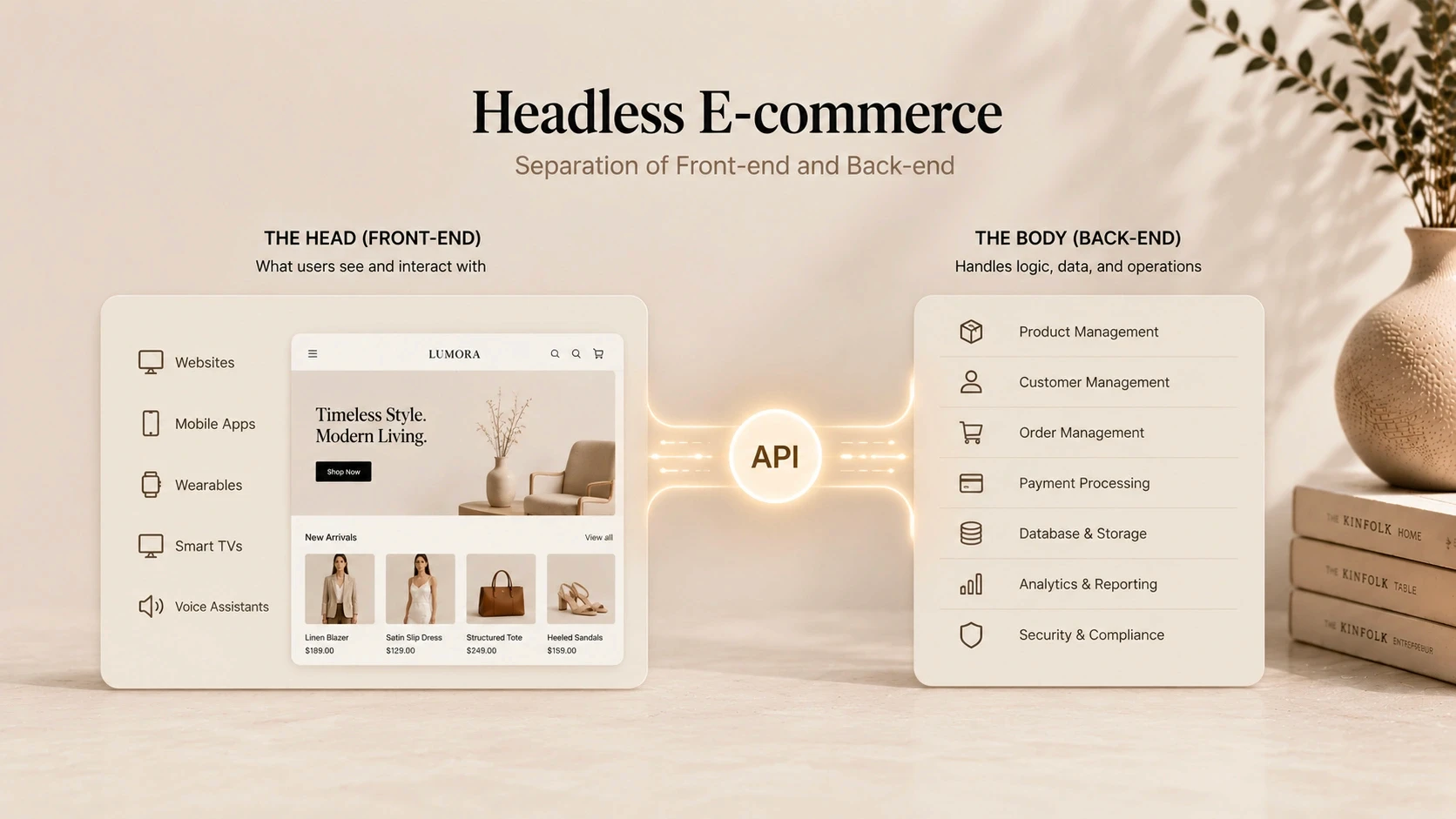
Because they communicate through a bridge rather than being glued together, your team can change the storefront without risking the payment gateway. You get safety, speed, and flexibility.
Headless vs Traditional E-commerce: The Big Showdown
People always ask me to compare the old way with the new way. Understanding the exact differences helps you see where the value lies. I put together a simple breakdown below.
Feature | Traditional E-commerce | Headless E-commerce |
Setup Time | Fast. You pick a theme and launch. | Slower. Everything is custom-built. |
Design Freedom | Limited by your chosen theme. | Unlimited. You can build anything. |
Site Speed | Can get slow with too many plugins. | Extremely fast. The code is lightweight. |
Developer Need | Low. You can do a lot yourself. | High. You need an expert team. |
Selling Channels | Mostly just your website. | Website, mobile apps, smart devices, etc. |
Looking at a headless vs traditional ecommerce comparison makes the trade-offs obvious. The traditional route saves you time upfront. The headless route gives you raw power and scale for the future.
So, Is Headless Commerce Worth It? The Real Benefits
Now we hit the big question. Is headless commerce worth it for your specific brand? Let's look at the actual business results you can expect if you make the jump.
Lightning Fast Speed
Search engines love fast websites. Customers love fast websites. AI chatbots looking for data prefer fast websites. Because a headless site does not carry heavy back-end code on the front pages, it loads almost instantly. This directly boosts your SEO rankings. Higher rankings mean more organic traffic. More traffic on a fast-loading site equals more revenue.
Ultimate Creative Control
Standard themes limit your creativity. You might want a unique swiping feature for your mobile shoppers. A basic platform might say no. A decoupled setup says yes. Your designers can create a deeply immersive brand experience. They are never restricted by back-end rules. You build exactly what your customers want to see.
Selling Everywhere at Once
Shopping is changing. People do not just buy on desktop computers anymore. They buy through Instagram, smart home devices, and mobile apps. Because you are using api-first commerce, you can use the exact same back-end inventory system to push products to a smartwatch app, an interactive kiosk, or a web browser. You manage your stock in one place, but you sell everywhere.
Better Security
Security matters. When the front part of your store is separated from your sensitive customer data, hackers have a much harder time getting in. Even if someone manages to mess with your website design, they cannot easily reach the credit card database. This separation gives you incredible peace of mind.
When You Should Probably Avoid It
I always tell my friends and clients the truth. This technology is not for everyone.
First, it costs more money to build. You cannot just buy a fifty-dollar template and call it a day. You have to hire designers and developers to build the storefront from scratch.
Second, it takes more time to launch. A simple store can go live in a weekend on a basic platform. A custom decoupled store might take a few months to design, code, and test perfectly.
Finally, you need ongoing tech support. Your marketing team cannot just install a random plugin to add a new feature. They will need to ask the development team to code it. If you do not have a budget for continuous tech support, this path will cause you stress.
Building High-Performing Digital Products with CREATEXP
You might be wondering who actually builds these complex, high-speed stores. Finding the right tech partner is usually the hardest part of upgrading your business.
This is exactly why we started CREATEXP back in 2023. Four friends in Bangalore, India, got together with a shared obsession. We loved clean design, perfect code, and the firm belief that every business deserves a world-class digital presence.
We noticed a massive gap in the market. Founders had to choose between slow, bloated enterprise agencies or unreliable freelancers. We decided to fix that. Today, CREATEXP is a design and development studio that combines the fast-moving agility of a startup with the careful precision of an enterprise team.
How We Do Things Differently
We do not believe in unnecessary processes or hidden chaos. Everything we do happens in-house. We never outsource your vision to cheap third-party vendors. Our studio houses a tight-knit team of designers, developers, strategists, and copywriters.
In just three years, we have become a trusted partner for over 50 founders and enterprises across five continents. Whether you need a 30-day MVP to test a new product idea, a conversion-focused website to secure funding, or a complex custom software system to automate your operations, we bring the exact same commitment to quality.
We specialise in UI/UX design, web development, software development, and deep CRM/ERP solutions. We focus strictly on building digital products that drive real business growth. We move fast, we build things we are incredibly proud of, and we stay invested in your success long after your new store goes live.
Your Final Cheat Sheet
If you are skimming, here are the core facts you need to remember about modernizing your store architecture:
Speed is money: Separating your design from your database creates lightning-fast load times. This improves SEO and sales.
Total freedom: You can design any user experience you want without worrying about back-end platform limits.
Sell everywhere: APIs allow you to connect your inventory to mobile apps, social media, and physical digital screens effortlessly.
It requires budget: You need a dedicated technical team to build and maintain the setup. It is not a DIY project.
Timing matters: Wait until your business is generating solid revenue and actually hitting the limits of traditional platforms before upgrading.
Questions People Always Ask Us
How much does a headless store cost to build?
Costs vary wildly based on your needs. A basic setup might start around $10,000 to $20,000, while massive enterprise builds can easily exceed $100,000. You are paying for custom design, custom coding, and API integrations.
Does it actually improve search engine rankings?
Yes, it directly impacts your SEO. Search engines prioritize fast, mobile-friendly websites. By stripping away heavy back-end code from the user interface, your pages load instantly. This sends highly positive signals to search algorithms.
Can I keep my current e-commerce platform?
Usually, yes! Many brands keep Shopify Plus or BigCommerce as their back-end engine. They simply turn off the front-end theme and use custom code for the visual storefront. You keep your familiar inventory dashboard but get a brand new, super-fast website.
Do I need an in-house developer to run it?
You will definitely need technical support. You do not necessarily have to hire a full-time employee, though. Many businesses partner with an external studio like ours to handle ongoing maintenance, updates, and new feature rollouts.
Warning: Working With Us May Trigger Unstoppable Momentum