
Software Development
Akarsh Shrivastava
CMO & Co-Founder
You have a product to build. You've got the idea, maybe a rough brief, and now you're staring at a long list of agencies wondering who to actually trust with it. Everyone looks impressive on paper. Every agency has a polished website, glowing testimonials, and a pitch deck that makes them sound like the perfect partner.
And yet, bad hires happen constantly. Projects go over budget, timelines slip, and the final product looks nothing like what was promised. The problem isn't a shortage of good agencies. It's that most founders don't know exactly what to look for, or what questions to ask, before signing the contract.
Here's the thing: a failed software development partnership doesn't just cost money. It costs time, and for a startup, time is the one resource you can't recover. A Standish Group study found that only 31% of software projects are delivered successfully on time and on budget. The other 69% either overrun, get scaled back, or fail outright. That number improves dramatically when the hiring decision is made well. This guide tells you exactly how to do that.
The Short Version Before We Go Deep
Hiring the right software development company comes down to four things: proof of delivery, transparency of process, honesty about timelines and costs, and alignment on what success actually looks like.
Agencies that nail these four things consistently deliver good outcomes. Agencies that are vague on any of them tend to produce the projects that end up in that 69%.
The rest of this guide walks you through how to evaluate each one, with a step-by-step process, the questions to ask, and the comparison tools to make the call confidently.
Step 1: Get Clear on What You're Actually Hiring For
Before you look at a single agency, you need to know what you're building and what kind of help you need. This sounds obvious. In practice, it's where most hiring processes go wrong.
Sending a vague brief to ten agencies and comparing their proposals is a recipe for confusion. Every agency will interpret the brief differently. You'll get wildly different quotes. And you'll have no reliable way to compare them.
Define your scope first
What kind of product are you building? A web app, a mobile app, a SaaS platform, an e-commerce store? How many core user types does it serve? What are the five to eight essential features for v1? What platform integrations are required?
You don't need a full product requirements document. But a clear brief, problem statement, target users, core features, platform, and timeline expectations, makes every other step in this process faster and more accurate.
Questions to answer before approaching agencies
What is the core problem my product solves, and for whom?
What does v1 need to do, what's in scope and what's deliberately out?
What platform, technology preferences, or constraints exist?
What is my realistic budget range?
What does success look like 90 days after launch?
A well-defined brief also signals to agencies that you're a serious, organised client. The best agencies are selective about who they work with. Coming prepared gives you an immediate advantage.
Step 2: Build Your Longlist the Right Way
Most founders start with a Google search. That's fine, but it's not the most reliable signal of quality. Search rankings reflect SEO investment, not delivery track record.
Where to actually find good agencies
Clutch.co, verified client reviews with project details, cost ranges, and ratings. One of the most reliable sources for agency vetting.
Referrals from founders in your network, a warm recommendation from someone who shipped a product is worth ten cold search results
LinkedIn, search by specialisation, look at their actual team size, and check if the people they list actually work there
Portfolio reviews, look for live, working products you can click on and test, not just screenshots
How many agencies to shortlist
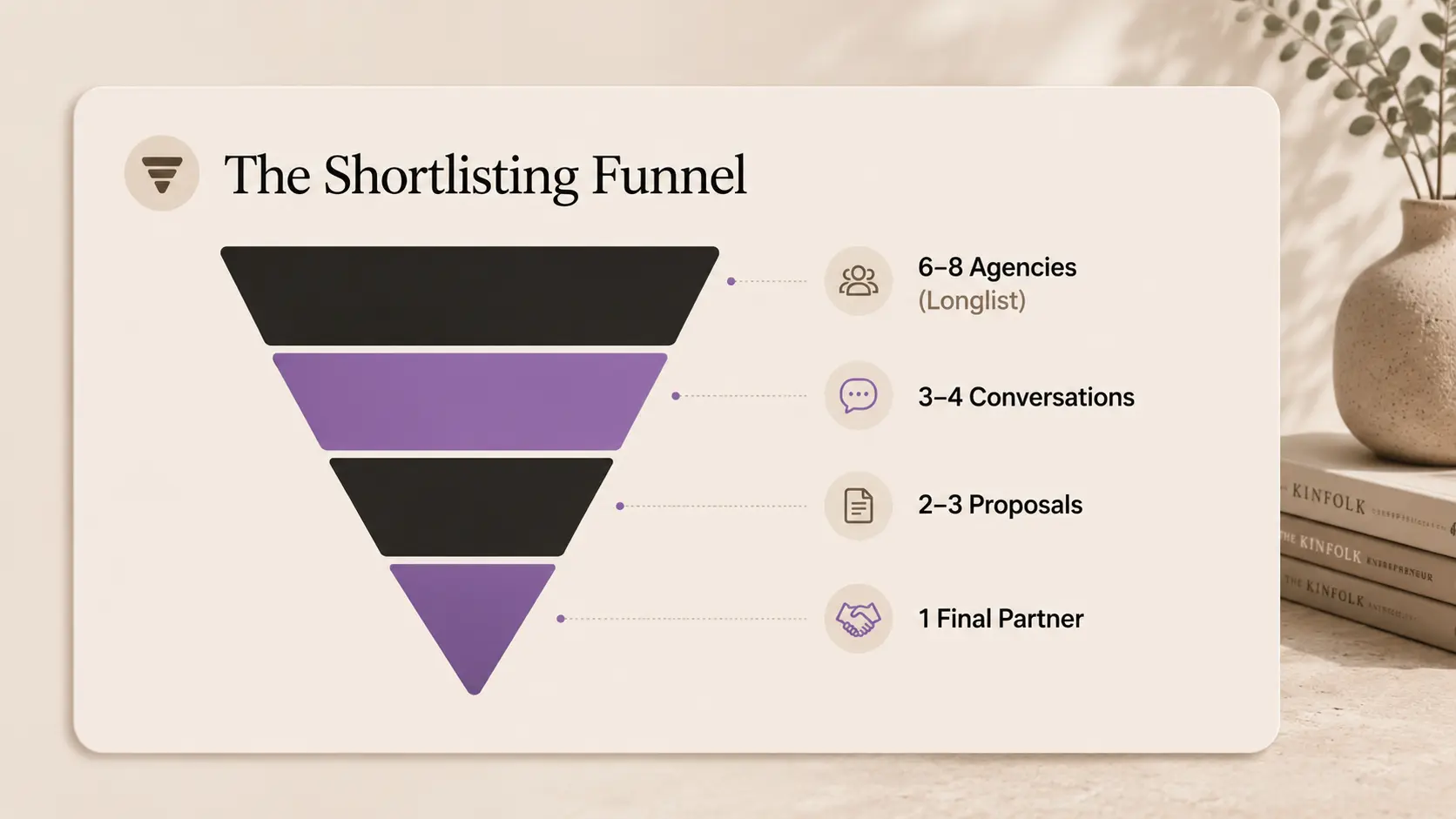
Start with six to eight. After a quick portfolio and culture check, you'll likely narrow to three or four worth having a real conversation with. From those conversations, two or three will be strong enough to receive your formal brief and respond with a proposal.
Don't shortlist based on size alone. A ten-person focused studio often delivers better outcomes for startup projects than a hundred-person agency where your project is a small account.
Step 3: Evaluate Each Agency With Specific Criteria, Not Gut Feel
Gut feel matters, eventually. But it should be the final filter, not the first one. Before you trust your instincts, run every shortlisted agency through the same set of objective criteria.
Software Company Vetting Scorecard
Criteria | What to Look For | Red Flag |
Portfolio quality | Shipped products, live case studies, measurable outcomes | Only mockups, no live product links |
Process clarity | Can explain each phase by name with real examples | Generic 'discover → design → deliver' slide |
Team transparency | Introduces actual team before contract | Account manager buffers all communication |
Timeline honesty | Gives phased timeline with clear milestones | Promises unusually fast delivery without detail |
Client references | Willing to connect you with past clients | Declines or deflects the request |
Post-launch support | Defined support window in the contract | Treats handoff as end of relationship |
Pricing structure | Scope-based or milestone-based pricing | Refuses to explain what drives the number |
Communication style | Asks more questions than they answer early on | Leads with a proposal before asking enough |
The questions that separate strong agencies from average ones
Most agencies are prepared for "tell me about your process" and "can I see your portfolio." These are fair questions but they don't reveal much. Push harder.
Questions that actually reveal quality
"Walk me through a project that went wrong and how you handled it." Confident agencies answer this directly. Weak agencies dodge it.
"Who specifically will work on my project, can I meet them before we sign?" This separates in-house teams from outsourcing operations.
"What does your onboarding process look like for a new client?" Strong agencies have a structured answer. Average ones improvise.
"What would you push back on in my brief?" Good development partners challenge assumptions. Yes-machines are dangerous.
"Can I speak to a client you worked with 12 months ago?" Recent references are rehearsed. Older ones are honest.
Evaluating their process for vetting software companies
A development company's internal process tells you a lot about what working with them will feel like. Ask them to walk you through a typical project, week by week, for something similar to what you're building. Listen for specifics. Vague generalities at this stage usually mean a vague project experience.
Step 4: Send Your Brief and Evaluate the Proposals
Once you have two or three agencies who've passed the vetting stage, send your brief formally and ask for a detailed proposal. Give them a realistic deadline, five to seven business days is reasonable.
What a strong proposal looks like
A restated understanding of your project goals, they should prove they listened
A phased scope breakdown, not a single project number
A milestone-based timeline with named deliverables at each stage
A team structure, who does what
Clear terms around revisions, out-of-scope changes, and intellectual property
Post-launch support terms written into the engagement
What to be cautious of
A quote with no scope breakdown, you can't evaluate what you can't see
A timeline that's suspiciously fast, read the fine print on what that actually covers
No mention of what happens if requirements change
Intellectual property terms that are ambiguous, make sure you own everything produced
Step 5: Choose the Right Engagement Model
How you structure the commercial relationship matters as much as who you hire. Different engagement models carry different risks, and understanding them upfront prevents the most common project disputes.
Software Development Engagement Models Compared
Model | How It Works | Best For | Watch Out For |
Fixed price | Scope defined upfront, single price agreed | Well-defined MVP, clear requirements | Scope creep disputes if brief is loose |
Time & materials | Billed hourly or daily as work happens | Evolving products, ongoing development | Budget overruns if scope drifts |
Milestone-based | Payment tied to delivery of agreed outputs | Most startup projects, balanced risk | Milestone definitions need to be specific |
Retainer | Monthly fee for fixed hours of access | Ongoing design or dev support post-launch | Unused hours rarely roll over |
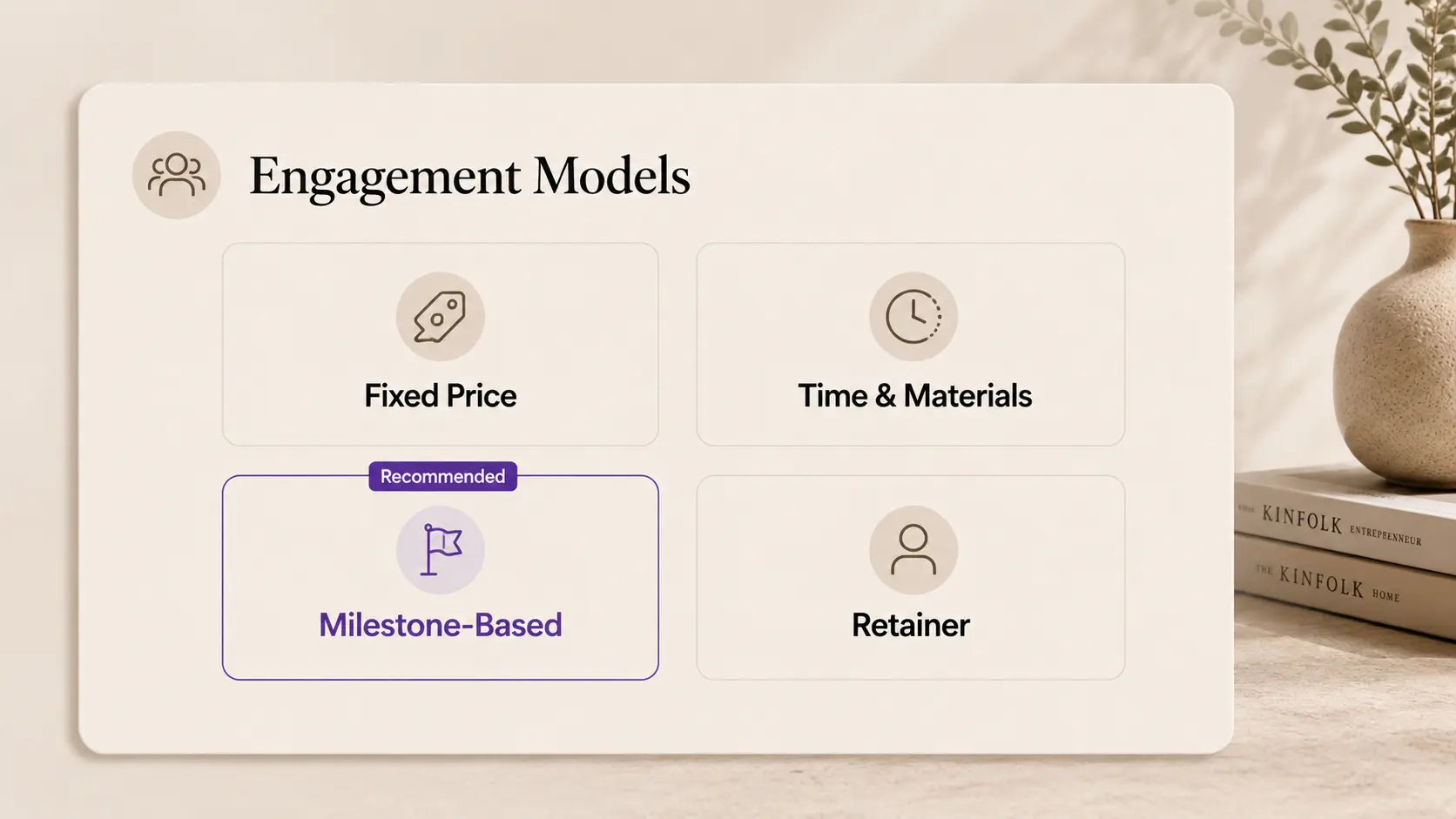
For most startup projects, milestone-based pricing is the most balanced model. You're not locked into a fixed scope that might need to evolve, but you're also not writing an open cheque. Payments tied to delivered outputs keep both sides accountable.
Step 6: Read the Contract Like It's Going to Be Tested
A lot of founders skim the contract because everything feels good at this point. Don't. The contract is where the working relationship gets defined in writing, and it's what protects you if things go sideways.
Non-negotiable contract elements
IP ownership, you should own 100% of the code, designs, and assets produced
Scope definition and change request process, how additions to scope are handled and priced
Payment schedule tied to milestones, not to arbitrary dates
Termination clause, what happens if either party needs to exit the engagement
Confidentiality terms, especially important if your idea isn't yet public
Post-launch support period and what it covers
If any of these are missing or vague, ask for them to be clarified before signing. A good agency will welcome the specificity, it protects them too.
What Working With a Development Partner Like CREATEXP Actually Looks Like
CREATEXP is a India-based studio that builds digital products for startups and enterprises across five continents. The reason this section is worth reading isn't to pitch, it's to give you a concrete example of what a well-structured agency engagement looks like in practice.
Every project at CREATEXP starts with a proper discovery session. Before a single line of code or pixel of design is produced, the team maps the product goals, the target users, the constraints, and the definition of success. That conversation happens with the people who will actually do the work, not with a salesperson who disappears after the contract is signed.
The team is fully in-house. Designers, developers, strategists, and copywriters work in the same studio, on the same project, with no outsourcing in the chain. That's not the norm in the agency world, but it's what makes consistency possible. When a developer has a question about design intent, they ask the designer directly. The quality doesn't get diluted through handoff chains.
When choosing a software development partner, transparency matters as much as capability. CREATEXP's proposals are milestone-based, with clear deliverables at each stage and no ambiguity about what triggers the next payment. Post-launch support is written into every engagement, not offered as an upsell after the project closes.
The studio has delivered products for 50+ founders across industries, from SaaS platforms and fintech apps to marketplaces and custom enterprise software. The most consistent feedback from those projects: the relationships that worked best were the ones where expectations were set clearly at the start and both sides stayed invested in the outcome, not just the deliverable.
Ready to Find a Development Partner You Can Actually Trust? Talk to the CREATEXP team. We'll tell you honestly whether we're the right fit, and what to look for if we're not. |
Before You Send That First Email to an Agency
Here's everything condensed into the points that matter most:
Define your scope before approaching anyone. A clear brief gets you accurate quotes and attracts better agencies.
Only 31% of software projects succeed on time and budget. The hiring decision is the highest-leverage variable in that outcome.
Find agencies on Clutch or through founder referrals, not just Google rankings.
Ask to meet the actual team doing the work before signing. Undisclosed outsourcing is a structural risk.
A strong proposal has a phased scope, milestone timeline, named team, and post-launch terms. A weak one has a number and a handshake.
Milestone-based engagement models balance risk for both sides, prefer them over fixed price or pure time-and-materials.
Read the contract carefully. IP ownership, scope change process, and termination terms are non-negotiable.
The best development partners push back on your brief. If they agree with everything immediately, that's a warning sign.
The Questions Most Founders Ask Before Hiring
How do I hire a software development company?
Start by defining your project scope clearly, what you're building, who it's for, and what v1 needs to do. Then build a shortlist of six to eight agencies from Clutch, founder referrals, and portfolio research. Evaluate each using a consistent criteria set: proof of delivery, process transparency, team structure, and post-launch support. Send your brief to the best two or three and compare their proposals on scope, milestone clarity, and team transparency. Choose the one where the commercial terms and working relationship both make sense.
What should I look for when choosing a software development partner?
Look for four things: a track record of shipped products you can verify, a clearly defined process they can describe in specifics, an in-house team they'll introduce before you sign, and post-launch support terms written into the contract. Agencies that are strong on all four are worth a serious conversation. Agencies that are vague on any of them are a risk regardless of how polished the pitch is.
How much does it cost to hire a software development company?
Cost varies by scope, team location, and engagement model. For a focused MVP or web application, expect $15,000–$60,000 with a quality global studio, and $40,000–$150,000 with a US-based agency. Enterprise builds and complex platforms can cost $150,000–$500,000+. The final number is driven by scope clarity, the more ambiguous your brief, the wider and less reliable the quote will be.
How long does software development take?
A focused MVP with clear scope typically takes eight to sixteen weeks from kickoff to launch. Larger products with multiple integrations and complex user flows can take four to eight months. Any agency quoting significantly less than eight weeks for a meaningful product should be pushed to explain their timeline in detail, fast promises often reflect either a narrow scope or an optimistic estimate that won't hold.
Should I hire a local software company or a global one?
Location matters less than it did five years ago. Quality global studios, particularly in India, Eastern Europe, and Southeast Asia, regularly deliver work on par with US and European agencies at 40–60% of the cost. What matters more than geography is the agency's communication practices, process rigour, and portfolio of comparable projects. A well-run studio in Bangalore with strong client testimonials is a better choice than a poorly run one in New York.
What questions should I ask a software development company before hiring?
Ask them to show you live, working products they've built. Ask who specifically will work on your project. Ask how they handle scope changes mid-project. Ask what post-launch support looks like. Ask them to walk through a project that went wrong. And ask to speak to a client from twelve months ago. Strong agencies answer all of these confidently. Weak ones get vague or defensive.
How do I vet a software development company?
Start with their portfolio, look for live products, not mockups. Check their reviews on Clutch.co for verified client feedback. Ask for client references and actually call them. Request a process walkthrough specific to your type of project. Meet the team who'll do the work, not just the sales contact. And compare two or three agencies on the same brief before making a decision, comparison reveals quality differences that individual presentations hide.
Warning: Working With Us May Trigger Unstoppable Momentum