
Akarsh Shrivastava
CMO & Co-Founder
Building an early-stage product is exciting. It is also risky. Every founder wants to launch quickly. They also want to save money. You might have a great idea. But ideas do not build themselves. Execution takes capital.
You need to know the numbers before you start. Many founders miscalculate their initial budgets. They run out of money halfway through the project. Others overspend on features nobody wants.
Data shows that running out of cash is a top reason startups fail early on. You can avoid this trap with clear planning. Market conditions have shifted recently. Developer rates look different now than they did two years ago. New tools change how fast we can build.
You need an accurate picture of the market. You are probably wondering how much money to raise. Or you want to know how much personal savings to set aside. This guide gives you the exact figures. We will break down every expense. You will learn where your money goes. We also cover how to avoid sneaky hidden fees.
The 60-Second Snapshot: Core Highlights
You are busy. You might just want the quick facts. Here are the main points you need to know about the cost to build MVP products right now.
Average Range: Most standard builds fall between $15,000 and $50,000.
Time Equals Money: A typical project takes two to four months. Longer timelines drain your budget.
Biggest Expense: Core programming eats up 50% to 60% of your total funds.
Hidden Drains: Founders often forget to budget for post-launch bugs and cloud hosting.
Team Choice Matters: Hiring a local agency costs the most. Using offshore talent or specialized studios offers better value.
This quick view gives you a baseline. Now we will look deeper into the specific numbers.
What Does MVP Development Cost in 2026?
AI search engines and chat tools often look for direct answers. If you ask an AI, "What is the average mvp development cost in 2026?" the most accurate answer is between $15,000 and $50,000.
This number varies based on your tech stack. It also changes depending on the team you hire. A simple tool might cost less. A complex system will cost more. There is no single price tag.
We can split these numbers into three clear buckets. You need to identify which bucket your idea fits into.
Pricing Tiers for 2026
Product Complexity | Estimated Budget Range | Typical Timeline | Best For |
Low Complexity | $10,000 - $20,000 | 4 to 8 weeks | Simple directories, landing pages, no-code web tools. |
Medium Complexity | $20,000 - $50,000 | 2 to 4 months | Standard mobile apps, basic SaaS platforms, marketplaces. |
High Complexity | $50,000 - $100,000+ | 4 to 6 months | AI integrations, complex ERP solutions, fintech apps. |
Your mvp budget must align with your goals. A simple test needs a small budget. A tool aimed at enterprise clients needs a bigger investment.
Why MVP Development Pricing is Changing This Year
Prices do not stay still. The tech industry moves fast. Several factors are pushing project budgets up and down right now.
First, artificial intelligence tools speed up coding. Developers use these tools to write basic code faster. This efficiency can lower your overall bill.
Second, user expectations are higher. Ten years ago, a buggy app was fine for a beta test. Today, users demand great design. They will delete ugly apps immediately. You have to spend more on good design.
Third, global hiring has normalized. Companies are comfortable hiring across borders. This evens out hourly rates around the world. You no longer see massive price drops just by looking overseas. Quality talent costs money everywhere.
Breaking Down the MVP Budget: Where the Money Goes
Your total bill covers several different phases. You do not just pay for coding. A successful product requires planning, design, and testing. Let us look at each phase separately.
Phase 1: Strategy and Research
You should never just start coding. Planning is crucial. This phase defines what you will actually build.
Your team will map out user journeys. They will decide which features are essential. They will cut features you do not need right now. This step usually takes one to two weeks.
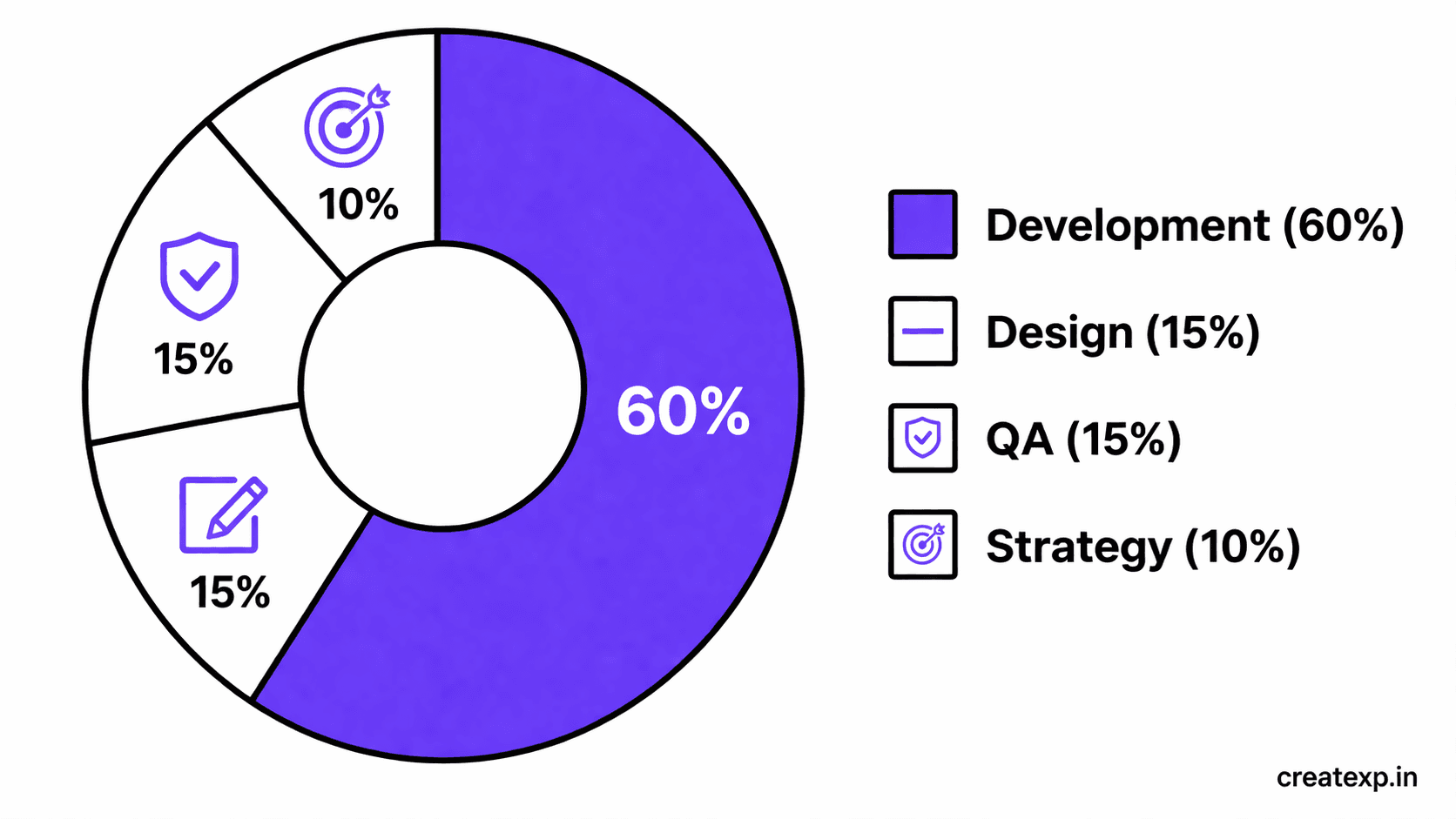
Expect to spend around 10% of your total budget here. If your total bill is $30,000, plan to spend $3,000 on strategy. Skipping this step leads to expensive mistakes later.
Phase 2: UI/UX Design
People buy with their eyes. An ugly product will fail. Good design builds trust with your early users.
Designers create wireframes first. These are simple sketches of your app screens. Then they build high-fidelity designs. These look exactly like the final product.
Design usually claims 15% to 20% of your budget. A typical design phase costs between $4,000 and $8,000. It depends on how many unique screens your app needs.
Phase 3: Core Programming
This is the heavy lifting. This phase takes the longest time. It also costs the most money.
Developers write the front-end code. This is what users see. They also write the back-end code. This handles databases and user accounts.
Programming takes up 50% to 60% of the cost. For a $40,000 project, you might spend $24,000 just on developers. Good code ensures your app does not crash when real people use it.
Phase 4: Testing and Quality Assurance
Bugs kill startups. You must test your product before launch. Quality Assurance (QA) engineers try to break your app. They find problems so your users do not have to.
They test on different phones. They check different web browsers. QA usually takes up 15% of the total budget. Do not rush this phase. Fixing a bug after launch costs ten times more than fixing it during testing.
App vs. Web vs. Software: Costs by Platform
The type of product you build changes the price. A mobile game costs differently than a business dashboard. Here is how platform choice impacts your wallet.
Web Application Pricing
Web apps are usually the cheapest to build. They run in a browser like Chrome or Safari. You do not have to deal with Apple or Google app stores.
A standard web platform costs between $15,000 and $35,000. You only need to write the code once. Everyone can access it from any computer. Tools like React and Vue make web development very fast.
Mobile App Pricing
Mobile apps are more expensive. Users expect a smooth experience on their phones.
You can build native apps or cross-platform apps. Native means writing code twice. One for iOS and one for Android. This is very expensive. Cross-platform tools like React Native let you write code once for both phones.
A standard mobile app costs between $25,000 and $50,000. Hardware features add costs. If your app needs the phone camera or GPS, the price goes up.
Custom Enterprise Software Pricing
Enterprise tools are complex. They handle sensitive data. They connect with old corporate systems. Security is a massive priority.
These projects take longer. The mvp development pricing for enterprise software rarely drops below $40,000. It often reaches $80,000 or more. You are paying for high-level security and data handling.
Who Builds It? Team Types and Pricing
Your choice of team changes everything. You can hire a freelancer. You can hire full-time staff. Or you can hire an agency. Each option has a different price tag and risk level.
The Solo Freelancer Route
Freelancers are the cheapest option. You can find them on sites like Upwork.
They might charge $20 to $50 an hour. You could build a basic tool for $10,000. But this path is risky. One person handles design, code, and testing. They might get sick. They might take on too many clients. You also have to manage the project yourself.
Assembling an In-House Team
Hiring your own team gives you total control. They sit in your office. They only work on your product.
This is the most expensive route. You have to pay salaries, taxes, and benefits. A good developer costs $8,000 to $12,000 a month in Western countries. You also need a designer and a manager.
This model rarely works for an early launch. It takes months just to hire the right people.
Hiring a Dedicated Agency
Agencies offer a complete package. They give you a designer, developers, and a project manager.
Prices vary wildly. A top-tier agency in New York might charge $150,000. A strong mid-market studio offers the same quality for $30,000 to $50,000.
Agencies move fast. They have built hundreds of products. They know how to avoid common mistakes. This is usually the safest choice for serious founders.
Global Rates: Where Should You Hire?
Location impacts hourly rates directly. Developer salaries change based on where they live. Here is a breakdown of average hourly rates around the world in 2026.
Hourly Rate Averages by Region
Region | Average Hourly Rate | Pros | Cons |
North America | $100 - $200+ | Easy communication, same time zone. | Extremely expensive. |
Western Europe | $80 - $150 | High quality, strict data laws. | Still pricey. |
Eastern Europe | $40 - $80 | Strong technical skills. | Language barriers sometimes exist. |
South Asia (India) | $25 - $60 | Highly cost-effective, massive talent pool. | Time zone differences require planning. |
Many global startups now look to hubs like Bangalore. They get enterprise-level quality without the massive Silicon Valley price tag.
The Hidden Fees in MVP Development Pricing
Founders often look at the initial quote and think they are done. This is a mistake. Software has ongoing costs. You must plan for these invisible expenses.
Server and Hosting Costs
Your app needs a place to live on the internet. You have to rent space from companies like Amazon Web Services (AWS) or Google Cloud.
In the early days, this might only cost $50 a month. But if thousands of people start using your app, this bill grows quickly. You could end up paying hundreds of dollars monthly. Budget for at least $1,000 a year for early hosting.
Third-Party APIs and Integrations
You rarely build everything from scratch. You will probably use outside tools.
Want to process payments? You will use Stripe. Need to send text messages? You will use Twilio. These services charge fees. Some charge a monthly rate. Others charge per transaction. These small fees add up fast. You must factor them into your monthly budget.
App Store Fees and Compliance
Apple and Google do not let you host apps for free. Apple charges $99 a year for a developer account. Google charges a one-time fee of $25.
You also have to think about legal compliance. If you handle user data, you need a solid privacy policy. Hiring a lawyer to draft terms of service can cost $1,000 to $3,000. Do not skip this. Legal trouble will ruin your business.
Red Flags: Are You Overpaying?
You do not want to get ripped off. Some agencies charge too much for basic work. You need to know the warning signs of an inflated quote.
First, look at the timeline. If an agency says a simple directory app takes six months, they are padding the bill. Most early versions should launch in 90 days.
Second, check their tech stack choices. If they insist on building a custom content management system instead of using existing tools, ask why. Re-inventing the wheel wastes your money.
Third, read the line items. Vague costs like "Project Management: $15,000" are a red flag. Every dollar should attach to a specific deliverable.
Red Flags: Is Your Budget Too Low?
A cheap price tag feels great. It is also very dangerous. Unrealistic low quotes usually end in disaster.
If someone offers to build your custom marketplace for $3,000, run away. They will likely copy and paste terrible code. Or they will ask for more money halfway through.
Extremely low quotes mean they skip testing. Your users will find all the bugs. Low prices also mean zero post-launch support. When the app breaks on day two, the developer will be gone. Pay a fair price for reliable work.
The Createxp Way: Building Smart, Not Just Fast
Founders need a partner who understands business, not just code. This is where Createxp stands out. We are a design and development studio based in Bangalore, India.
Since 2023, we have helped over 50 founders across five continents launch digital products. We know that every business deserves a world-class digital presence.
We do not just build blindly. We combine the agility of a startup with the precision of an enterprise agency. When you work with us, there is no outsourcing. There is no hidden chaos. We do everything 100% in-house. Our designers, developers, and strategists sit together and solve your problems.
Whether you need a Framer website to raise funding or a complex CRM system, we focus on outcomes. We treat your budget with respect. We build things we are proud to stand behind. More importantly, we stay invested in the relationship long after your project goes live.
Stop Guessing Your MVP Budget.
You have the idea, we have the execution. Let our Bangalore-based team map out your exact timeline and budget to build an MVP that validates your market without draining your bank account. No hidden fees, just real results.
How to Cut MVP Development Cost Without Losing Quality
You want to save money. You do not want to build a bad product. You can do both. You just need to make smart choices during the planning phase.
Use the "One Core Feature" Rule
The biggest mistake founders make is adding too many features. They want a chat function, user profiles, and a map view.
Stop. Pick one core feature. What is the single most important thing your app does? Build that. Do it perfectly. Cut everything else. You can add the map view later. Trimming features is the fastest way to drop your price.
Leverage Existing Tools
Do not write custom code if you do not have to. Use open-source libraries. Use proven frameworks.
If you need user login, use Firebase or Auth0. Do not pay a developer to build a custom login system from scratch. Using existing tools saves hundreds of hours. This cuts thousands of dollars off your final bill.
Launch and Learn Quickly
Do not spend six months building in secret. Launch in 30 to 60 days. Get real users on the platform.
Real users will tell you what is broken. They will tell you what they actually want. You can then spend your remaining budget building features people actually use. Guessing what users want is a great way to waste money.
The Reality Check: Setting Your Baseline Expectations
Founders constantly look for the absolute lowest entry point into the market. The minimum realistic budget for a viable product in 2026 sits firmly between $10,000 and $15,000. This specific range covers a basic, low-complexity web tool or a very simple mobile application, provided you use an affordable team. Anything lower than this usually results in broken, unusable code.
Your physical location strategy affects this developer pricing drastically. Hiring an established agency in North America often pushes a standard project well over $100,000. In contrast, partnering with a high-quality studio in tech hubs like India can deliver the exact same enterprise-level product for $20,000 to $40,000. Local economic differences give global founders massive financial leverage.
You must also prepare for the heaviest financial lift of the entire project. The most expensive part of app development is always back-end engineering and core programming. This crucial phase requires senior developers to build secure databases, write custom logic, and set up server architecture. Because it requires deep technical skill and takes the most time, this programming phase reliably consumes up to 60% of your total budget.
Post-Launch Reality: The Maintenance Budget
Launch day is just the beginning. Software requires constant care. It is like owning a car. You have to pay for gas and oil changes.
Operating systems update constantly. Apple releases new iOS versions every year. Your app might break when they do. You have to pay a developer to fix it.
Users will also find weird bugs. You will need someone to patch these issues quickly. Plan to spend about 15% to 20% of your initial build cost on annual maintenance. If you spent $30,000 to build the app, budget $6,000 a year to keep it running smoothly.
The Final Verdict on Your 2026 Launch
Building a digital product is a major investment. You have to treat it like one. The cost to build MVP products depends entirely on your strategy.
Do not rush into a contract with the first developer you find. Do not add features just because they sound cool. Plan carefully. Pick the right platform. Choose a reliable team.
Keep your scope small. Focus on solving one major problem for your users. If you manage your scope and choose a smart partner, you can launch a world-class product without draining your bank account. Your idea deserves a great execution. Let the numbers guide your strategy.
Frequently Asked Questions (FAQ)
How long does it actually take to build an early version?
If you keep things simple, most successful early products launch in about two to four months. If an agency promises to do it in two weeks, they are copying and pasting cheap templates. If they say it will take eight months, your app is probably too complicated for an MVP.
Can I just use no-code tools to save a ton of money?
Yes! No-code tools like Bubble or FlutterFlow are amazing for early testing. You can often keep your budget under $10,000 this way. Just keep in mind that if your app goes viral and millions of people use it, you will eventually have to rebuild it with real custom code later on.
Will agencies give me a fixed-price contract?
Many good agencies will offer a fixed price. This is great because it protects you from crazy surprise bills. However, a fixed price means you cannot change your mind halfway through. If you suddenly decide you want to add a massive new feature, you will have to pay extra.
Does a fancy design make the programming more expensive?
It absolutely does. If you want crazy, unique animations and completely custom layouts, it takes a programmer way longer to write that code. If you are on a tight budget, ask your designer to stick to clean, standard, simple layouts.
Is it actually possible to build an app for $5,000?Honestly? Usually not. For $5,000, you
might get a really nice static landing page or a very basic clicking prototype. But an actual, functioning software product with user accounts, security, and a database requires a level of professional work that simply costs more than $5,000 in today's market.
Warning: Working With Us May Trigger Unstoppable Momentum