
MVP Development
Akarsh Shrivastava
CMO & Co-Founder
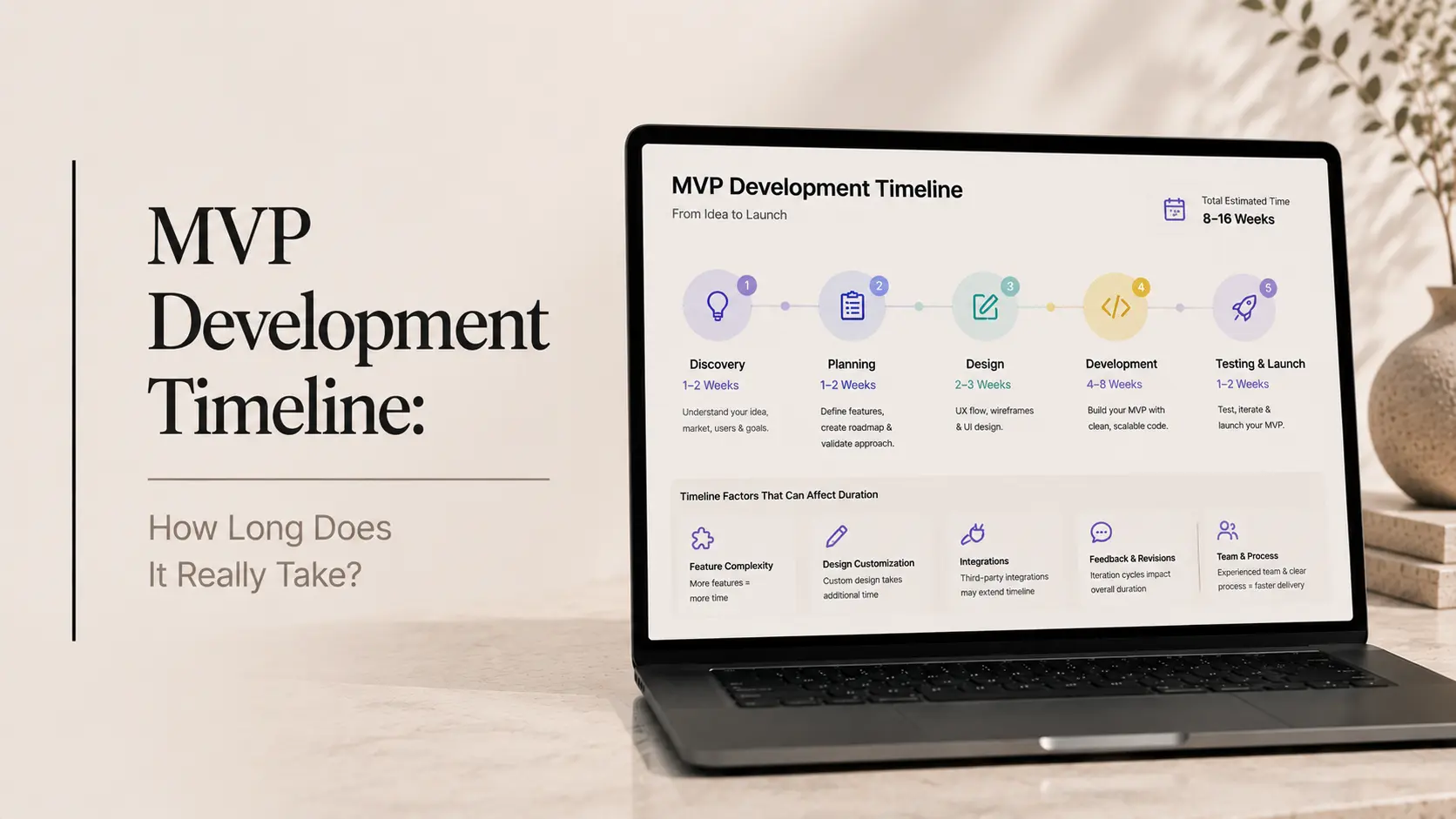
You've got the idea. You've probably sketched it on a napkin, explained it to twelve people, and maybe even lost a little sleep over it. Now you're asking the one question every founder eventually lands on:
It's a fair question. And honestly? Most answers you'll find online are either vague, way too optimistic, or written by someone who's never shipped anything in their life. So let's cut through the noise and talk about what an MVP development timeline actually looks like, in the real world, not in a slide deck.
According to CB Insights, 35% of startups fail because there's no market need for their product. A big chunk of that happens because founders spent 12–18 months building something without validating it first. That's exactly what an MVP is supposed to prevent. And yet, the irony is, many teams spend just as long building their MVP.
So, What's a “Realistic” MVP Development Time?
Let's get the honest answer out early: , depending on complexity. But here's the thing, that range is almost useless without context.
A landing page with a waitlist? That's 2–3 days.
A marketplace with two user types, payments, and a dashboard? That's 3–4 months minimum.
A SaaS platform with AI features, third-party integrations, and enterprise auth? Budget for 6+ months.
The MVP development time depends on three core things: , , and how fast decisions get made.
The Trap Most Founders Fall Into
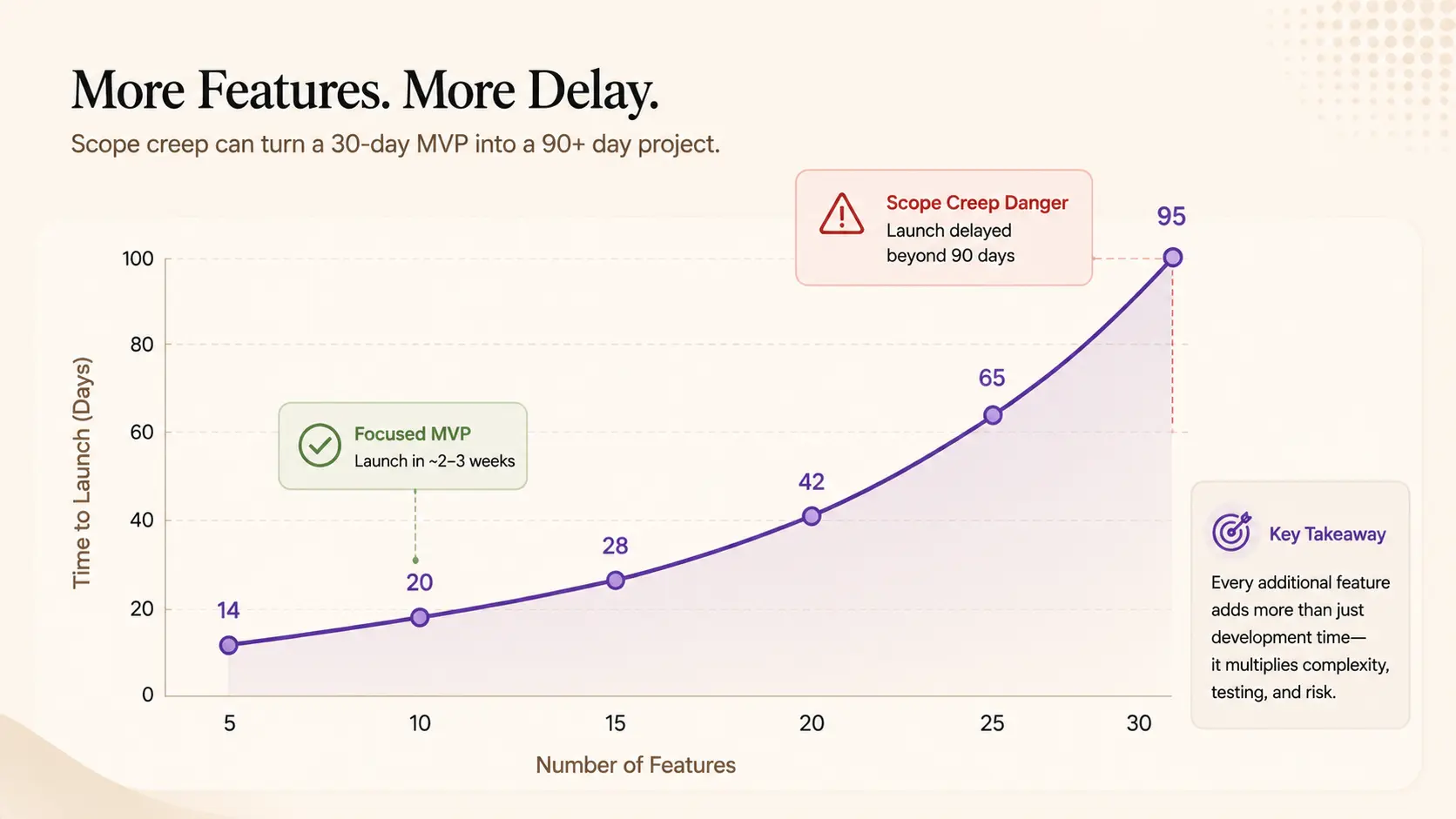
They confuse “MVP” with “full product.” An MVP is the viable product, not the feature-complete dream version. Every feature you add adds time. And in the early days, time is the one thing you can't buy back.
The Real MVP Development Timeline: Phase by Phase
Here's how a typical MVP build actually breaks down. This isn't theoretical. This is what it looks like when a team that's done this before runs the show.
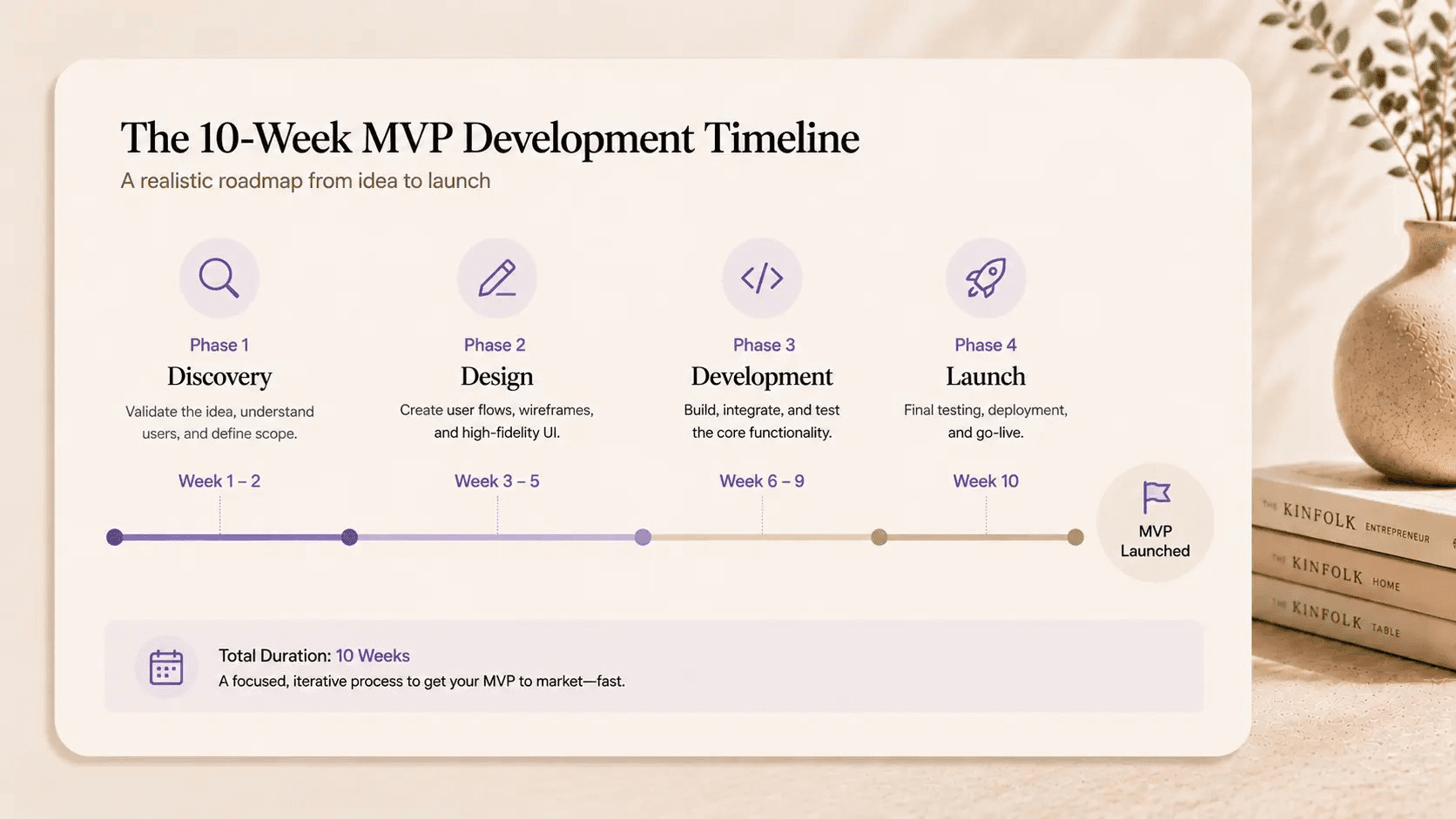
Phase 1, Discovery & Scoping (Week 1)
This is the week most people skip. Big mistake.
Discovery is where you figure out you're actually building and . It includes:
• User research and defining the core problem
• Mapping out the core user journey (not every journey, just the one that matters most)
• Writing a feature list and then cutting it in half
• Technical architecture decisions, what stack, what integrations, what's custom vs. off-the-shelf
• Writing a scope document that everyone signs off on
When this phase is skipped, the development phase expands to fill the gap. Teams end up building, stopping, rebuilding, arguing. It gets expensive fast.
That's not an exaggeration.
Phase 2, UI/UX Design (Weeks 2–3)
Design is often underestimated in the startup timeline. But here's the truth: a well-designed MVP gets better feedback. Users can actually use it. Investors can actually visualize it.
This phase covers:
• Wireframes (low-fidelity sketches of screens and flow)
• High-fidelity UI design (the actual look and feel)
• Clickable prototype for early feedback
• Design handoff, making sure developers don't have to guess
Two weeks is enough for most MVPs if scope is tight. For something more complex, three weeks is realistic.
Phase 3, Development (Weeks 3–8)
This is the big one. And it's also where timelines tend to slip.
Most MVPs fall into one of these buckets:
MVP Type | Typical Dev Time |
Landing page + waitlist | 2–5 days |
Simple web app (CRUD, auth, basic UI) | 3–4 weeks |
Two-sided marketplace | 6–10 weeks |
SaaS with integrations & dashboards | 8–14 weeks |
Mobile app (iOS or Android) | 8–12 weeks |
Custom software / ERP / CRM | 12–20+ weeks |
The numbers above assume a focused, experienced team. Add 30–50% if the team is learning the stack or managing scope changes mid-build.
1. Unclear requirements (discovered after dev starts)
2. Too many stakeholders giving conflicting feedback
3. Feature creep, "can we just add one more thing?"
4. Poor communication between design and development
5. Third-party API delays or integration issues
Phase 4, QA, Testing & Launch (Week 8–10)
Nobody wants to talk about testing. But shipping a buggy MVP is worse than shipping late.
This phase includes:
• Functional testing (does it work as expected?)
• Cross-browser and device testing
• User acceptance testing (UAT) with real users
• Bug fixing and iteration
• Deployment and go-live
Budget at least 1–2 weeks here. For anything with payments or sensitive user data, budget more.
Can You Actually Build an MVP in 30 Days?
Yes. But only if certain conditions are met.
A 30-day MVP is very real, but it requires ruthless prioritization. Here's what needs to be true:
•No new features once development starts. None.
•Junior developers or people learning a new stack can't hit this timeline.
•If it takes 3 days to get approval on a design, the 30-day window is already slipping.
•One core problem. One user flow. One value proposition.
A 30-day MVP doesn't mean a cheap or low-quality product. It means a tightly scoped, strategically built product that does and ships fast enough to get real user feedback.
How Team Structure Affects Your Startup Timeline
One of the biggest variables in any MVP development time calculation is who's actually doing the work.
Option 1, In-House Team
Building in-house sounds great on paper. But for most early-stage startups, it means slow hiring, mismatched skills, and a team that's figuring things out as they go.
Often 2–3x longer than expected.
Option 2, Freelancers
Freelancers can move fast, but only when well-coordinated. The challenge is project management. When a designer, developer, and copywriter are each working independently, things fall through the gaps.
Highly variable. Very dependent on communication quality.
Option 3, Dedicated Studio
A specialized studio brings a full team, proven processes, and domain experience. There's no ramp-up time. The team has shipped MVPs before and knows exactly where the pitfalls are.
Fastest route to a production-ready MVP, especially when the studio has done it before.
What Should You Have Ready Before Development Starts?
This is a question every founder should ask before signing any contract. The more prepared you are coming in, the faster things move.
Here's what a development team needs from you:
•Not "I want to build Uber for X." What problem does your user have, and what's the simplest solution?
•Who is this for? What do they care about?
•What's must-have vs. nice-to-have?
•Logo, brand colors, tone of voice, even if rough.
•Any platform requirements? Existing tools it needs to integrate with?
Coming in prepared can save a full week of back-and-forth discovery time. Easy win.
CREATEXP's 30-Day MVP: Built for Founders Who Can't Afford to Wait
When it comes to MVP development, CREATEXP has built a process that's specifically designed around startup reality, where speed matters, budgets are finite, and the goal is validated learning, not perfection.
Here's how CREATEXP approaches the MVP development timeline differently:
Week 1, Discovery Sprint
A full week dedicated to scoping, strategy, and architecture. The team gets into the details of your business, your users, and your goals. By the end of week one, there's a shared document everyone's aligned on.
Week 2, Design Sprint
High-fidelity designs that look like a finished product, because first impressions matter, especially with investors and early users. No low-effort wireframe hand-offs here.
Weeks 3–4, Build Sprint
Development with daily check-ins. No disappearing acts. No "we'll show you in two weeks." Founders stay in the loop throughout.
End of Week 4, Launch-Ready MVP
QA-tested, deployed, and ready to show the world.
What makes this work isn't just speed, it's the fact that CREATEXP operates with an . No outsourcing. No handoffs to subcontractors in different time zones. The same designers, developers, and strategists who start the project finish it. That consistency eliminates the biggest time-killers in any MVP build.
They've done this for 50+ founders across 5 continents, in sectors ranging from fintech to SaaS to marketplaces. And the feedback is consistent: the structure is what makes it feel fast without feeling chaotic.
Your MVP Is Closer Than You Think Stop waiting for the perfect version. Start building the right one. |
Key Takeaways
• Most MVP development timelines range from 4 weeks to 6 months, depending on complexity.
• A 30-day MVP is achievable, but only with a locked scope, fast decision-making, and an experienced team.
• Discovery and design are not optional phases. Skipping them stretches development time and increases cost.
• The biggest reasons MVPs go over time: scope creep, unclear requirements, slow feedback loops, and misaligned teams.
• Choosing the right team structure (in-house vs. freelance vs. studio) has a huge impact on your startup timeline.
• Prepare a clear problem statement, user profile, and feature priority list before development starts. It saves real time.
• An MVP is not a mini version of your full product. It's the smallest thing you can ship that delivers real value and generates real feedback.
Frequently Asked Questions
How long does it take to build an MVP from scratch?
For a simple web-based MVP, one core feature, basic auth, and a clean UI, you're looking at 4–6 weeks with an experienced team. More complex products with multiple user types, integrations, or mobile apps can take 3–6 months. The biggest variable is scope.
What is the average MVP development time for a SaaS product?
A SaaS MVP with core features, a dashboard, user authentication, and one or two integrations typically takes 8–14 weeks. That includes design, development, and QA. Anything with AI features, complex billing logic, or enterprise requirements will take longer.
Can an MVP be built in 30 days?
Yes, but scope must be minimal and decisions must be fast. A 30-day MVP is a real deliverable, not a marketing claim. It requires a dedicated, experienced team and a founder who can make decisions quickly without second-guessing every choice mid-build.
How much does MVP development cost?
Cost depends on timeline and team. A 4-week MVP with a focused studio can range from $10,000 to $30,000 depending on complexity. Longer MVPs with more features naturally cost more. Going the freelancer route can be cheaper upfront, but often costs more in time, management overhead, and rework.
What should I build first in my MVP?
Start with the single feature that solves your user's core problem. Not the best-looking feature. Not the most impressive one. The one that would make someone say "I need this." Everything else is version two.
Why do so many MVPs take longer than expected?
The most common reasons: scope creep, unclear requirements at the start, slow stakeholder approvals, and choosing a team that's learning on the job. The fix is simple in theory, lock the scope, choose experienced people, and keep feedback loops short.
What's the difference between an MVP and a prototype?
A prototype is something you test to validate a concept, often not functional, sometimes just a clickable design. An MVP is a real, working product that actual users can sign up for and use. Both are useful, but they serve different purposes at different stages.
Warning: Working With Us May Trigger Unstoppable Momentum