
Product Design
Trehan Sangpriya
CEO & Co-Founder
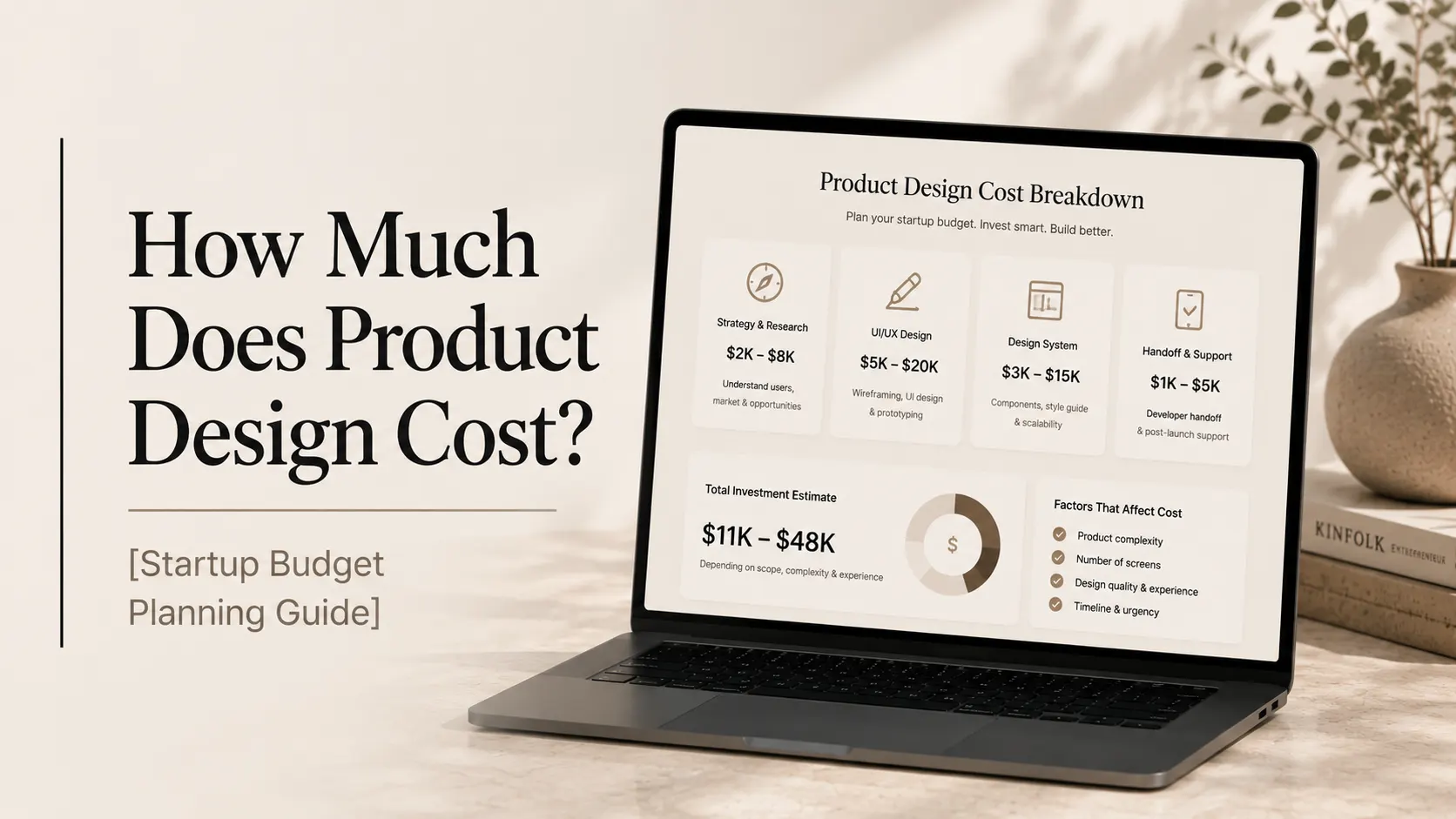
You've got a product idea and a budget that needs to stretch. Now someone's told you to "invest in design", and you want a real number, not a vague range that spans from $5,000 to $500,000. Honestly, fair enough. That kind of answer is useless.
Here's the thing: product design cost does vary enormously. But it varies for reasons you can actually understand and plan around. Scope, stage, region, team type, these are the levers. Once you know what moves the number, you can make a decision that actually fits your situation.
Before we get into specifics, here's a data point worth holding onto. According to a study by the Design Management Institute, design-led companies outperformed the S&P 500 by 211% over ten years. That's not a coincidence. But it also means that underspending on design early, or spending in the wrong places, has a real cost. Getting the design budget right from day one matters more than most founders realise.
The Quick Answer (Before the Full Breakdown)
If someone's pushed for time, here's the honest summary.
For a startup building an MVP, product design typically costs between $8,000 and $35,000. A full product design engagement, covering strategy, UX, UI, and a design system, usually runs $25,000 to $100,000+, depending on complexity and who you hire.
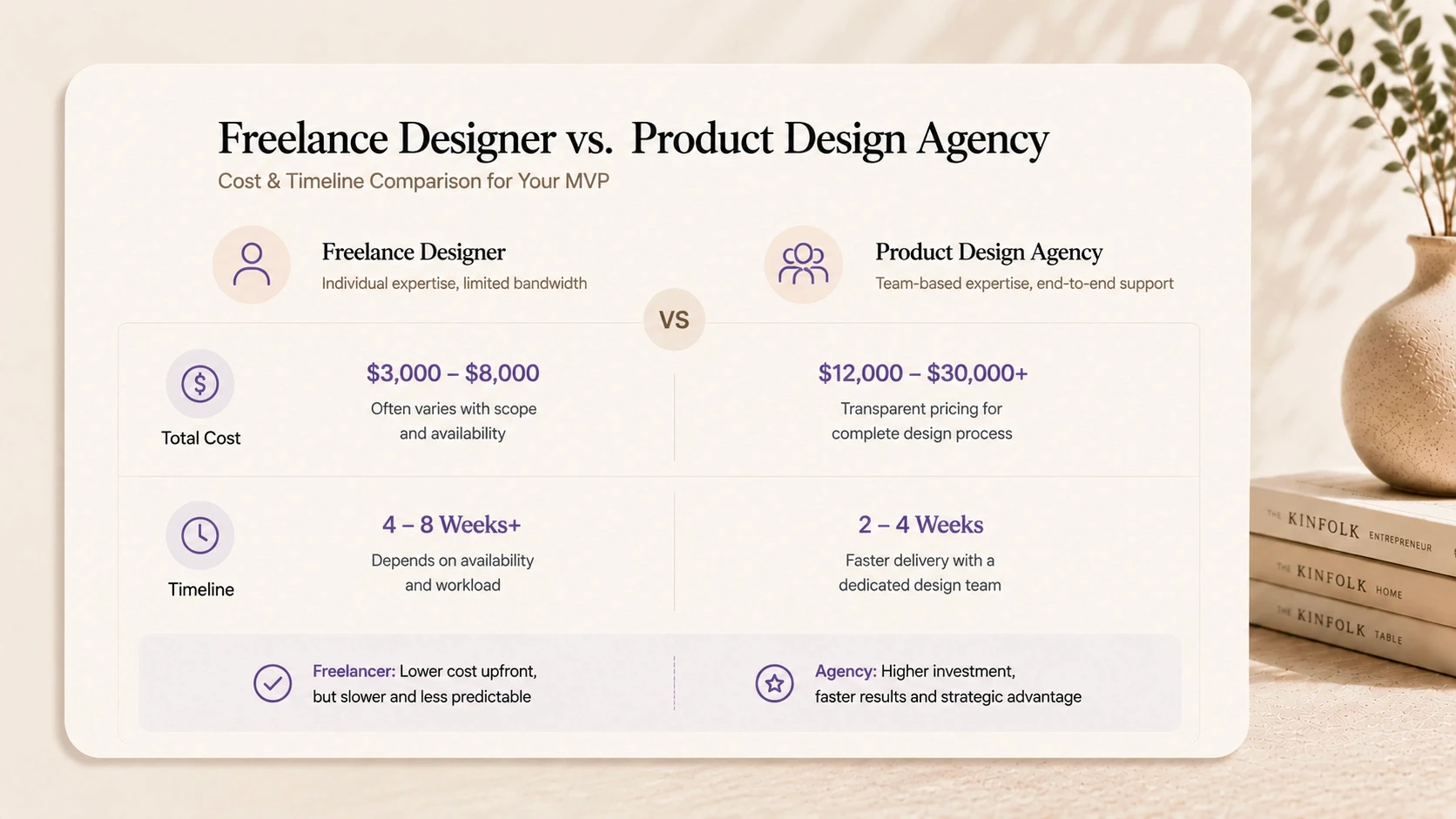
A freelancer will charge less upfront but often covers less scope. An agency costs more per project but brings a full team and faster delivery. In-house design is the most expensive path in year one, with total costs typically landing between $125,000 and $230,000 once you factor in everything beyond salary.
Those ranges mean something once you understand what's inside them. Let's break it down properly.
What Actually Drives the Cost of Product Design
This is the part that most pricing guides skip, and it's the most useful thing to understand. Product design pricing isn't arbitrary. Four main variables determine where your number lands.
1. Scope of Work
The single biggest factor. A landing page design is a completely different engagement from a full product design covering user research, UX architecture, UI design, prototyping, and a design system. Define what you actually need before you ask for a quote, otherwise you're comparing apples to construction projects.
Common scope components and how they affect cost
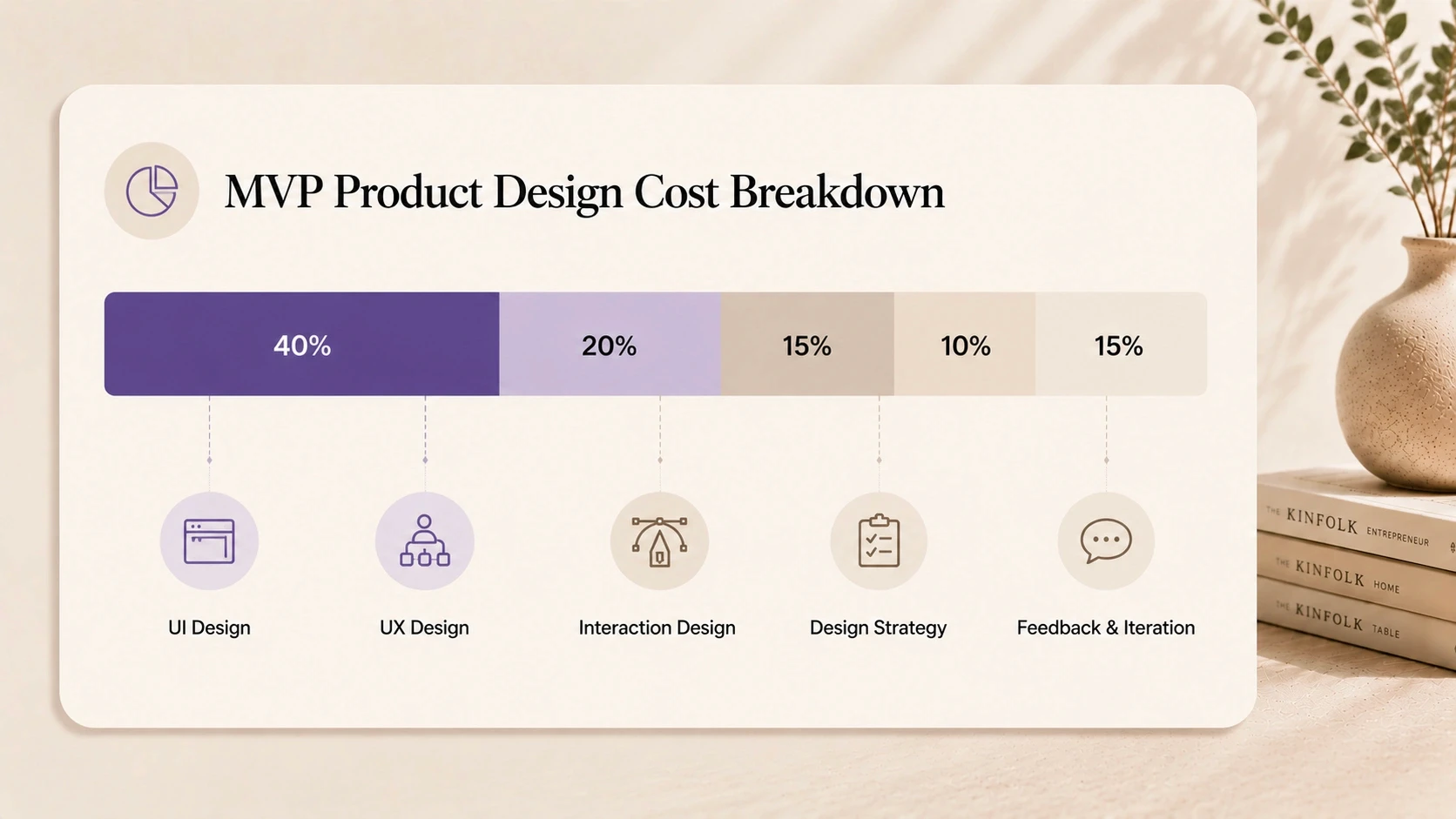
• User research and discovery: adds $2,000–$8,000 to any project
• Wireframing and UX flows: typically 20–30% of total design cost
• High-fidelity UI design: usually the largest single line item
• Prototyping and testing: adds $3,000–$10,000 depending on rounds
• Design system: a separate workstream, $10,000–$30,000 on its own
2. Who You Hire
A junior freelancer, a senior freelancer, a boutique agency, and a full-service studio all produce different outputs at different price points. The cost of product design varies dramatically based on who's doing the work.
Junior freelancer: $15–$45/hr. Low cost but often limited to execution rather than strategy. Good for well-defined, contained tasks.
Senior freelancer: $60–$150/hr. More strategic, better output, but still one person's bandwidth and skill set.
Boutique agency (3–10 people): $50–$120/hr. A team rather than a solo contributor. Covers more ground, faster.
Full-service studio: $80–$200/hr (US), $25–$70/hr (global top studios). Strategy, design, and often development in one place.
3. Where They're Based
Geography still matters, even in a remote-first world. A US-based designer charges two to four times more than a designer in India or Eastern Europe, often for work of comparable quality if you choose carefully.
4. Your Stage and Complexity
An idea-stage startup needs a lean, focused design scope. A Series A company scaling across multiple platforms needs significantly more. Complexity of the product, number of user types, flows, integrations, states, directly affects how long design takes and what it costs.
Product Design Pricing by Project Type
This is probably the table you came here for. These are realistic 2026 ranges for each common type of design engagement, primarily reflecting US and global agency pricing.
Product Design Cost Ranges by Project Type (2026)
Project Type | Budget Range (USD) | Timeline | Best For |
Brand & visual identity | $2,000 – $8,000 | 1–3 weeks | Early-stage startups |
Landing page / marketing site design | $3,000 – $15,000 | 2–4 weeks | Pre-launch, fundraising |
Mobile app UX/UI (MVP) | $8,000 – $35,000 | 4–10 weeks | Seed-stage founders |
SaaS product design (full) | $20,000 – $80,000 | 8–16 weeks | Series A+ |
Design system creation | $10,000 – $30,000 | 4–8 weeks | Scaling teams |
Full product design (end-to-end) | $25,000 – $100,000+ | 10–20 weeks | Enterprise / growth stage |
Design audit + recommendations | $3,000 – $10,000 | 1–3 weeks | Existing products |
Monthly design retainer | $3,000 – $8,000/mo | Rolling | Ongoing design needs |
A few things worth noting here. These ranges assume a professional team or senior freelancer, not the cheapest option on a platform marketplace. Quality design at the budget end of each range is possible but requires careful vetting.
The retainer row deserves attention. For startups with ongoing needs but no full-time headcount, a monthly retainer with a studio or agency is often the most cost-efficient model. You get consistent access to a team at a fraction of the in-house equivalent.
How Location Changes the Design Budget
If you're flexible about where your design team is based, geography is one of the highest-leverage cost variables in your design budget. Here's what the market looks like in 2026.
Product Design Hourly Rates by Region (2026)
Region | Avg Hourly Rate | Full MVP Design Cost | Quality Indicator |
United States / Canada | $100 – $200/hr | $30,000 – $80,000 | High |
Western Europe (UK, Germany) | $80 – $160/hr | $25,000 – $65,000 | High |
Eastern Europe | $40 – $90/hr | $12,000 – $35,000 | High–Medium |
India (top studios) | $25 – $60/hr | $8,000 – $25,000 | High (selective) |
Southeast Asia | $20 – $55/hr | $7,000 – $22,000 | Medium–High |
Latin America | $35 – $75/hr | $10,000 – $30,000 | Medium–High |
The India row is worth highlighting. The top design studios in Bangalore, Mumbai, and Hyderabad deliver work on par with US and European counterparts, the difference is almost entirely cost. Many global founders and VCs have figured this out, which is why cross-continent studio engagements have grown significantly in the last three years.
The key is selective vetting. Not every studio in a lower-cost market delivers at that level. Look for studios with documented case studies, client reviews on platforms like Clutch, and a clear process, not just a portfolio of pretty screens.
What Makes a Design Project More Expensive
This is the part most cost guides don't cover, and it's where budgets blow up. Knowing what inflates product design pricing helps you plan more accurately.
Things that push costs up
• Unclear brief, ambiguity leads to more revision rounds, which means more hours
• Multiple user types with different flows (each adds scope)
• Complex data visualisation or dashboard UI
• Custom illustrations or motion design on top of core UX/UI
• Tight deadlines, rush work typically carries a 20–35% premium
• Frequent scope changes mid-project
Things that bring costs down
• A well-defined brief with clear goals and success metrics
• Fewer revision rounds, agree on a clear feedback process upfront
• Working with a studio rather than multiple freelancers (less coordination overhead)
• Phased delivery, design the MVP scope first, defer additional features
• Choosing a global studio over a US-based one for the same quality tier
One of the most effective ways to manage design budget is phase gating. Design and validate the core product first. Expand scope after you have user validation. This is how the best-run startups stretch their design investment further.
How Much Should Your Startup Actually Spend on Design?
This is the real question, isn't it. Not just what things cost, but what the right amount to spend is at your specific stage.
Design Budget Planning by Startup Stage
Startup Stage | Typical Design Budget | What to Prioritise | Avoid Spending On |
Idea / Pre-seed | $3K – $12K | Landing page, brand basics, MVP prototype | Full design systems, complex animations |
Seed | $12K – $40K | Full MVP UI/UX, onboarding flows, core product screens | Over-designed v1 features |
Series A | $40K – $100K | Design system, growth-focused redesign, scalable components | Redesigning what already works |
Series B+ | $100K+ | In-house team + agency for specialist sprints | Outsourcing core product strategy |
The most common mistake at the pre-seed stage is either spending too little, resulting in a product that's hard to use and hard to fund, or too much on design that won't survive user feedback anyway.
A good rule of thumb for seed-stage startups: allocate 10–15% of your total product budget to design. If your total build budget is $200,000, design should be $20,000–$30,000. Any less and you're likely cutting corners that will cost more to fix after launch.
Design isn't a one-time expense
This is worth saying directly. Product design is not a line item you pay once and close. Products need ongoing design work, new features, redesigns based on user feedback, platform expansions. The most effective startups treat design as a continuous investment, not a project cost.
That's why retainer models and long-term agency partnerships tend to produce better outcomes than one-off engagements. Consistency in the design relationship builds context and quality over time.
How CREATEXP Approaches Product Design Pricing
CREATEXP doesn't do one-size-fits-all pricing, and that's deliberate. The cost of product design varies so much based on scope, stage, and goals that a fixed price list would be misleading more often than helpful.
What the studio does instead is scope conversations first. Before any number is on the table, there's a proper discovery call to understand what you're building, where you are in your journey, and what success actually looks like. That conversation is what produces an accurate number, not a ballpark figure that leaves room for nasty surprises.
For early-stage startups, the studio typically structures engagements in phases. Phase one covers discovery, UX, and core UI design. Phase two, usually after the first round of user validation, covers iteration, expanded features, and design systems. This approach keeps upfront cost manageable while leaving room to invest more as confidence in the product direction grows.
The team is entirely in-house, designers, UX leads, and developers working together from day one. There's no outsourcing to a cheaper sub-team once the project is signed. What you see in the proposal is what builds the product. That transparency is part of what keeps revision cycles short and delivery on schedule.
For companies that need ongoing design capacity without adding headcount, the studio offers monthly retainer arrangements. These give you a dedicated design team on call, covering everything from new feature design to marketing assets, at a predictable monthly cost.
Want a Real Number for Your Project? Tell the CREATEXP team what you're building and get an accurate scope and estimate. |
Budget Numbers Worth Pinning Up
Here's everything distilled into the points you'll actually use:
1. Product design for an MVP typically costs $8,000–$35,000. End-to-end product design for a full product runs $25,000–$100,000+.
2. US agencies charge $100–$200/hr. Top global studios charge $25–$70/hr for comparable quality.
3. Scope is the biggest cost driver. Define what you need before asking for a price, ambiguity always adds cost.
4. A tight deadline adds 20–35% to design cost. Plan ahead wherever possible.
5. Seed-stage startups should allocate 10–15% of total product budget to design.
6. Retainers ($3,000–$8,000/mo) are often the most cost-efficient model for ongoing design needs.
7. Phase your design investment, design and validate core scope before expanding to secondary features.
8. Bad design isn't just aesthetically disappointing. It kills conversion, user retention, and investor confidence.
Questions Founders Usually Ask First
How much does product design cost for a startup?
For an early-stage startup, product design typically costs between $8,000 and $35,000 for an MVP-level engagement. This usually covers UX research, wireframing, UI design, and a prototype. Full product design including a design system and multiple user flows runs $25,000 to $80,000 with a professional agency.
What is included in the cost of product design?
Product design cost typically covers user research, UX architecture, wireframes, high-fidelity UI design, prototyping, and design handoff documentation. Some engagements also include a design system, usability testing, and brand guidelines. Always confirm what is and isn't included before signing a contract.
Is product design a one-time cost or ongoing?
Both. There's usually a larger upfront project cost to design the core product, followed by ongoing design spend as you add features, iterate based on user feedback, and expand to new platforms. Mature startups typically maintain either an in-house design team or an ongoing agency retainer for continuous design work.
How much should I budget for design at the seed stage?
A good benchmark for seed-stage startups is 10–15% of the total product development budget. If your total build budget is $150,000–$200,000, a realistic design budget is $15,000–$30,000. Spending below this range usually means cutting corners that get expensive to fix after launch.
Why does product design pricing vary so much?
Product design pricing varies based on scope, designer seniority, agency vs freelancer, geography, and project complexity. A landing page design and a full SaaS product design are categorically different engagements. Always compare quotes with the same scope before drawing conclusions about pricing.
Can I get good product design cheaply?
Yes, but it requires smart decision-making. Choosing a high-quality global studio over a US-based agency, narrowing your scope to just what's needed for validation, and maintaining a clear brief all help reduce cost without sacrificing quality. The danger is false economy, cutting design budget so much that the product fails to convert or retain users.
How long does product design take?
Timeline depends on scope. A landing page or simple app UI takes two to four weeks. An MVP product design engagement typically runs four to ten weeks. A full product design covering multiple flows, a design system, and multiple rounds of testing can take twelve to twenty weeks. Rush timelines are possible but carry a cost premium.
What's the difference between product design and UI/UX design cost?
UI/UX design typically refers to the interface and experience design layer. Product design includes that same work plus strategic thinking, user research, problem definition, and alignment with business goals. Product design engagements cost more because the scope is broader, but they produce more commercially grounded outcomes.
Warning: Working With Us May Trigger Unstoppable Momentum