
Product Design
Neeha Fathima
CDO & Co-Founder
You're building something. Maybe it's an app, a SaaS tool, a marketplace, or a mobile product you've been thinking about for months. At some point, you land on a question that seems simple but actually isn't: do I need a product designer, or a UI/UX designer?
The two titles get thrown around interchangeably all the time. Even job descriptions confuse them. And for founders who aren't from a design background, figuring out the difference, and more importantly, which one you actually need right now, can feel like guesswork.
Here's why this matters more than people realise. Research by Forrester found that every dollar invested in UX returns up to $100 in value. Meanwhile, McKinsey data shows that design-driven companies outperform industry benchmarks by over 200% in revenue growth over a decade. The point isn't just to hire any designer. The point is to hire the right kind of designer at the right stage.
This post breaks down the real difference between product design and UI/UX design, when each one applies, and how to make the call for your specific startup situation. No jargon, no filler. Just the clarity you came here for.
The Short Version, Before We Go Deep
If you're pressed for time, here's the clearest way to frame it.
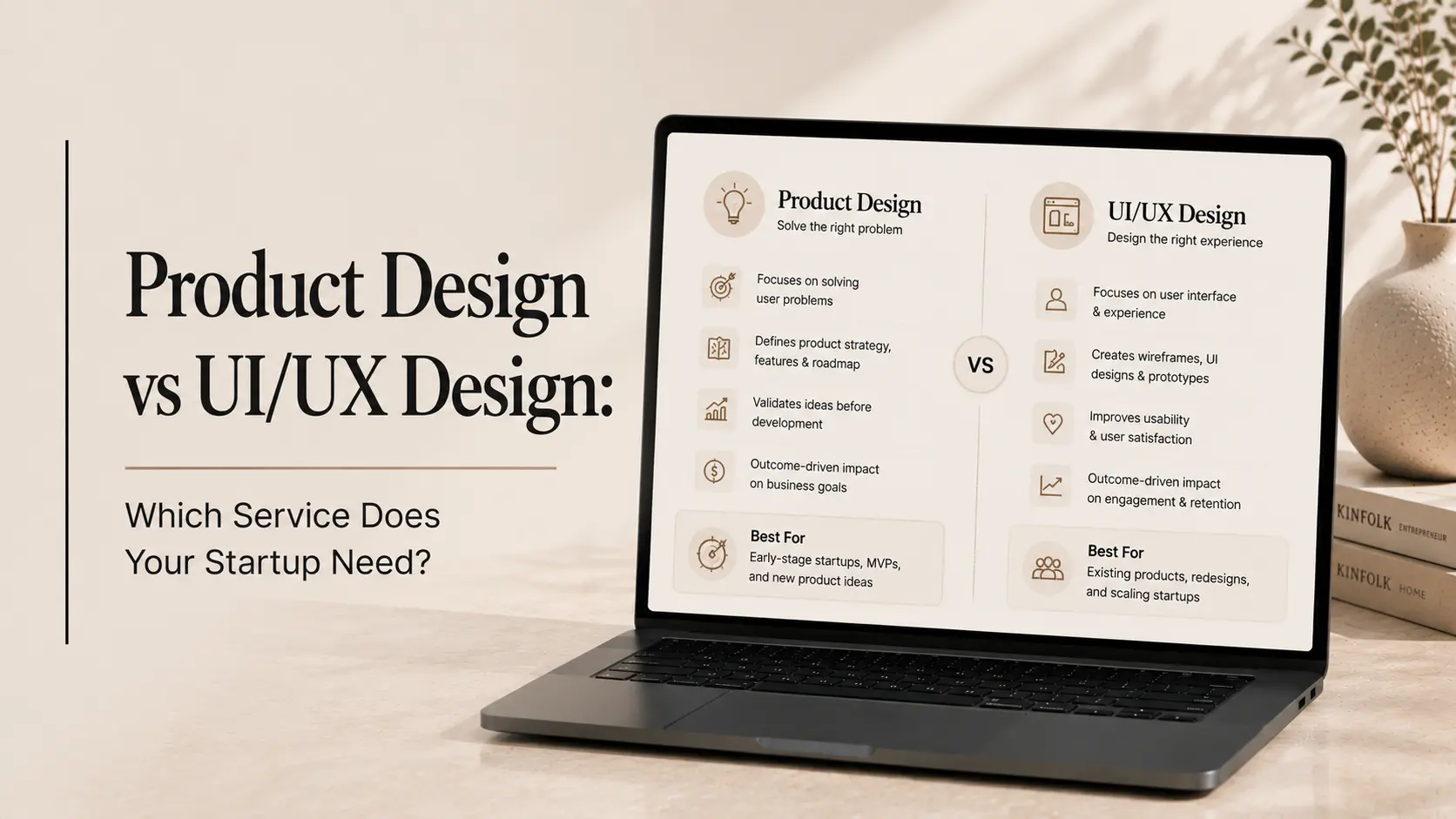
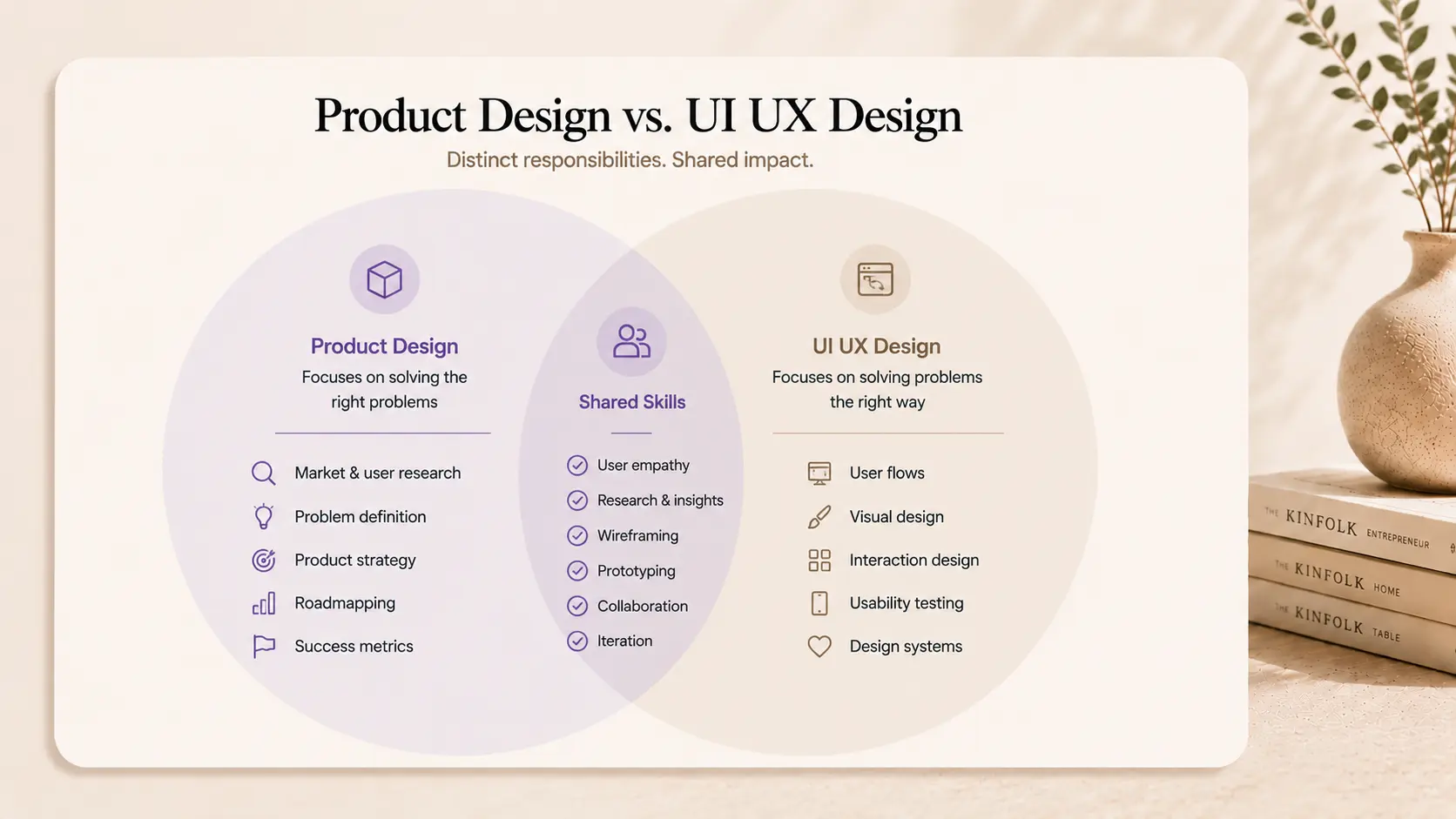
A UI/UX designer focuses on how a product looks and feels. They think about screens, flows, interactions, and whether users can easily do what they came to do. The output is wireframes, prototypes, user flows, and polished interface designs.
A product designer does all of that, but also zooms out further. They think about why the product exists, whether it solves the right problem, how it fits the market, and how design decisions connect to business outcomes. They're thinking about the whole system, not just the screens.
In smaller startups, one person often wears both hats. In larger companies, these are separate roles with distinct responsibilities. Understanding the difference between product design and UI/UX matters most when you're deciding who to bring in and at what stage.
What UI/UX Design Actually Covers
Let's start here because it's what most people are more familiar with.
UX Design: The Experience Side
UX stands for user experience. A UX designer's job is to make sure people can use your product without friction. They map out the journey a user takes, identify where things break down, and design flows that feel intuitive.
What a UX designer typically delivers
• User research, interviews, surveys, usability tests
• User personas and journey maps
• Information architecture, how content and features are organised
• Wireframes, low-fidelity layouts that map out structure
• Prototypes, clickable mockups to test flows before building
The core question a UX designer answers is: can users achieve their goals easily and without confusion?
UI Design: The Interface Side
UI stands for user interface. A UI designer takes the structure a UX designer has laid out and makes it visually polished. Typography, colour, spacing, icons, component states, animations, all of that lives in the UI layer.
What a UI designer typically delivers
• Visual design and style guides
• High-fidelity mockups ready for development
• Design systems and component libraries
• Responsive layouts across devices
• Micro-interactions and motion guidelines
In most agencies and studios, UX and UI work is done together. Separating them is more of an organisational distinction than a practical one at the startup stage.
What Product Design Actually Covers
Product design is a broader discipline. It includes everything UI/UX covers, but it sits at the intersection of user needs, business goals, and technical feasibility. That's actually the classic definition, a product designer is someone who balances all three.
The Extra Layers a Product Designer Brings
Where a UX designer asks "can users do this easily," a product designer also asks "should this feature exist at all" and "does building this move the business forward."
What a product designer typically delivers
• Product strategy and feature prioritisation input
• Competitive and market research
• Jobs-to-be-done frameworks and problem definition
• Full UX and UI design (they do this too)
• Alignment with engineering on feasibility
• Metrics-driven design, tying design decisions to conversion, retention, or activation
When people ask "what is the difference between product design and UX design," the honest answer is scope and seniority. Product designers think more systemically. They're invested in outcomes, not just outputs.
Side by Side: What Each Role Actually Does
Role Comparison at a Glance
Focus Area | Product Designer | UI/UX Designer |
Core question | Does this product solve the right problem? | Is this experience easy and pleasant to use? |
Works on | Full product lifecycle | Interface and interaction design |
Research type | Market, user, competitive | Usability, interaction, visual |
Key deliverables | Strategy docs, roadmaps, prototypes | Wireframes, flows, UI, style guides |
Thinking level | Business + system | User + interface |
When you need them | Pre-build and scaling stage | Build and improvement stage |
So Which One Does Your Startup Actually Need?
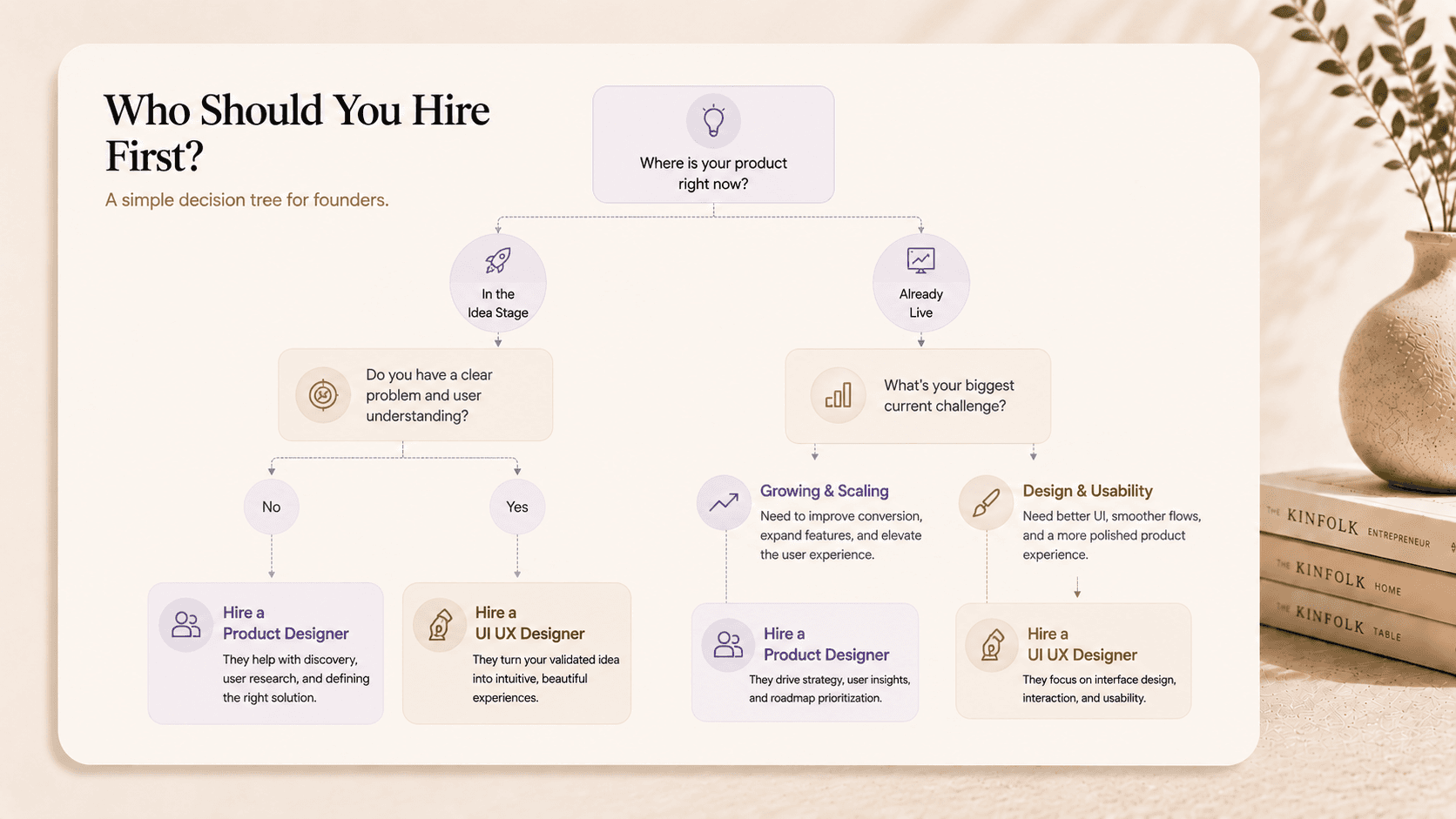
This is the question that really matters. And the answer depends on where you are right now.
Hire for Product Design When…
You're at an early stage. You have an idea, maybe some rough thinking, but you haven't validated the core problem yet. Or you're pivoting. Or you're scaling into a new market and need to rethink your product's positioning and feature set.
Product design is also the right call when your team is small and you need someone who can think strategically AND execute. Most early-stage startups can't afford to separate strategy from execution. A good product designer bridges that gap.
Specific scenarios for product design
• Pre-MVP stage, figuring out what to build and why
• Post-launch pivot, rethinking the product direction after early feedback
• Series A growth, aligning design with growth metrics
• Building a design system for scale
Hire for UI/UX Design When…
Your product exists. You have users. But the experience is rough, conversion is low, or users keep dropping off at a specific point. This is where a strong UI/UX designer does their best work.
UI/UX is also the right call when you have a clear product strategy already locked in and you need execution. You know what you're building. Now you need someone to make it clean, intuitive, and visually compelling.
Specific scenarios for UI/UX design
• App redesign where the structure is set but the experience needs work
• Onboarding improvements to reduce early drop-off
• Marketing website or landing page optimisation
• Design audit, identifying what's broken and fixing it
Not Sure Where You Fit? Use This
Quick Situation-to-Service Guide
Your Situation | What You Likely Need |
Idea stage, no product yet | Product Designer |
Product exists, users drop off | UI/UX Designer |
Scaling to new markets | Product Designer |
Redesigning existing interface | UI/UX Designer |
Building MVP in 30 days | Both (or a hybrid) |
App is live but feels 'off' | UI/UX Designer |
Pivoting direction entirely | Product Designer |
Wait, Don't They Just Overlap?
Yes. Quite a bit, honestly. And that's not a flaw in the system, it's just how design actually works in practice.
Most experienced product designers are strong at UI/UX. Most senior UI/UX designers think about product strategy whether it's in their job description or not. The lines blur, especially at smaller companies where designers wear multiple hats.
The distinction matters most when you're hiring or briefing an agency. Knowing the difference between product design and UX design tells you what questions to ask, what scope to define, and what outcomes to hold someone accountable to.
The Danger of Getting This Wrong
If you hire a UI/UX designer when you actually need product strategy, you'll end up with beautiful screens that solve the wrong problem. That's an expensive mistake.
On the flip side, if you bring in a product designer when all you really need is an interface refresh, you might pay for strategy work you didn't need and slow down execution.
Clarity on scope saves you time, money, and the frustration of a misaligned engagement.
How CREATEXP Thinks About This for Startups
At CREATEXP, this is probably the conversation we have most often with new clients. And the answer is rarely one-size-fits-all.
Founders who come to the studio at the idea stage usually need product design thinking first. Before anyone opens Figma, there's a conversation about what the product is solving, who it's for, and what success looks like in 90 days. That strategic layer is what separates a website or app that performs from one that just looks good.
When a startup has an existing product and needs a redesign, the approach shifts. The work becomes much more about research, usability, and interface execution. What is breaking in the current experience? Where are users leaving? What does the data say?
What makes this work is the in-house team structure. Designers, developers, and strategists working together from day one means the design decisions are always made in the context of what can actually be built, what the business needs, and what users will respond to. There's no hand-off gap between strategy and execution. Everything moves as one unit.
For startups specifically, the ability to move fast without losing quality is what matters. CREATEXP's structure, focused teams, no outsourcing, direct communication, is built around exactly that kind of engagement.
Still Not Sure What Your Startup Needs?
Tell us where you are and we'll tell you exactly what kind of design support makes sense.
Get a Free Design Consult
The Part Worth Bookmarking
Here's the condensed version if you want to come back to this quickly:
UI/UX design focuses on how people experience your product, flows, interactions, visual design, usability.
Product design includes all of that plus strategy, problem definition, prioritisation, and tying design to business outcomes.
The real difference between product design and UI/UX is scope: one is about the interface, the other is about the whole product system.
If you're pre-product or pivoting, start with product design. If your product exists and needs improvement, UI/UX design is likely what you need.
When to hire a product designer: early stage, strategic pivots, scaling phases, or when you need one person who can think and execute.
Most experienced designers blend both disciplines, the title matters less than the scope you define before engagement starts.
Getting the wrong type of designer is expensive. Clarity upfront saves you from beautiful work that misses the actual problem.
Questions That Come Up a Lot
What is the main difference between product design and UX design?
UX design focuses on how people interact with and experience a specific product or interface. Product design covers that same work, but also includes strategic thinking, why the product exists, what problems it should solve, and how design decisions connect to business goals. Think of UX as a subset of product design.
Can one designer do both product design and UI/UX?
Yes, and many do. At the startup stage especially, you'll find designers who handle the full spectrum, from strategy and research to wireframes and polished visual design. The more important question is whether the person you hire has the range and experience your specific stage requires.
When should a startup hire a product designer?
Hire a product designer when you're still figuring out what to build, when you're pivoting, or when you need someone who can bridge design strategy with execution. Early-stage startups particularly benefit from product design thinking because making the wrong product look great is still a failure.
Is UI/UX design enough for an MVP?
It depends on how validated your idea already is. If you've already done the strategic thinking and know what you're building, then yes, UI/UX design can take you from concept to a working MVP. If the product direction is still unclear, some product design thinking should come first.
How do I know if my startup needs a product design agency or a UX designer?
If you need end-to-end help, strategy, design, and development working together, an agency is usually more efficient than hiring individual contributors. Agencies with in-house, cross-functional teams are especially valuable for startups that need to move fast without sacrificing quality.
Do product designers write code?
Generally, no. Product designers focus on research, strategy, wireframes, prototypes, and visual design. Some have basic front-end knowledge, which helps with feasibility conversations, but coding is usually handled by developers. The value of a product designer is in their thinking, not their ability to ship code.
What's more important for a startup, product design or UI/UX design?
Both matter, but at different stages. In the early days, product design thinking is more critical, building the right thing matters more than making the wrong thing look polished. As your product matures, strong UI/UX design becomes the lever for growth, conversion, and retention.
Warning: Working With Us May Trigger Unstoppable Momentum