
SaaS Development
Trehan Sangpriya
CEO & Co-Founder

So you're building a SaaS product, or you're already running one, and someone on your team just said "we should switch to microservices." Now you're trying to figure out if that's the right call or just tech enthusiasm talking. Honestly? That's exactly the right question to be asking before you make the move.
Here's the thing I see constantly: teams jump to microservices because it's what Netflix does. What AWS recommends. What every architecture diagram on the internet seems to show. But Netflix has 1,000+ engineers. You probably don't. And the architecture decisions that make sense at that scale actively hurt you at early stage.
That said, and this is important, microservices architecture for SaaS is genuinely powerful when the timing is right. According to a CNCF survey, over 84% of organisations using microservices reported improved scalability and better deployment speed. Companies like Shopify, Stripe, and Slack all made the migration when the product and team were ready. The results were significant. The challenge is knowing when "ready" actually means ready.
Let me walk you through this properly, what SaaS microservices actually mean in practice, when they make sense, and how to avoid the mistakes that cost teams months of painful rework.
What Microservices Actually Means for a SaaS Product
Let's clear up the confusion first, because a lot of people think they understand this and don't quite.
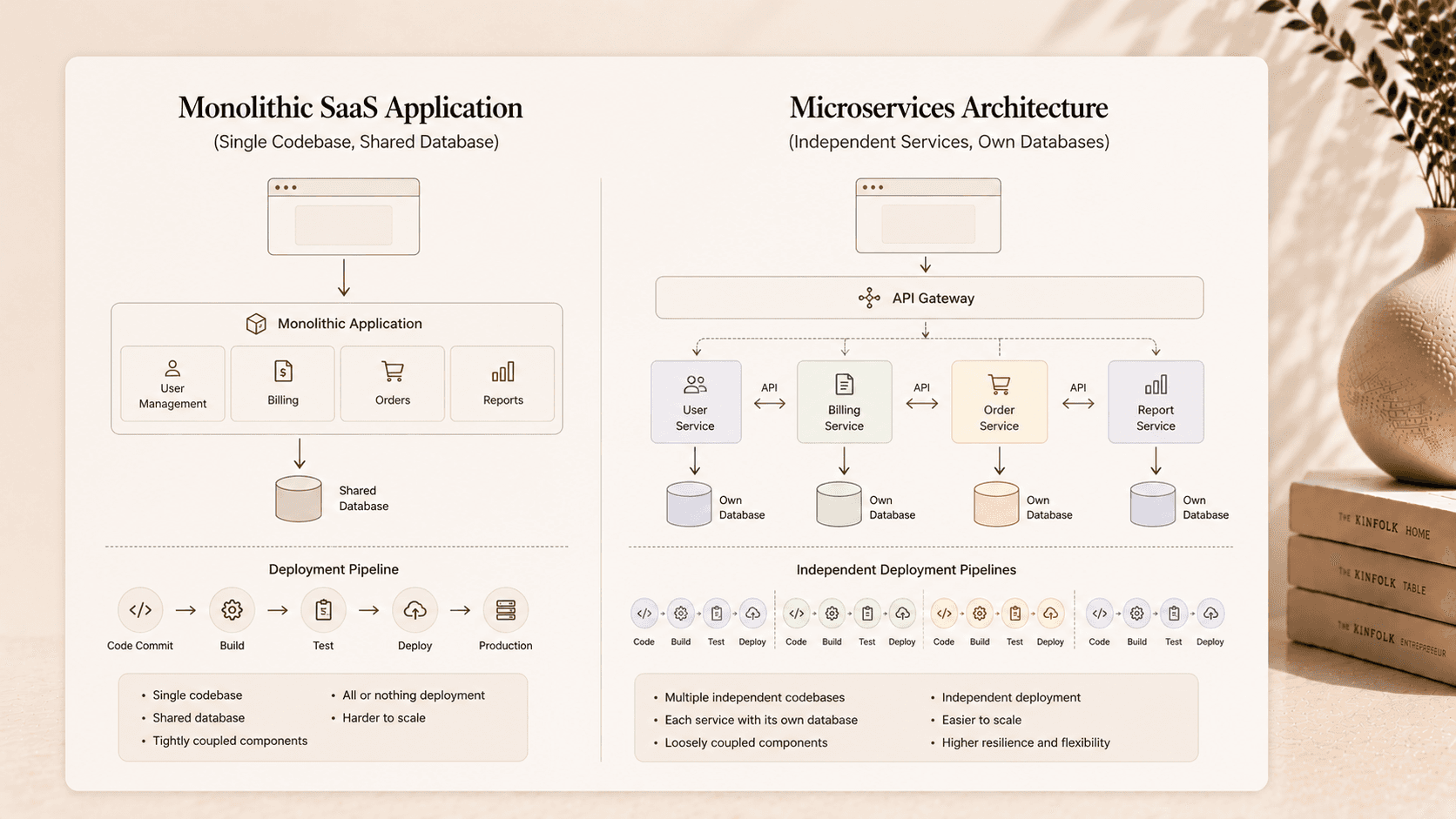
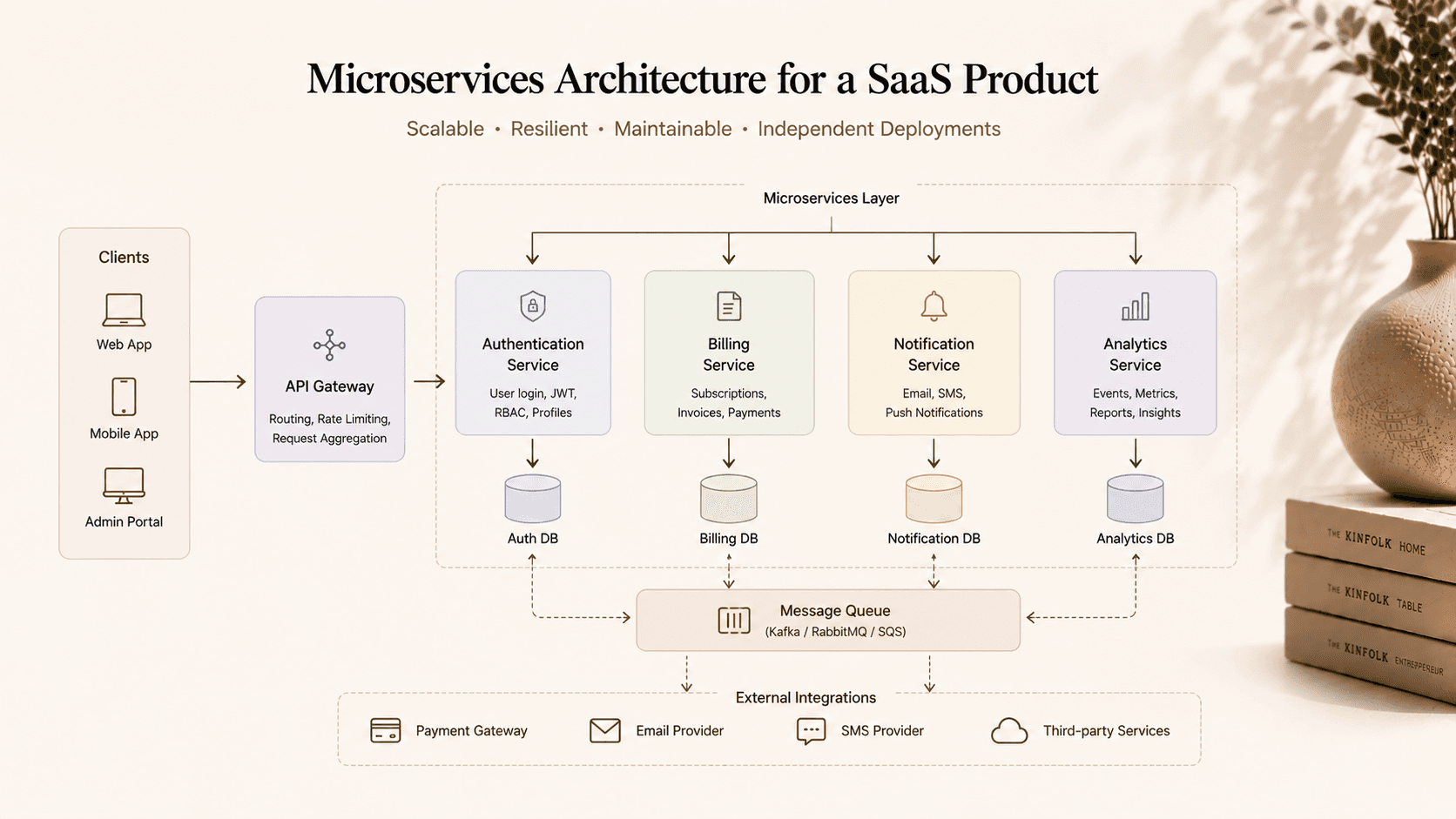
A microservices architecture means your SaaS application is split into many small, independent services, each one responsible for a specific business function. Your user authentication service runs separately from your billing service, which runs separately from your notification service, and so on. Each service has its own database, its own deployment pipeline, and its own scaling rules.
Compare that to a monolith, where all of that lives in one codebase, one database, one deployment. One repo, one deploy, one app. Simple to start, increasingly painful as it grows.
The practical difference looks like this:
In a monolith, if your email notification service has a memory leak, it can bring down the entire application. In a microservices setup, that service crashes in isolation. Everything else keeps running. Your customers can still log in, still manage their account, still process transactions, they just don't get that one email until the service restarts.
That isolation is real and valuable. But it comes with coordination overhead that a small team feels immediately.
Microservices vs Monolith for SaaS: The Honest Comparison
People treat this debate as settled. It isn't. Both architectures are valid. The right choice depends on where you are.
Factor | Monolith | Microservices |
|---|---|---|
Team size needed | 1–10 developers | 10+ (ideally, one team per service) |
Initial development speed | Fast | Slower (more infrastructure to set up) |
Deployment complexity | Simple | Complex (requires CI/CD, orchestration) |
Scalability | Limited (scale the whole app) | Fine-grained (scale only what needs it) |
Fault isolation | Poor (one failure can affect all) | Strong (failures are contained) |
Technology flexibility | Single stack | Each service can use different tech |
Debugging | Easier | Harder (distributed tracing required) |
Good starting point | Always | When the monolith is causing real pain |
The honest answer to "which is better" is: a monolith is almost always right to start with. A microservices architecture for SaaS makes sense when specific pain points in the monolith are costing you real money or real reliability.
When SaaS Microservices Actually Make Sense
This is where I want to be direct with you, because the timing question is where most teams get it wrong.
Signs Your Monolith Is Ready to Break Up
You're ready to seriously consider SaaS microservices when:
Deployments take forever and affect everything. You have to deploy the entire application every time anything changes. One team's feature blocks another team's release.
Different parts of the app have radically different scaling needs. Your analytics pipeline needs 10x the resources of your authentication service, but you're forced to scale them together.
Your team is large enough to own services independently. Microservices work best when you have dedicated teams, one team, one service. Below ~15 engineers, this creates more overhead than it's worth.
A single service failure is taking down unrelated functionality. You've had incidents where a billing bug caused login to break. That's a monolith problem that microservices solves.
You're working across multiple tech stacks or have legacy components to isolate. Microservices let you wrap and isolate the messy parts without rewriting everything.
When You Should Absolutely Not Switch Yet
You're pre-product-market fit and still changing your core domain model regularly
Your team is under 10 engineers
You don't have a CI/CD pipeline you trust completely
You haven't dealt with distributed systems failures before (they're very different from monolith failures)
The Core Benefits of SaaS Microservices, When They Apply
Let me give you the real benefits, not the marketing version.
Independent scaling. This is the one that matters most at scale. If your video processing service needs 50 instances during peak hours but your user management service needs two, you can scale them independently. In a monolith, you're spinning up the whole application. That's both expensive and wasteful.
Team autonomy. Each team owns their service, their database, their deployment, their tech choices. They can move faster without coordinating with other teams for every release. At scale, this is transformative. At small scale, it's overhead.
Resilience. A microservices SaaS product is harder to take down completely. Services fail, restart, and self-heal independently. If your CI pipeline is mature and your services are properly health-checked, you can achieve very high availability without heroic effort.
Technology flexibility. Your data processing service can use Python and Pandas. Your API gateway can use Node.js. Your search service can use Elasticsearch. In a monolith, everything uses the same stack. Microservices let you use the right tool for each job.
The Real Challenges Nobody Mentions (Enough)
Here's what I want you to know before you commit, because these surprises have derailed real projects.
Network failures are your new normal. In a monolith, function calls are fast and reliable. In microservices, everything is a network call. Network calls fail. You need retry logic, circuit breakers, timeouts, and fallback strategies everywhere. This is real complexity.
Distributed tracing is non-negotiable. When a request touches five services and something breaks, you need to know exactly where. Tools like Jaeger, Zipkin, or Datadog APM become essential. Without them, debugging is genuinely painful.
Data consistency gets hard. Each service has its own database. When a user changes their email, that change needs to propagate through every service that stores it. Eventual consistency is not the same as immediate consistency, and your users will notice the difference.
Service discovery and orchestration. Kubernetes has become the standard for running microservices. But Kubernetes has a learning curve that takes weeks to months to climb properly. Factor this into any migration plan.
How Createxp Approaches Microservices Architecture for SaaS
I want to be clear about something: we don't recommend microservices to every client who asks about it. That's not because we can't build it, it's because we know when it creates value and when it creates problems.
Createxp has built SaaS products at multiple scales. Some are clean monoliths serving tens of thousands of users perfectly well. Others are microservices architectures for products where independent scaling, team autonomy, and fault isolation were genuinely required.
The evaluation we run for every SaaS architecture decision:
Team size and structure. Can you staff independent service teams, or will microservices create context-switching overhead that slows everyone down?
Current pain points. Are you hitting specific scalability walls? Which services would genuinely benefit from independent deployment?
Infrastructure maturity. Do you have the CI/CD pipeline, monitoring, and on-call process to handle distributed systems failures?
Timeline and budget. Microservices migration takes longer and costs more upfront. The ROI is real, but it's a 12–18 month payoff timeline, not a 30-day one.
When microservices are right, we build them properly: API gateway, service mesh, distributed tracing from day one, individual service databases, and event-driven communication between services where appropriate. When a monolith is right, we build a well-structured monolith with clean boundaries that can be extracted to services later without a full rewrite.
That's the honest answer most clients don't hear often enough.
Your Architecture Should Solve Real Problems, Not Hypothetical Ones
Microservices are a solution to specific problems at specific scale. Build what your team can maintain. Solve the problems you actually have.
Key Takeaways
Start with a well-structured monolith. Migrate to microservices when the monolith is causing specific, measurable pain, not because microservices are modern.
Microservices architecture for SaaS makes sense when: teams are large enough to own services independently, scaling needs genuinely differ between services, and deployment coordination across teams is blocking releases.
The real benefits, independent scaling, fault isolation, team autonomy, only materialise when the team and infrastructure are mature enough to support them.
Distributed systems failures are fundamentally different from monolith failures. Build distributed tracing, circuit breakers, and retry logic from day one.
Data consistency across services is one of the hardest problems in microservices. Plan for eventual consistency and design your user experience accordingly.
Don't skip Kubernetes literacy. It's the standard orchestration layer for SaaS microservices and it takes real time to learn well.
Frequently Asked Questions
What are microservices in SaaS?
Microservices in SaaS means the application is split into small, independent services, each responsible for one business function (authentication, billing, notifications, etc.). Each service has its own database and deployment pipeline. Services communicate via APIs or message queues. This allows independent scaling and deployment of each component, and contains failures within individual services rather than bringing down the entire application.
Should a SaaS start with microservices or a monolith?
Almost always start with a monolith. A well-structured monolith is faster to build, easier to debug, and requires less infrastructure to operate. Microservices should be adopted when specific pain points in the monolith, deployment bottlenecks, scaling inefficiency, team coordination overhead, become real and costly. Netflix, Amazon, and Shopify all started as monoliths and migrated over time.
What are the main benefits of microservices for SaaS?
The main SaaS microservices benefits are: independent scaling (scale only the services that need it), fault isolation (one service failure doesn't take down the application), team autonomy (each team deploys their service independently), technology flexibility (use the right stack for each service), and higher availability through service-level health checks and self-healing.
What are the challenges of microservices architecture for SaaS?
The key challenges are: network failure handling (every service call can fail), distributed tracing complexity (debugging across services requires tooling), data consistency issues across separate service databases, significantly more complex CI/CD and orchestration infrastructure, and the need for larger, more specialised engineering teams to operate effectively.
Warning: Working With Us May Trigger Unstoppable Momentum