
SAAS Development
Trehan Sangpriya
CEO & Co-Founder
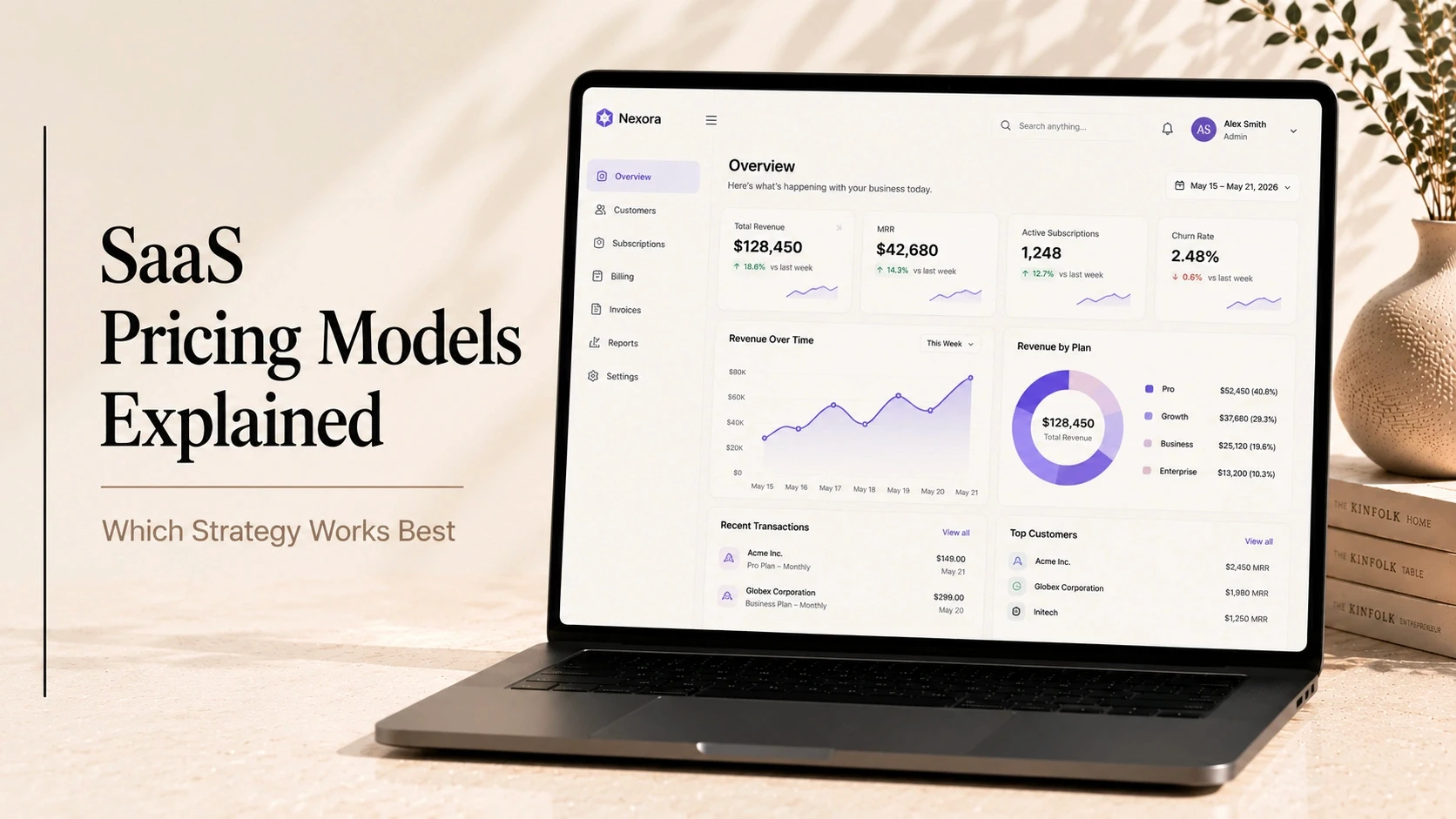
Pricing is the hardest product decision you'll make. Most founders get it wrong at least once. Some get it wrong multiple times before landing on something that works. And the reason it's so hard isn't the math, it's the fact that your pricing model communicates your value proposition, determines which customers you attract, and shapes how your revenue scales. Get it wrong and you leave money on the table. Get it catastrophically wrong and you price yourself out of the market entirely.
If you're here, you're probably at one of a few specific crossroads. Maybe you're launching your first SaaS product and staring at a blank pricing page. Maybe you're struggling to convert free users to paid. Maybe your growth has plateaued and you suspect pricing is part of why. Or maybe you're growing but your pricing model doesn't feel right for where the business is going.
Here's a useful starting point: according to Price Intelligently, pricing decisions are the highest-leverage decisions a SaaS company makes, more than acquisition or retention efforts combined. A 1% improvement in pricing yields an 11% increase in profit, versus a 1% improvement in acquisition yielding only a 3.3% profit improvement. Pricing strategy isn't a setup task you complete once. It's an ongoing lever.
This guide covers every major SaaS pricing model, how each works, who it's right for, and the real-world trade-offs involved. By the end, you'll have a clear framework for choosing the right model (or combination of models) for your product.
Why Your Pricing Model Matters More Than Your Price
Before comparing specific models, it's worth understanding why the model itself, not just the number, matters so much.
Your pricing model determines:
Who can buy: some models attract individuals, some attract enterprises, some lock out both
How revenue scales: some models scale linearly, some scale exponentially, some create a ceiling
What your salespeople say: a complex pricing model is a sales friction point
How customers perceive value: the metric you charge on communicates what you think your product is worth
A company that charges per seat is saying "the more people use this, the more it's worth." A company that charges per API call is saying "the more data you process, the more it's worth." Those are fundamentally different value statements. And if the metric you're charging on doesn't align with how your customers experience value, you'll fight conversion and churn forever.
The most important question in SaaS pricing is: What is the single metric that best correlates with the value customers get from your product?
Answer that question honestly, and the right pricing model becomes significantly clearer.
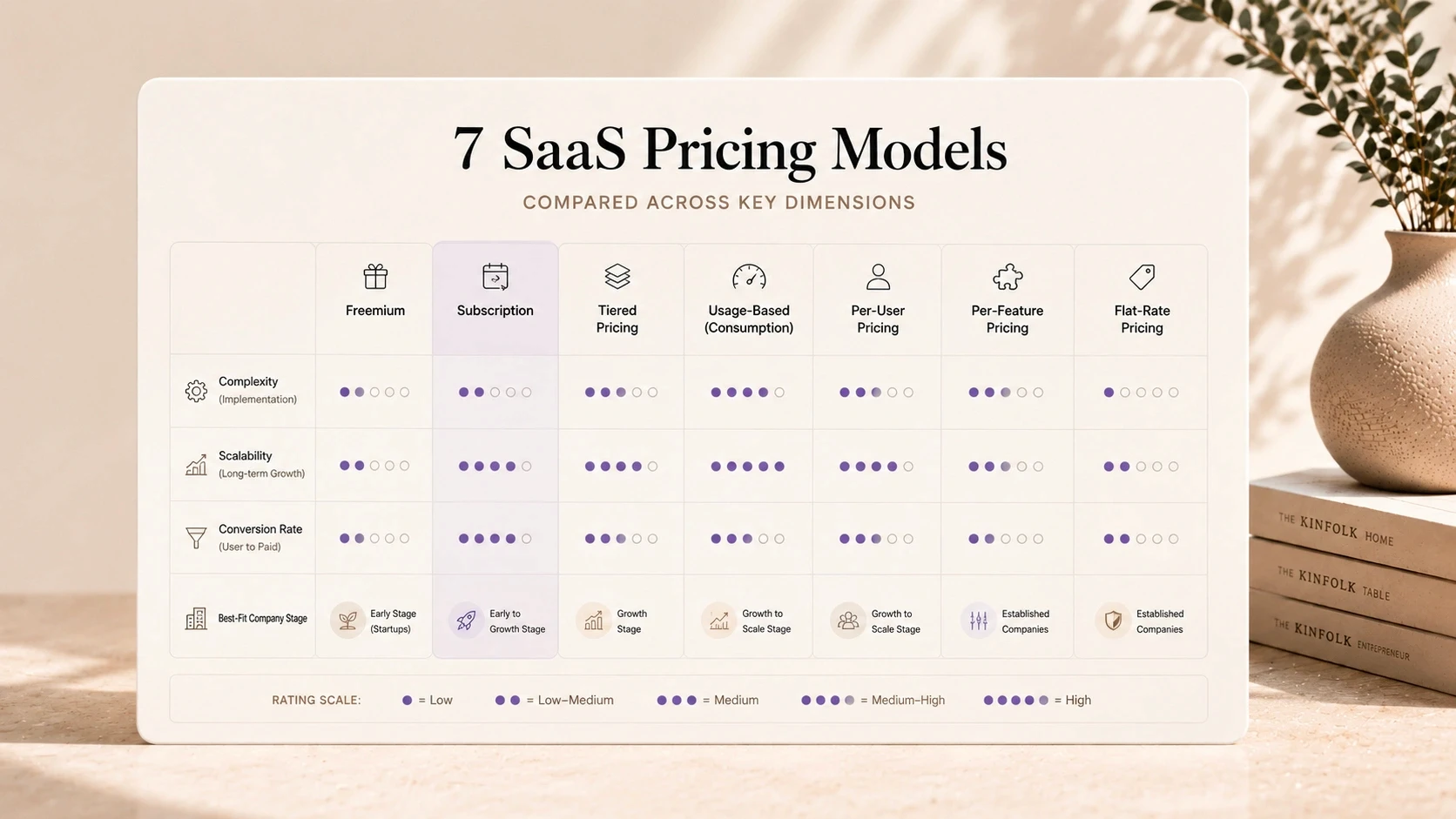
The 7 Major SaaS Pricing Models
Model 1, Flat Rate Pricing
What it is: One product, one price, one plan. Everyone pays the same amount. No tiers, no usage limits, no seat count.
Examples: Basecamp ($99/month for unlimited users)
How it works: Simple. You charge a fixed monthly or annual fee regardless of usage or team size. The product is the product, one version, one price.
Advantages:
Easiest to communicate and sell
No pricing page confusion
Predictable revenue for both you and your customer
Disadvantages:
Leaves money on the table, power users pay the same as light users
No natural upsell path
Hard to serve multiple market segments at different price points
Best for: Very focused, single-use-case products with a clearly defined customer segment. Rare in practice because most products serve multiple customer types at different value levels.
Model 2, Per-Seat (Per-User) Pricing
What it is: You charge a fixed amount per user per month. More users = more revenue.
Examples: Slack ($7.25/user/month), Notion ($8/user/month), most project management tools
How it works: Each seat on the account is billed separately. Team accounts scale with headcount.
Advantages:
Simple to understand and sell
Revenue grows naturally as customers grow their teams
Easy to track and calculate
Disadvantages:
Creates friction for adoption, customers may deliberately limit seats to control costs
Penalises you when team size doesn't correlate with value delivered
Encourages shared logins (which you can't fully prevent)
Best for: B2B tools where value clearly scales with number of users, project management, HR tools, communication platforms
The adoption problem: Per-seat pricing is the most common model but creates a specific problem. Customers resist adding seats to keep bills down. This limits product spread within an organisation and can slow the organic growth that drives expansion revenue.
Model 3, Usage-Based (Consumption) Pricing
What it is: You charge based on how much of the product the customer uses, API calls, messages sent, emails delivered, data processed, transactions completed.
Examples: Stripe (per transaction), Twilio (per message/call), AWS (per compute hour), Snowflake (per query)
How it works: Customers pay for what they actually use. Low usage months cost less. High usage months cost more.
Advantages:
Low barrier to start, aligns with "try before you pay" instinct
Revenue scales naturally with customer success
Fair for customers, they're only paying for what they use
Disadvantages:
Unpredictable revenue, difficult to forecast
High-volume customers may push for volume discounts
Need robust usage tracking and billing infrastructure
Best for: Infrastructure products, API businesses, and products where usage directly correlates with customer value
Usage-based pricing has grown significantly in the last five years. OpenView Partners' 2023 report found that usage-based pricing companies grew 38% faster than traditional seat-based SaaS companies. This model is increasingly popular, but it requires mature usage tracking infrastructure and a value metric that genuinely maps to customer outcomes.
Model 4, Tiered Pricing
What it is: Multiple plans at different price points, each with a different set of features, limits, or usage thresholds. The most common SaaS pricing structure in the market.
Examples: HubSpot (Free, Starter, Professional, Enterprise), Zapier (Free, Professional, Team, Enterprise)
How it works: You create 3–4 plans that serve different customer segments. Each tier offers more features, higher limits, or more seats than the one below.
Advantages:
Serves multiple customer segments from one pricing page
Natural upgrade path as customers grow
Can land customers cheap and expand revenue over time
Disadvantages:
Complex to design well, hard to draw the right boundaries between tiers
Customers may buy the lowest tier and never upgrade
Too many tiers create decision paralysis
The psychology of three plans: Research in pricing psychology consistently shows that three-tier pricing outperforms two or four tiers. The middle tier becomes the anchor, most customers choose it because it doesn't feel like either the "cheap" option or the expensive one. Design your plans so the tier you most want customers on is in the middle.
Best for: Products serving a range of customer segments from SMB to enterprise, where feature needs genuinely differ by company size
Model 5, Per-Feature Pricing
What it is: A base plan with individual features (or feature modules) sold as add-ons. Customers pay for the core product plus whatever additional capabilities they need.
Examples: Intercom (core + add-on modules for bots, surveys, articles)
How it works: The base plan covers fundamental functionality. Advanced features, often those that only specific customer types need, are priced separately.
Advantages:
Customers only pay for what they use
Can price premium features independently of the core product
Works well when different user types need very different feature sets
Disadvantages:
Complex pricing page that requires explanation
Can feel nickel-and-dime-ish if not positioned carefully
Hard to communicate total cost upfront
Best for: Products with genuinely modular feature sets where different customer types need different capabilities
Model 6, Freemium
What it is: A free tier with genuine functionality, designed to convert free users to paid over time.
Examples: Slack, Notion, Figma, Dropbox, Spotify
How it works: A meaningful subset of the product is free forever. Users who hit usage limits, need advanced features, or want team functionality upgrade to paid.
Advantages:
Massive top-of-funnel, low barrier to try the product
Product-led growth engine, users experience value before paying
Word-of-mouth amplifier, free users evangelize
Disadvantages:
High infrastructure cost to support free users
Many free users will never convert, requires careful cohort analysis
Can commoditise your product if free tier is too generous
The freemium conversion reality: Most freemium SaaS products convert between 2–5% of free users to paid. That means 95%+ of your free users will never give you money. The model only works when: (a) the lifetime value of converted users is high enough to justify the cost of the free tier, and (b) free users provide enough network effect or word-of-mouth to keep acquisition costs low.
Best for: Products with strong network effects, consumer SaaS, developer tools, and products where getting the product into users' hands accelerates viral growth
Model 7, Hybrid Pricing
What it is: A combination of models, typically per-seat plus usage-based, or tiered plus usage-based.
Examples: Intercom (per seat + message limits), Salesforce (per seat + storage usage), Datadog (infrastructure hosts + usage)
How it works: You charge on two dimensions simultaneously. A base charge (flat or per seat) plus a variable charge based on usage.
Advantages:
Captures both predictable base revenue and growth from usage
Reduces the revenue volatility of pure usage-based pricing
More accurately reflects multi-dimensional value delivery
Disadvantages:
More complex to communicate and sell
Billing is harder to build and explain to customers
Requires sophisticated usage tracking
Best for: Mature products serving enterprise customers where value is genuinely multi-dimensional. Not recommended as a starting model, earn this complexity.
How to Choose the Right SaaS Pricing Model
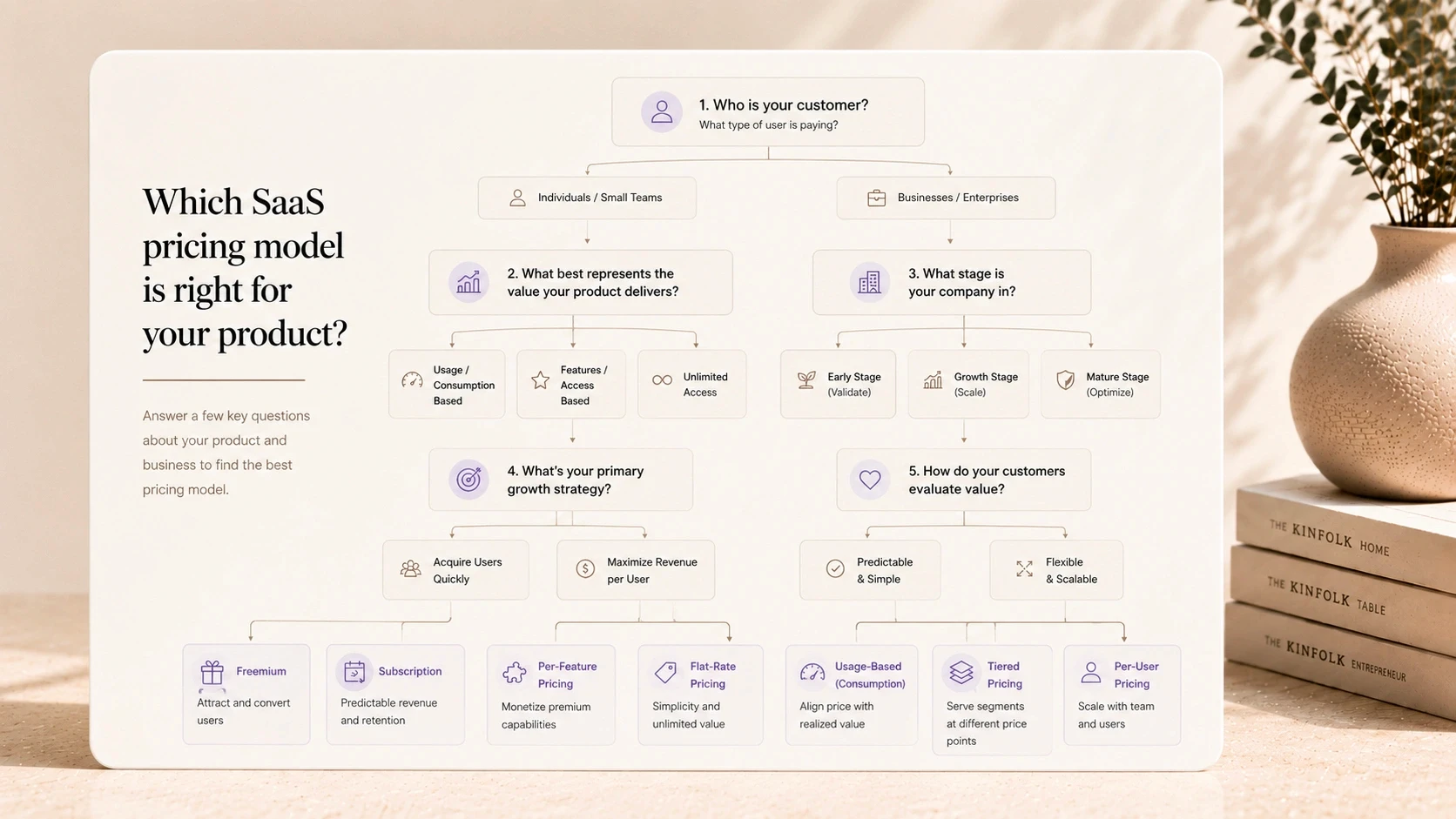
Here's a decision framework that cuts through the noise.
Question | Model Implication |
Does value scale with users? | Per-seat pricing |
Does value scale with usage/consumption? | Usage-based pricing |
Do you serve radically different customer segments? | Tiered pricing |
Do you need a PLG acquisition engine? | Freemium + upsell path |
Is your product highly modular? | Per-feature pricing |
Are you B2C or developer-focused? | Usage-based or freemium |
Are you enterprise B2B? | Tiered or hybrid |
A few additional principles:
Start simpler than you think you need to. A complex pricing model requires a sophisticated sales and billing infrastructure. Build complexity as you learn, not before you know what your customers value.
Your pricing model is a hypothesis. Test it. Run pricing experiments. Talk to churned customers about why they left. Talk to your best customers about what they'd pay for a tier above yours. Pricing is never finished.
Don't anchor on what competitors charge. Competitor pricing tells you what they think their product is worth, not what yours is worth.
How Createxp Thinks About SaaS Pricing in Product Builds
Pricing isn't a feature, but it might as well be. The way a SaaS product presents its plans, gates its features, and upgrades users has a direct impact on conversion, retention, and expansion revenue. And how the product is built has a direct impact on whether the pricing model you choose is even technically feasible.
Createxp has built SaaS products across multiple pricing architectures, usage-based billing with Stripe's metered billing API, tiered feature gating with role and plan-based access control, freemium products with conversion triggers built into the product flow, and hybrid models with dual-dimension billing.
Here's what the team has learned from building these systems:
Pricing decisions should be made before development starts. A product built without considering the pricing model often requires significant rework when pricing decisions are made later. Usage-based billing requires metering infrastructure. Tiered gating requires a plan management layer. These are architectural decisions that have to be planned for.
Feature gating is a product design challenge, not just a technical one. Where you put the paywall matters enormously. It needs to be at the point where users have experienced enough value to see the upgrade as worthwhile, not so early that they never get there.
Upgrade flows should be as frictionless as the initial checkout. A surprising number of SaaS products make signing up easy and upgrading painfully complicated. The in-product upgrade path deserves the same design attention as the pricing page itself.
Metered billing is harder than it looks. Usage tracking, billing period management, overage handling, and invoice generation for consumption-based models require robust infrastructure. Stripe's metered billing API handles much of this, but it still needs to be implemented correctly.
Annual plans need to be actively promoted, not just listed. Annual billing improves revenue predictability dramatically. But customers need a reason to choose annual over monthly, typically a 15–20% discount. Building the annual/monthly toggle prominently into the pricing experience drives materially higher annual plan adoption.
Whether you're designing a freemium product with a carefully crafted conversion funnel, a usage-based API product with metered billing, or a tiered SaaS with feature gates at each plan level, the technical architecture behind the pricing model is as important as the pricing strategy itself.
Your Pricing Model Is a Competitive Decision
Don't underestimate what your pricing model communicates. It tells customers what you think your product is worth, what kind of relationship you want with them, and whether their growth will be rewarded or penalised by working with you.
The right pricing model, built correctly into your product, is a growth engine. The wrong one is a friction point that costs you customers at every stage.
Build Your SaaS Pricing Architecture Right
Key Takeaways
Pricing model is more important than price point. A 1% improvement in pricing generates 3.5x more profit impact than a 1% improvement in acquisition.
The most important question in SaaS pricing: what single metric best correlates with the value customers get from your product? That answer should drive your model choice.
The seven main SaaS pricing models are: flat rate, per-seat, usage-based, tiered, per-feature, freemium, and hybrid. Each serves different value propositions and customer types.
Tiered pricing (3 tiers) is the most common model and works best when you serve multiple customer segments. The middle tier should be the one you most want customers on.
Freemium only works when free-to-paid conversion rates are high enough to offset the cost of the free tier, typically requires 2–5% conversion and high LTV on paid plans.
Usage-based pricing is growing rapidly and companies using it grow 38% faster than seat-based peers, but requires mature usage tracking infrastructure.
Start with a simpler pricing model than you think you need. Add complexity only as you learn what customers actually value.
Pricing architecture is a technical decision as much as a strategic one. Feature gating, metered billing, and upgrade flows need to be planned into the product from the beginning.
Frequently Asked Questions
What are the main SaaS pricing models?
The seven main SaaS pricing models are: flat rate (one price for everyone), per-seat (charge per user), usage-based (charge per unit of consumption), tiered (multiple plans at different prices), per-feature (base plan with add-ons), freemium (free tier with paid upgrade), and hybrid (combining two models). Most SaaS companies use tiered pricing or a combination of per-seat and usage-based.
How do I choose a pricing model for my SaaS?
Start by identifying your value metric, the single thing that most clearly correlates with the value customers get from your product. If value scales with users, per-seat pricing is natural. If value scales with consumption, usage-based pricing makes sense. If you serve very different customer segments, tiered pricing fits best. If you need organic growth through free users, freemium is worth considering.
What is usage-based pricing in SaaS?
Usage-based pricing (also called consumption pricing) charges customers based on how much of the product they actually use, API calls, data processed, messages sent, transactions completed. Customers pay more when they use more, and less when usage is low. It's growing rapidly in SaaS, particularly for infrastructure products, APIs, and developer tools, because it aligns cost with customer success.
Is freemium a good SaaS pricing strategy?
Freemium works well when: your product has strong network effects, the cost of serving free users is low relative to LTV of converted users, and the free experience creates enough value that some percentage (typically 2–5%) naturally upgrades. It doesn't work when free users cost too much to serve, or when the value proposition isn't strong enough to drive voluntary upgrades.
What is the most common SaaS pricing model?
Tiered pricing is the most common SaaS pricing model, multiple plans (usually three) at different price points with different feature sets or usage limits. It's popular because it allows a single product to serve multiple customer segments: individuals or small teams on the entry tier, growing teams on the middle tier, and enterprises on the top tier.
How much should I charge for my SaaS product?
Price based on the value you deliver, not on your costs or what competitors charge. Research what outcomes your product creates for customers and what a fraction of that value looks like as a monthly fee. A SaaS product that saves a business 10 hours per month at $100/hr could reasonably charge $100–$200/month for a single user. Most founders undercharge by 20–50% because they're pricing from their own perspective, not their customer's.
What is the difference between tiered pricing and per-seat pricing?
Per-seat pricing charges a fixed amount per user, more users means a proportionally higher bill. Tiered pricing creates defined plans at different price points, where moving from one tier to the next changes the price non-linearly and adds features or capabilities. Many SaaS products combine both: per-seat pricing within each tier, with feature sets that differ between tiers.
Warning: Working With Us May Trigger Unstoppable Momentum