
SAAS Development
Saket Khare
CTO & Co-Founder
You’ve got the idea. You’ve validated it enough to know you want to build. Now you’re staring at a blank page trying to figure out what this thing should actually be built with, and the internet is giving you seventeen contradictory opinions. React or Next.js? Postgres or MongoDB? Node or Python? AWS or Vercel? It’s a lot. And honestly, making the wrong call here can cost you months of rework later.
This is the guide I wish existed when founders first ask that question. Not “here’s every option that exists”, but “here’s what actually works, why it works, and what the real trade-offs are.”
Here’s some useful context first. According to a survey by Stack Overflow, over 63% of professional developers use JavaScript as their primary language, and frameworks like React and Node.js dominate production environments. That’s not a coincidence, it’s a signal about where the talent pool, the tooling, and the community support are strongest. Your SaaS tech stack choices don’t happen in a vacuum. They affect how fast you can hire, how easily bugs get fixed, and how much help you can find at 2am when something breaks.
This guide covers the full SaaS technology stack layer by layer, frontend, backend, database, infrastructure, and the third-party services that handle the pieces you shouldn’t build yourself. By the end, you’ll have a clear picture of what to use, when to use it, and what to avoid.
Why Your Tech Stack Decision Matters More Than You Think
Let me say something that might sound counterintuitive: the best tech stack for a SaaS product is almost never the most technically impressive one. It’s the one that:
Gets you to a working product fastest
Your current team (or the team you can hire) knows well
Has a strong ecosystem of libraries and tooling
Scales without a complete rewrite when you grow
The graveyard of failed startups is full of products built on clever architectures that nobody could maintain, hire for, or debug quickly. Keep this in mind throughout everything that follows.
Layer 1, Frontend: What Your Users See
The frontend is your product’s face. For SaaS, it needs to be fast, interactive, and maintainable over time.
React or Next.js, The Practical Choice
The honest answer to “what frontend framework should I use for SaaS?” is almost always React or Next.js.
React is the dominant component-based UI library. It has the largest ecosystem, the most tutorials, the most hiring pipeline, and the most available third-party component libraries (shadcn/ui, Radix, MUI, Tailwind UI). If you’re building a dashboard-heavy SaaS app, React is your foundation.
Next.js wraps React and adds server-side rendering, static generation, and file-based routing. For SaaS products where your marketing site and app live on the same domain, Next.js is excellent. It handles SEO better than pure React and has become the de facto standard for full-stack JavaScript applications.
What About Vue or Angular?
Vue is a solid alternative, simpler learning curve, slightly smaller ecosystem. It’s a valid choice if your lead developer prefers it. Angular is more common in enterprise environments and comes with a steep learning curve. For most early-stage SaaS products, it’s overkill.
Styling
Use Tailwind CSS. It’s fast to work with, consistent, and has near-universal adoption in modern SaaS development. Pair it with a component library (shadcn/ui is the current favourite) and you can build polished, professional interfaces without a dedicated UI designer.
Layer 2, Backend: Where Your Logic Lives
Your backend handles the core business logic, authentication, data processing, and API communication. This is where technical decisions have the most downstream impact.
Node.js (with Express or NestJS)
Node.js is the most common backend choice for early-stage SaaS, and for good reason. JavaScript everywhere means your frontend and backend developers share a language. The npm ecosystem is enormous. Hiring is easier than for almost any other backend runtime.
Express is minimal and flexible, good for teams who want control. NestJS adds structure and opinions on top of Express, good for teams who want a more scalable, maintainable architecture from the start. If you’re building something that will have a team of three or more developers, NestJS is worth the initial setup overhead.
Python (Django or FastAPI)
Python is the right choice when your SaaS product involves significant data processing, machine learning, or AI features. Django is a full-stack framework with batteries included, ideal for content-heavy or data-heavy applications. FastAPI is newer, faster, and excellent for API-first architectures.
If you’re building an AI-enabled SaaS product, Python is likely your best SaaS development stack choice for the backend layer.
What About Ruby on Rails?
Rails has a reputation for being “old”, and it’s not entirely fair. It’s still an excellent choice for fast-moving early-stage products. Convention over configuration means less boilerplate and faster initial development. Several successful SaaS businesses (GitHub, Shopify, Basecamp) were built on Rails and scaled successfully. The trade-off: a smaller talent pool compared to Node.js.
Layer 3, Database: Where Your Data Lives
The database is the most consequential technical decision in your SaaS stack. Getting it wrong means either a painful migration later or performance problems at scale.
PostgreSQL, The Default Choice
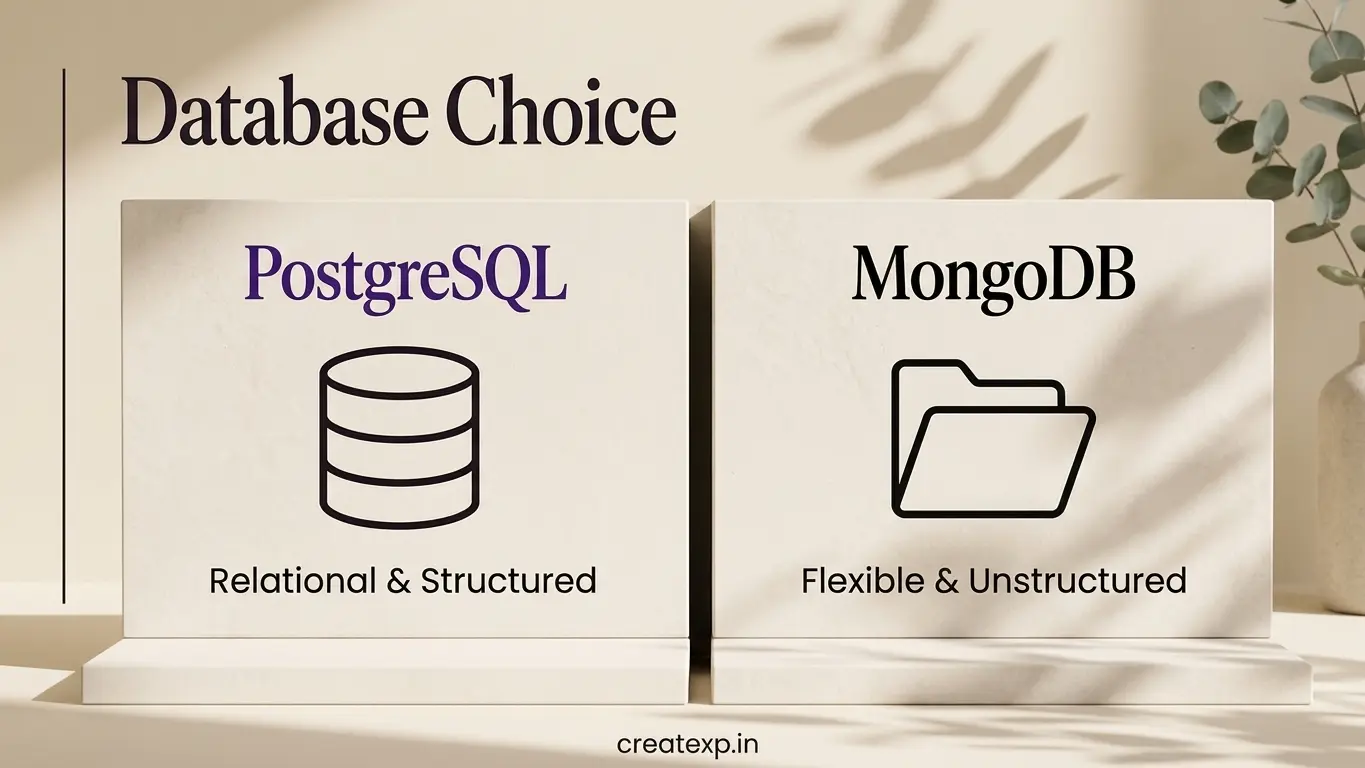
For most SaaS products, PostgreSQL is the right answer. It’s relational, battle-tested, handles complex queries efficiently, supports JSON natively, and has a massive community. If you don’t have a specific reason to use something else, use PostgreSQL.
It scales well to tens of millions of rows. For most SaaS products, it handles everything through the entire growth journey without a database change.
MongoDB
MongoDB makes sense when you have genuinely unstructured or highly variable data, user-generated content, flexible document schemas, or data models that change frequently. It’s not inherently faster or better than PostgreSQL, it’s different. The right tool for the right problem.
For most SaaS products: PostgreSQL first, MongoDB only when the use case specifically calls for it.
Redis, The Performance Layer
Redis isn’t your primary database. It’s your caching and real-time layer. Use it to:
• Cache expensive database queries
• Store session data
• Power real-time features (notifications, activity feeds)
• Handle rate limiting
Add Redis to your stack when you start seeing performance pressure on your database, not before.
Layer 4, Authentication
Don’t build authentication from scratch. This is one of the most important pieces of advice for any SaaS founder. Auth is complex, security-critical, and endlessly time-consuming to build and maintain correctly.
The best options in 2026:
Service | Best For | Pricing Model |
Clerk | Modern SaaS, great DX, React native | Per monthly active user |
Auth0 | Enterprise, complex requirements | Per monthly active user |
Supabase Auth | Supabase-first stacks | Included with Supabase |
NextAuth.js | Next.js projects, self-hosted | Free / open source |
Firebase Auth | Firebase stacks | Free up to limits |
Clerk has become the favourite for new SaaS builds in 2026, excellent developer experience, beautiful pre-built UI components, and built-in organisation management for B2B SaaS.
Layer 5, Billing and Subscriptions
If you’re building a SaaS product, Stripe is the only answer worth discussing. It handles everything:
Monthly and annual subscriptions
Trial periods and freemium tiers
Metered usage billing
Failed payment recovery (dunning)
Tax handling across geographies
Self-service customer portal
The Stripe billing portal alone saves weeks of custom development. Use it from day one. The transaction fees (0.5–0.8% on top of payment processing for Stripe Billing) are worth every cent compared to building equivalent functionality.
Layer 6, Infrastructure and Hosting
Where you run your SaaS product determines your reliability, your latency, and your operational overhead.
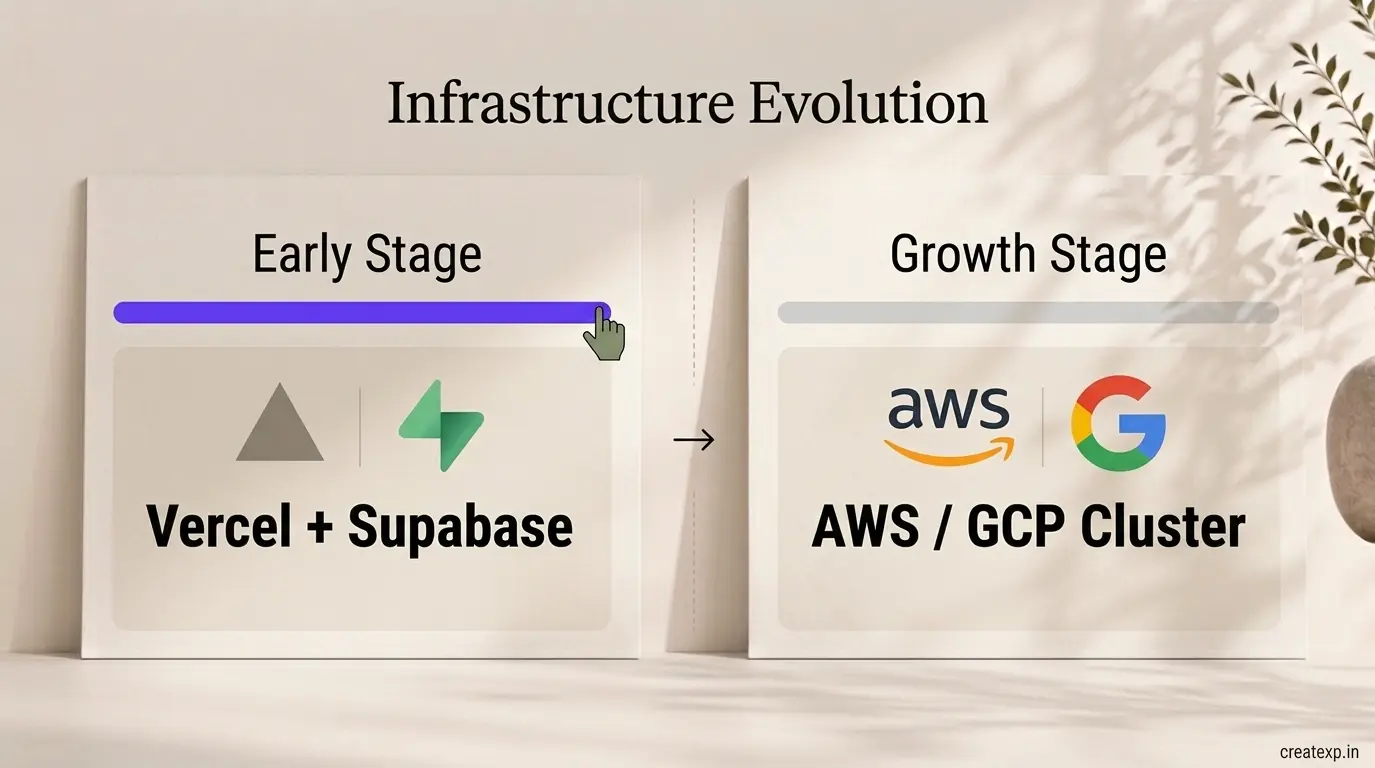
Early-Stage: Prioritise Developer Experience
For most early-stage SaaS products, the goal is getting to market fast with minimal DevOps overhead. These platforms handle most of the infrastructure complexity for you:
Vercel, Ideal for Next.js frontends. Automatic deploys, edge functions, global CDN. Free to start.
Railway, Full-stack deployments with managed databases. Simple, affordable, fast to set up.
Render, Similar to Railway. Good for Node.js backends, PostgreSQL, Redis.
Supabase, PostgreSQL + auth + storage + real-time subscriptions as a managed service. Excellent for early-stage products.
Growth Stage: Move Toward AWS, GCP, or Azure
As your product scales, managed cloud platforms give you more control, more services, and more granular cost optimisation. The trade-off is significantly more complexity and DevOps skill requirements.
Don’t rush to AWS in the early stage. The productivity cost of managing infrastructure before you’ve validated your product is not worth it.
Layer 7, The Must-Have Third-Party Services
This is where experienced SaaS builders save enormous amounts of time. These services handle critical functions you shouldn’t build from scratch.
Category | Recommended Tools | Why |
Email delivery | Resend, Postmark, SendGrid | Reliable deliverability, templates |
Transactional email | Resend | Modern API, React Email integration |
Product analytics | Mixpanel, PostHog | User behaviour, funnel analysis |
Error monitoring | Sentry | Real-time error tracking and alerts |
Logging | Datadog, Logtail | Application and infrastructure logs |
Feature flags | LaunchDarkly, Statsig | Safe deployments, A/B testing |
Customer support | Intercom, Crisp | In-app chat, helpdesk |
Search | Algolia, Typesense | Fast, relevant search without building it |
File storage | AWS S3, Cloudflare R2 | Scalable, cheap object storage |
Don’t add all of these on day one. Add them when you need them.
The Starter SaaS Tech Stack (Recommended for Most Founders)
If you’re starting a new SaaS product and want a proven, modern foundation, here’s the stack that covers most needs:
📦 Recommended Starter SaaS Stack |
Frontend: Backend: Database: Auth: Billing: Hosting: Email: Monitoring: |
This stack is fast to build with, well-documented, easy to hire for, and scales cleanly through the early growth stages of most SaaS products. It’s not the only valid stack, but it’s the one that optimises for building fast while avoiding the most common early-stage pitfalls.
How Createxp Builds SaaS Products
Building a SaaS product is one thing. Building one that scales, performs, and doesn’t become a maintenance nightmare six months in is another.
Createxp has worked with founders across industries, fintech, edtech, logistics, productivity, and B2B services, to take SaaS ideas from brief to production. The patterns that work consistently are the same ones this guide describes: modern, proven, hire-able stacks.
Here’s what the Createxp approach adds to the technical foundation:
Architecture Before Code
Every SaaS build starts with a technical architecture session. Database schema, API structure, auth flows, third-party integrations, and infrastructure plan are all defined before a line of code is written. Decisions made here save weeks of costly refactoring later.
SaaS-Specific Patterns Built In
Multi-tenancy, role-based access control, subscription management, usage metering, and onboarding flows are built into the architecture from the start. Not bolted on as an afterthought when the business need appears.
Performance Tested, Not Assumed
Load testing, query optimisation, and caching strategies are part of the build process, not something addressed when the first complaint arrives. A SaaS product that handles 100 users reliably should be designed from the beginning to handle 10,000.
Clean Handover
Every project is documented. The client’s internal team or future developers can extend the codebase without starting from scratch. Createxp doesn’t create dependency, it creates a foundation.
Createxp has delivered SaaS products built on the same technology stack principles outlined in this guide. The proof is in the products that are still running, still scaling, and still being extended years after delivery.
Your SaaS Stack Deserves a Solid Foundation The stack you choose now determines how fast you build, how easily you hire, and how painlessly you scale. |
Key Takeaways
The best SaaS tech stack is the one your team knows, the market supports, and that scales without a rewrite, not the most technically impressive one.
Next.js + PostgreSQL + Clerk + Stripe covers the core needs of most SaaS products and is the most commonly recommended starter stack in 2026.
Don’t build authentication or billing from scratch. Use Clerk or Auth0 for auth, and Stripe for subscriptions, every time.
PostgreSQL is the right database default for most SaaS products. Add Redis for caching when performance demands it. Use MongoDB only when your data model specifically requires it.
Start on Vercel + Railway + Supabase. Move to AWS/GCP when your scale requires more control, not before.
Python is the right backend choice for AI-enabled or data-heavy SaaS. Node.js is the right choice for everything else.
Third-party services (Sentry, Resend, Mixpanel, Algolia) save weeks of development time. Add them as you need them, not all at once.
Frequently Asked Questions
What is the best tech stack for a SaaS product?
For most founders in 2026, the best SaaS tech stack is Next.js (frontend), Node.js or Next.js API routes (backend), PostgreSQL (database), Clerk (auth), and Stripe (billing), hosted on Vercel and Railway or Supabase. This combination is fast to build, well-documented, easy to hire for, and scales well through early growth stages.
Should I use React or Next.js for my SaaS?
Next.js is generally the better choice for SaaS products. It includes everything React offers but adds server-side rendering, better SEO, file-based routing, and full-stack capabilities in a single framework. For most SaaS products, especially those with a public marketing site and an authenticated app, Next.js covers both without needing separate frameworks.
What database should I use for a SaaS product?
PostgreSQL is the right default for most SaaS products. It’s relational, scalable, supports complex queries, and has excellent hosting options through Supabase and Railway. MongoDB is a valid choice for unstructured or highly variable data. Redis is used alongside your primary database for caching and real-time features, not as a replacement.
Do I need to build authentication myself for my SaaS?
No, and you shouldn’t. Authentication is security-critical and time-consuming to build correctly. Services like Clerk, Auth0, and Supabase Auth handle auth, session management, multi-factor authentication, and organisation management out of the box. Using one of these saves 2–4 weeks of development and significantly reduces security risk.
What is a SaaS development stack?
A SaaS development stack is the combination of technologies used to build a software-as-a-service product, typically including a frontend framework, backend runtime, database, authentication service, billing system, hosting platform, and monitoring tools. The stack defines how the product is built, how it performs, and how easily it can be maintained and scaled.
When should I move from Vercel/Railway to AWS?
Move to AWS, GCP, or Azure when your product has specific infrastructure requirements that managed platforms can’t meet, typically around custom networking needs, regulatory compliance, very high-volume workloads, or when infrastructure costs on managed platforms become significantly higher than self-managed cloud alternatives. For most SaaS products, that threshold is somewhere between $10,000–$50,000/month in revenue.
What tech stack do most SaaS companies use?
According to usage data and developer surveys, the most common SaaS technology stack combines React or Next.js on the frontend, Node.js or Python on the backend, PostgreSQL as the primary database, Stripe for billing, and AWS or Vercel for hosting. This pattern holds across startups and established SaaS companies because it balances developer productivity, ecosystem support, and scalability.
Warning: Working With Us May Trigger Unstoppable Momentum