
E-commerce Development
Saket Khare
CTO & Co-Founder
You’re about to launch an online store, or rebuild one that’s outgrown its current setup. And the first real decision you face is the platform. Shopify, WooCommerce, or just build something custom from the ground up. Everyone has a strong opinion. Your developer says custom. Your marketing friend says Shopify. A blog post you read last week made a convincing case for WooCommerce. Now you’re more confused than when you started.
Let’s fix that.
The global e-commerce market hit $6.3 trillion in 2024 and is still climbing. Shopify alone powers over 5.6 million online stores across 175 countries. WooCommerce runs on roughly 6.6 million active websites, making it the single most-used e-commerce plugin on the internet. And custom e-commerce quietly powers every store you’ve ever shopped at that felt completely different from the rest. All three are real, proven options, the question is which one fits your business.
This guide does something most comparisons don’t: it tells you the honest truth about where each platform excels, where it falls apart, and which type of business genuinely belongs on each one. By the end, you’ll know exactly which direction to take, and why.
Before You Compare: What Actually Matters in an E-Commerce Platform
Most people jump straight to feature comparisons. That’s backwards. The platform that wins on features doesn’t automatically win for your business.
Here’s what actually determines which platform is right for you:
Your product type, physical goods, digital products, subscriptions, services, or a mix
Your technical resources, do you have an in-house dev team, or will a freelancer manage it?
Your growth trajectory, where will you be in two years?
Your customisation needs, standard checkout or something unique to your business model?
Your budget, both upfront and ongoing
Answer those five questions honestly before reading the rest. They’re the filter that makes the decision obvious.
🟢 Shopify: The Platform That Gets Out of Your Way |
What Shopify Does Brilliantly
Shopify’s core value proposition is simple: you focus on selling, the platform handles everything else.
Hosting is included. No servers, no infrastructure headaches, no managing uptime.
Payments work immediately. Shopify Payments is built in. No separate payment gateway setup.
Apps handle the gaps. The Shopify App Store has 8,000+ apps covering loyalty, reviews, upsells, bundles, subscriptions, and more.
Speed to launch is unmatched. A functional, well-designed Shopify store can go live in under two weeks.
Support is always there. 24/7 live support is included on all plans. When something breaks, help is available.
Shopify’s Real Weaknesses
Transaction fees unless you use Shopify Payments. Shopify charges 0.5–2% on every transaction with a third-party gateway. On $100,000/month in sales, that’s $500–$2,000/month.
Customisation has a ceiling. Shopify’s Liquid template language has limits. Genuinely unique checkout flows or deeply custom product logic require workarounds.
App costs compound. Most stores need 10–20 paid apps at $15–$50 each per month. That’s $150–$1,000+/month in app spend.
You don’t own the platform. Shopify controls pricing, terms, and feature availability. Price increases and policy changes happen, and you adapt or leave.
Shopify Is Right For You If:
You’re launching a new store and need speed
You’re selling physical products through a standard sales model
You don’t have technical resources to manage infrastructure
You’re a DTC brand focused on marketing, not engineering
You’re targeting revenue under $5M/year where the simplicity premium is worth it
🟣 WooCommerce: The Flexible Choice for WordPress-First Businesses |
What WooCommerce Does Well
Full ownership. Your site, your data, your code. No platform lock-in.
Unlimited customisation. Because it’s WordPress + PHP, you can build anything. No Liquid limitations, no API restrictions.
Content and commerce together. If content marketing is a core part of your strategy, WooCommerce integrates seamlessly with a content-rich WordPress site.
Plugin ecosystem. 59,000+ WordPress plugins plus dedicated WooCommerce extensions give you access to virtually any functionality.
Cheaper at scale. No transaction fees. No per-seat pricing. As your revenue grows, WooCommerce’s cost stays relatively flat.
WooCommerce’s Real Weaknesses
You manage everything. Hosting, security, updates, backups, it’s all on you or your developer.
Performance requires work. WooCommerce on cheap shared hosting is slow. Good Core Web Vitals scores require a proper managed host, caching, and a CDN.
Plugin dependency is real. Adding functionality through plugins introduces security risks and compatibility issues. A site with 30 plugins is a maintenance project.
No built-in support. WooCommerce support is community-based. When something breaks, you’re Googling and waiting for forums.
WooCommerce Is Right For You If:
You already have a substantial WordPress presence
Content marketing and organic SEO are core to your acquisition strategy
You have technical resources to manage the platform
You want full ownership with no vendor lock-in
You’re scaling past $2–3M/year where transaction fees and app costs make Shopify increasingly expensive
🔶 Custom E-Commerce: When Neither Platform Is Enough |
When Custom Is the Right Answer
Custom e-commerce is right when your business model doesn’t map onto standard platform assumptions. Specifically:
Complex product configuration. Furniture customisers, made-to-order products with dozens of variables, B2B configure-price-quote tools, none of these work cleanly on Shopify or WooCommerce.
Unique checkout logic. Multi-step checkouts, custom quote flows, subscription models with complex billing rules, or checkout flows integrated with external fulfilment systems.
Multi-vendor marketplaces. Running a marketplace where multiple sellers list products and payouts are split? Neither Shopify nor WooCommerce handles this well natively.
Tight ERP or inventory integration. Enterprise businesses with real-time multi-warehouse inventory, or deep integration with SAP, Oracle, or proprietary systems.
Performance at significant scale. When you’re processing thousands of transactions per hour and millisecond load times directly affect revenue, custom architecture gives control that hosted platforms can’t.
What Custom E-Commerce Actually Costs
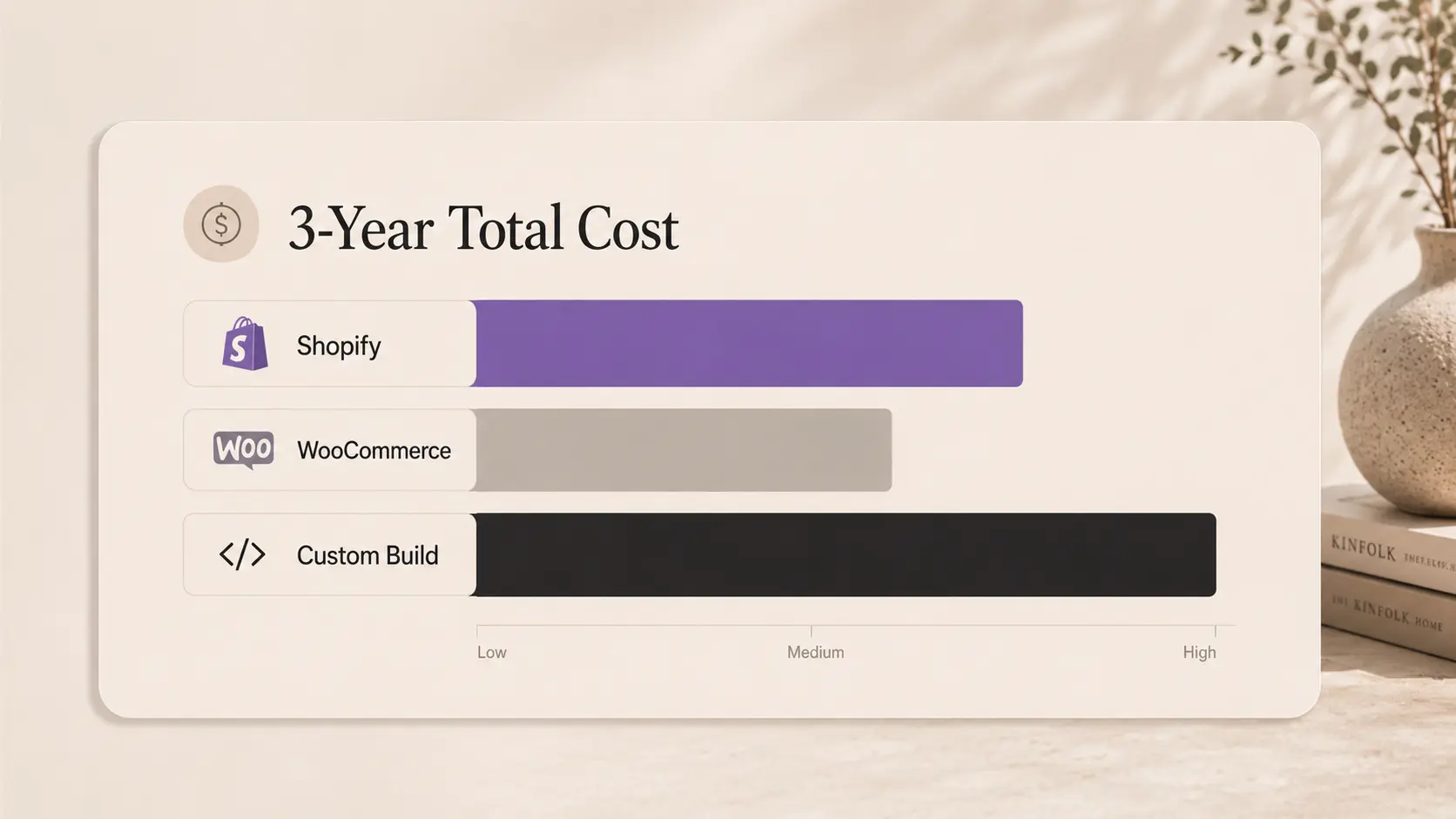
Custom e-commerce ranges from $30,000 for a focused, well-scoped build to $500,000+ for enterprise marketplace development. The upside: no transaction fees, no app subscriptions, no platform price hikes. Total cost of ownership over 3–5 years is often comparable to Shopify or WooCommerce once you add up their compounding costs.
The Feature-by-Feature Comparison
Let’s put the three options side by side on the metrics that matter most.
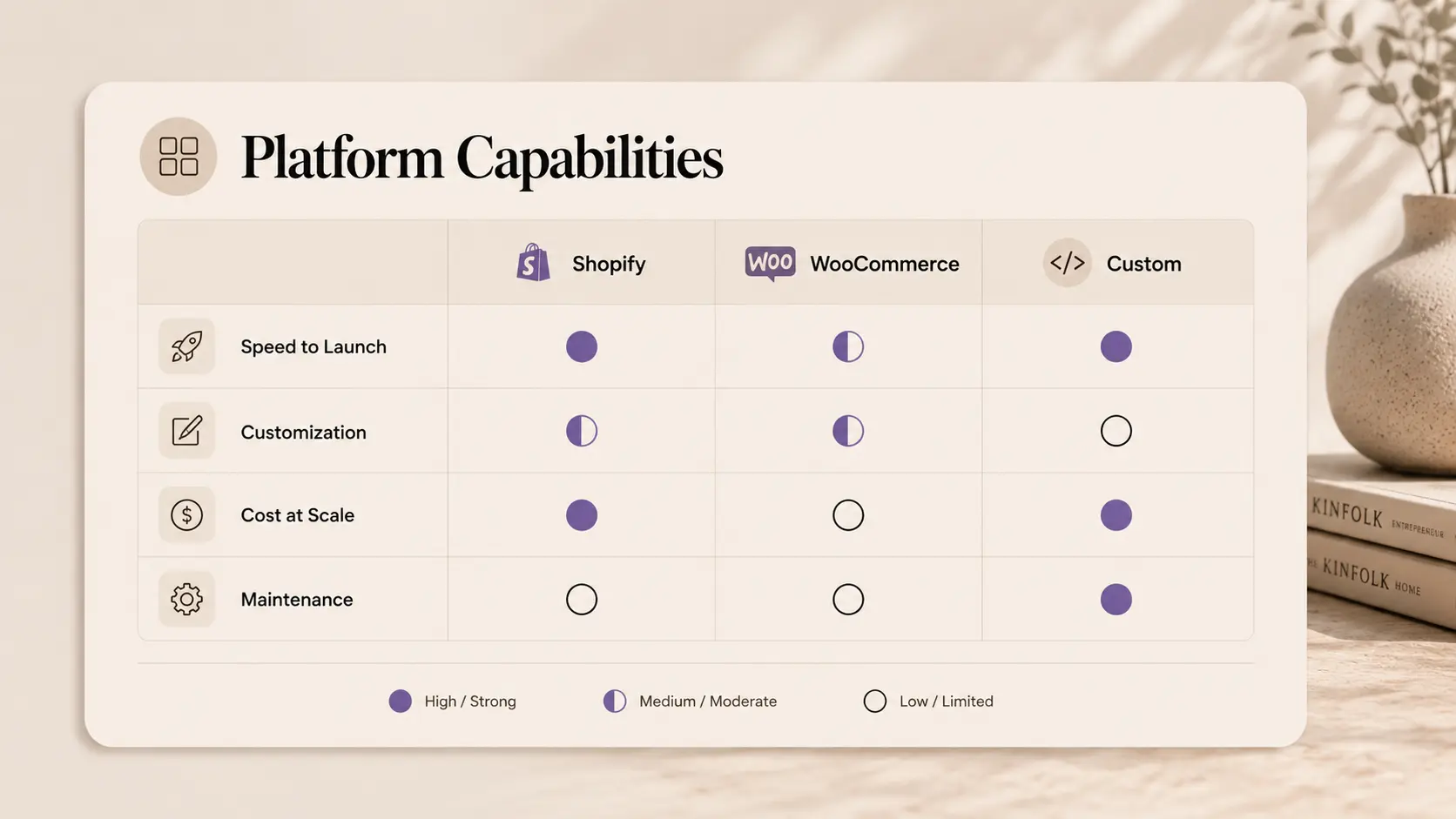
Factor | Shopify | WooCommerce | Custom |
Setup speed | Days–2 weeks | 1–4 weeks | 4–16+ weeks |
Upfront cost | $0 (platform) + build | $0 (plugin) + build | $30K–$500K+ |
Monthly platform cost | $29–$299+ | Hosting: $50–$300 | Hosting only |
Transaction fees | 0–2% | None | None |
Customisation ceiling | Medium | High | Unlimited |
Technical maintenance | None | Medium–High | High |
Content / SEO strength | Good | Excellent | Depends on build |
Scalability | Good–Excellent | Good (with work) | Excellent |
Data ownership | Limited | Full | Full |
Built-in support | 24/7 | Community only | Partner dependent |
The Cost Reality Over Three Years
This is the conversation most platform comparisons skip. Upfront cost is only part of the picture.
Shopify 3-Year Cost (Mid-Size Store)
Cost Item | Monthly | Annual | 3-Year Total |
Shopify Advanced plan | $299 | $3,588 | $10,764 |
Apps (average 15 apps) | $350 | $4,200 | $12,600 |
Theme (one-time) | — | — | $300 |
Custom dev work | $300 | $3,600 | $10,800 |
Transaction fees (0.5%) | $250 | $3,000 | $9,000 |
Total | $1,199 | $14,388 | $43,464 |
WooCommerce 3-Year Cost (Mid-Size Store)
Cost Item | Monthly | Annual | 3-Year Total |
Managed hosting | $150 | $1,800 | $5,400 |
Premium plugins | $100 | $1,200 | $3,600 |
Theme (one-time) | — | — | $200 |
Developer maintenance | $400 | $4,800 | $14,400 |
Security/backup tools | $50 | $600 | $1,800 |
Total | $700 | $8,400 | $25,400 |
Custom E-Commerce 3-Year Cost
Cost Item | One-Time | Annual | 3-Year Total |
Build (mid-complexity) | $60,000 | — | $60,000 |
Hosting | — | $2,400 | $7,200 |
Maintenance / features | — | $8,000 | $24,000 |
Total | — | — | $91,200 |
The honest read: Shopify and WooCommerce look cheaper than custom development over three years. But custom costs drop in year 4 and beyond. And for businesses doing $500K+ in monthly revenue, custom development’s elimination of transaction fees and app subscriptions changes the economics significantly.
How Createxp Builds E-Commerce Across All Three Platforms
One of the most important things to understand about working with a development studio is whether they have a platform agenda. A studio that only knows Shopify will recommend Shopify. A WooCommerce specialist will recommend WooCommerce. That’s not advice, it’s a comfort zone.
Createxp builds across all three: Shopify, WooCommerce, and fully custom e-commerce. The recommendation always comes from the brief, not from the studio’s preferred tooling.
Platform Recommendation Based on Business Model
The first conversation is about your products, your customers, your acquisition strategy, and your 3-year plan. Those answers determine the platform. Not the other way around. A DTC brand launching 30 products with no technical team gets a different recommendation than a B2B distributor with 10,000 SKUs and ERP integration requirements.
Conversion-Led Build Process
Whatever the platform, the build is focused on conversion, not just visual design. Product page architecture, checkout flow optimisation, mobile experience, page speed, trust signal placement, and CTA strategy are all defined before a pixel is drawn.
Performance as Standard
Whether it’s a Shopify theme build, a WooCommerce implementation, or a custom React storefront, PageSpeed targets are set at brief stage and measured at launch. A store that loads in 4 seconds on mobile is leaving revenue on the table, regardless of how good it looks.
The Full Stack, Not Just the Store
Createxp builds the store and the ecosystem around it: email flows, analytics setup, shipping integrations, inventory management connections, loyalty program implementation. A live store with no post-purchase automation or abandoned cart recovery is a store missing easy revenue.
Post-Launch Support That’s Structured, Not Reactive
The first 30–60 days after a store launch are the highest-risk period. Createxp includes a structured post-launch period on every e-commerce project, monitoring conversion rates, fixing edge cases, and setting up the optimisation roadmap for the next 6 months.
Your Store Deserves the Right Foundation Wrong platform decisions cost months. Let’s make sure you start on the right one. |
Key Takeaways
Shopify is the fastest path to a live store and the best choice for DTC brands without technical resources, but transaction fees and app costs compound significantly at scale.
WooCommerce gives you full ownership, no transaction fees, and excellent content/SEO integration, but requires ongoing technical management and a good hosting setup.
Custom e-commerce is right when your business model doesn’t fit standard platform assumptions: complex product logic, marketplace structures, deep ERP integration, or performance at serious scale.
Over a 3-year horizon, WooCommerce typically has the lowest total cost of ownership for mid-market stores. Shopify is more predictable. Custom is highest upfront but potentially cheapest long-term for high-volume businesses.
Platform should be chosen after mapping your product type, technical resources, growth trajectory, customisation needs, and budget, not based on what’s most popular.
Shopify’s 24/7 support and zero infrastructure management make it the lowest-risk option for non-technical founders.
The best e-commerce platform is the one that fits your business model, not the one that wins the most comparison articles.
Frequently Asked Questions
Which is better: Shopify or WooCommerce?
It depends on your business. Shopify is better for DTC brands that need to launch quickly, have no technical resources, and want minimal infrastructure management. WooCommerce is better for WordPress-based businesses, content-driven stores, and businesses scaling past $2–3M/year where avoiding transaction fees matters. Neither is universally better.
Is Shopify worth the cost compared to WooCommerce?
Shopify’s all-in monthly cost (platform + apps + transaction fees) is typically $800–$2,000/month for a mid-size store. WooCommerce total cost runs $500–$1,000/month including hosting and developer maintenance. Shopify is more expensive but also lower maintenance. The premium buys you time and simplicity, not features.
When should I choose custom e-commerce over Shopify or WooCommerce?
Choose custom development when your product requires complex configuration, your checkout flow is fundamentally different from standard, you need a multi-vendor marketplace, or you’re deeply integrating with enterprise systems. Custom is also worth considering when your monthly Shopify costs (including transaction fees and apps) approach $3,000+/month, the economics start to flip.
Can WooCommerce handle large stores?
Yes, with the right setup. WooCommerce has scaled to hundreds of thousands of products and millions of monthly visitors with proper managed hosting (Kinsta, WP Engine), caching, and database optimisation. It requires technical management that Shopify doesn’t, but it’s not inherently limited at scale.
Does Shopify or WooCommerce have better SEO?
WooCommerce generally has stronger SEO performance because it sits on WordPress, which has a mature content management and SEO tooling ecosystem. Shopify has adequate SEO capabilities but less flexibility in URL structure and content management. For content-led organic growth strategies, WooCommerce is the better platform.
What are Shopify’s transaction fees?
Shopify charges 2% on Basic, 1% on Shopify, and 0.5% on Advanced when you use a third-party payment gateway instead of Shopify Payments. These fees are waived if you use Shopify Payments, but Shopify Payments isn’t available in all countries. WooCommerce and custom builds have no platform-level transaction fees.
Is custom e-commerce better than Shopify for large businesses?
For businesses with unique operational requirements or significant scale (typically $5M+ in annual revenue), custom e-commerce is worth serious consideration. The elimination of transaction fees and app subscriptions, combined with complete control over architecture and performance, often justifies the higher upfront cost. For businesses with standard requirements, Shopify Plus handles significant volume well.
Warning: Working With Us May Trigger Unstoppable Momentum