
Web Redesign
UI UX Design
Neeha Fathima
CDO & Co-Founder
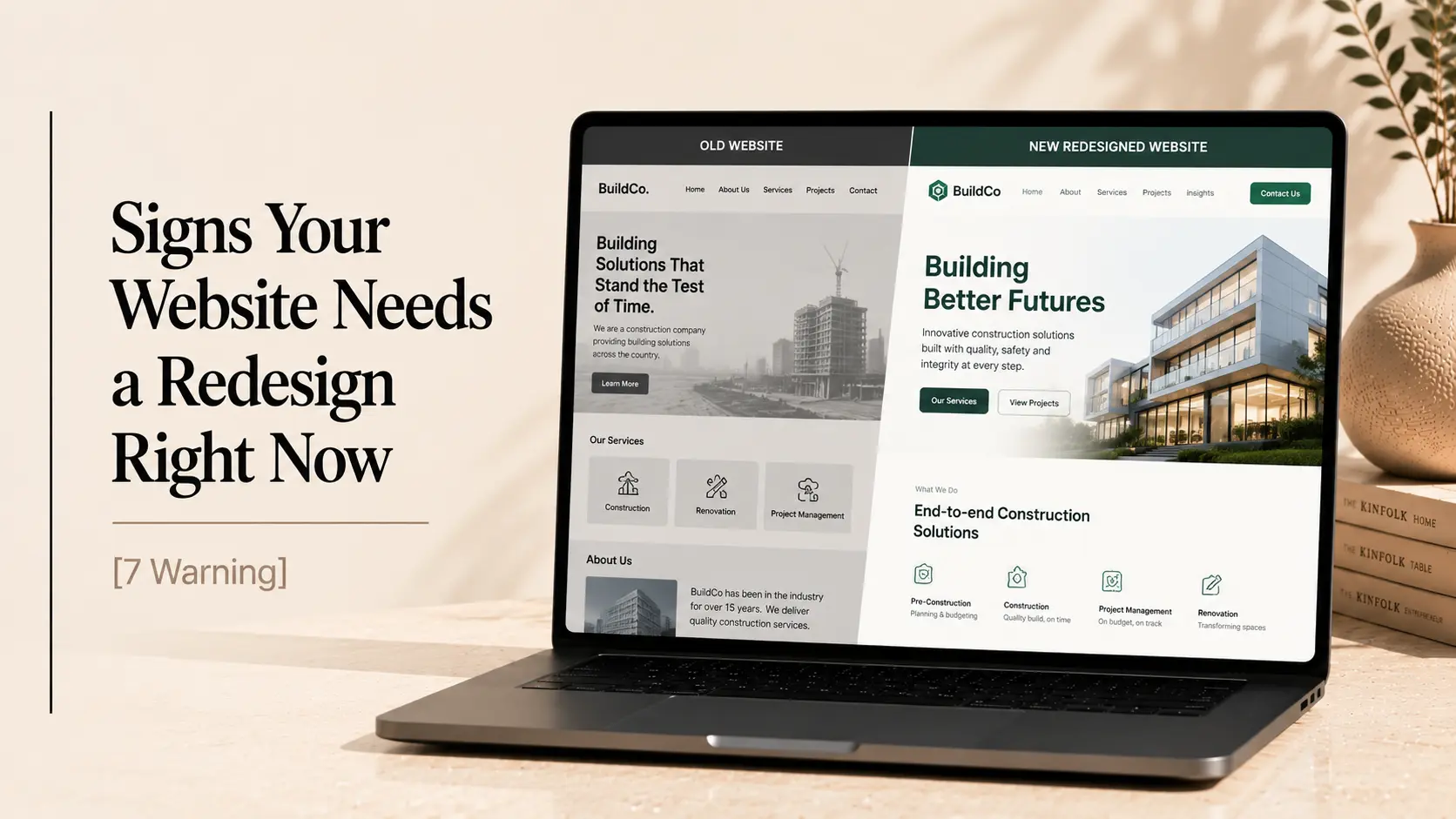
You haven't really looked at your website in a while. You built it, launched it, and moved on to actually running your business. But lately something's been nagging. Maybe a potential client mentioned it. Maybe you noticed a competitor's site and felt a little embarrassed. Or maybe the numbers just aren't adding up, traffic looks okay, but enquiries are thin.
Here's the uncomfortable truth: your website might be losing you business every single day without you knowing it. Not dramatically, not all at once, just quietly, steadily, in the form of visitors who land, take one look, and leave.
The data on this is striking. According to Stanford's Web Credibility Research, 75% of people judge a company's credibility based on its website design. And according to Google, 53% of mobile users abandon a site that takes longer than three seconds to load. These aren't abstract statistics. They're visitors who decided your business wasn't worth their time before they ever read a word of your content.
This article covers the seven clearest signs that your website needs a redesign, and what each one is actually costing you. If you recognise three or more of these, it's time to have a serious conversation about what to do next.
How to Know If Your Website Needs a Redesign
Before getting into the specific signs, it helps to understand what a website redesign actually addresses. A redesign isn't just about making things look prettier. It's about fixing the underlying problems that are making visitors leave, preventing Google from ranking you, and stopping potential customers from trusting your business.
The most common question is: "How often should you redesign a website?" The honest answer is: when it stops working. Not on a fixed schedule. Not because a new design trend emerged. When the site stops doing its job, converting visitors, communicating your value, and working correctly on the devices people use, that's when it's time.
Most businesses find themselves due for a meaningful redesign every 3–5 years, though some industries move faster and some slower. What matters is whether the site is actively doing its job right now.
Sign 1: Your Bounce Rate Is High and Conversions Are Low
This is the most direct signal. People are arriving at your website and leaving immediately without taking any action. If your Google Analytics shows a bounce rate above 65–70% alongside low conversion rates, your site has a problem worth investigating.
High bounce rate combined with low conversion usually means one of three things:
Visitors can't immediately understand what you do or who it's for
The page takes too long to load and they give up
The design doesn't communicate credibility, and they don't trust what they're seeing
A healthy B2B website should convert 2–5% of visitors into leads or enquiries. If you're at 0.5% or below, that gap is directly traceable to your website's design and messaging architecture.
What This Actually Costs
Let's make this concrete. Say your site gets 2,000 visitors per month. At a 0.5% conversion rate, you're getting 10 enquiries. At 2%, a conservative improvement from a redesign, you'd get 40 enquiries. That's 30 additional sales opportunities per month from the same traffic. No additional ad spend. No new SEO work. Just a website that actually converts.
Sign 2: Your Website Looks Terrible on Mobile
If you haven't checked your website on a phone recently, open it right now. Not on your laptop with a resized browser, on an actual phone. What do you see?
Is the text tiny? Do you have to pinch to zoom? Does the navigation work? Do images overflow the screen? Is the form usable with thumbs?
More than 60% of global web traffic comes from mobile devices. If your site was built in 2015 or earlier, there's a reasonable chance it was designed desktop-first and never properly adapted for mobile. Even many sites built in the last few years have mobile issues that were never fully resolved.
Google uses mobile-first indexing. This means Google evaluates your mobile experience first when deciding how to rank your site. A site that's broken on mobile isn't just frustrating users, it's actively suppressing your search rankings.
The mobile experience is one of the clearest signals that a website needs an update. It's also one of the most fixable, but fixing it properly often requires a rebuild rather than a patch.
Sign 3: Your Website Is Slow
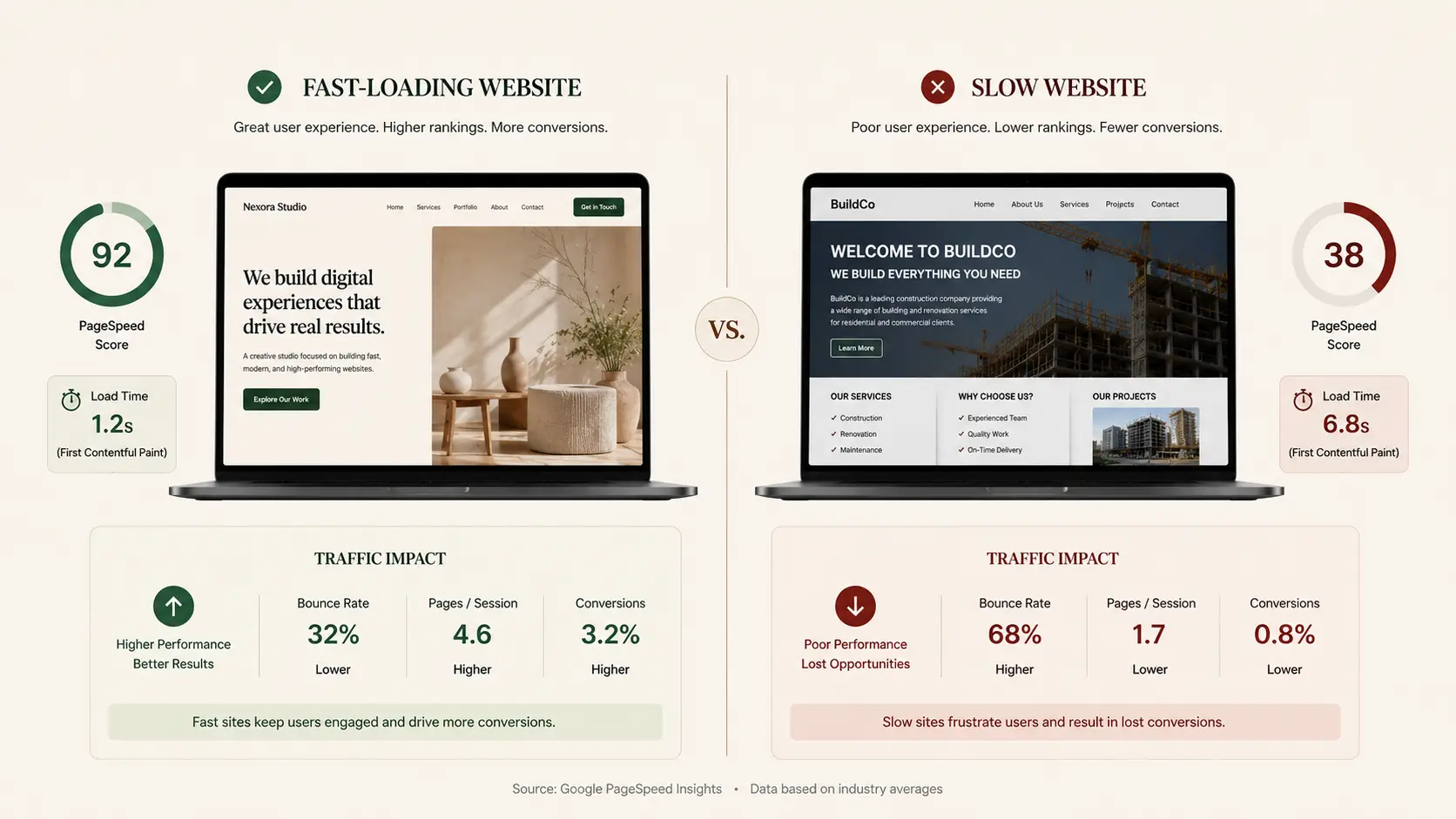
Open Google PageSpeed Insights right now and enter your URL. Look at your mobile score. If it's below 50, you have a problem. Between 50 and 70, you're losing ground to competitors. Above 90 is where you want to be.
A slow website costs you in three distinct ways:
1. Visitor abandonment. Google's data shows that as page load time increases from 1 to 3 seconds, the probability of bounce increases by 32%. At 5 seconds, that probability is up 90%.
2. Search rankings. Core Web Vitals, a set of Google's speed and user experience metrics, are a confirmed ranking factor. Slow sites rank lower than fast ones with equivalent content.
3. Ad spend efficiency. If you're running paid advertising and sending traffic to a slow landing page, you're wasting money every time someone bounces before the page finishes loading.
Common causes of slow websites include unoptimised images, excessive plugins, render-blocking JavaScript, no caching, no CDN, and cheap shared hosting. These often accumulate over time without anyone noticing until the site is genuinely painful to use.
Sign 4: Your Website Doesn't Reflect What Your Business Does Today
This is one of the most overlooked signs that a website needs a redesign, and it's incredibly common.
Your business has evolved. You've added services, changed your positioning, refined your target customer, or moved upmarket. But the website still describes the company you were three years ago. The messaging is outdated. The case studies are old. The team page has people who left. The services page lists things you no longer offer.
This matters for two reasons:
Trust: When a potential customer researches you and your website tells a different story than your LinkedIn or your sales pitch, it creates doubt. Inconsistency reads as a credibility gap.
Search relevance: If your positioning has shifted but your website content hasn't, Google is sending you traffic for terms that don't match your current offering. You're getting the wrong visitors and converting fewer of the right ones.
A website that doesn't reflect your current business is an outdated website in the truest sense, and no amount of traffic optimisation fixes a site that's communicating the wrong message.
Sign 5: You're Embarrassed to Share Your Own Website
This one is the gut-check test. When you meet a potential client, do you proactively share your website? Or do you quietly hope they don't look it up before your first call?
This feeling is more diagnostic than it sounds. You know what your business is worth. You know what your competitors' websites look like. If you're hesitating to put your website in front of prospects, investors, or potential hires, that hesitation is the market signal.
Credibility is perceived in seconds. Research from Missouri University of Science and Technology shows that it takes about 2.6 seconds for users to form a first impression of a website. In that window, they're deciding whether your business is serious, professional, and trustworthy.
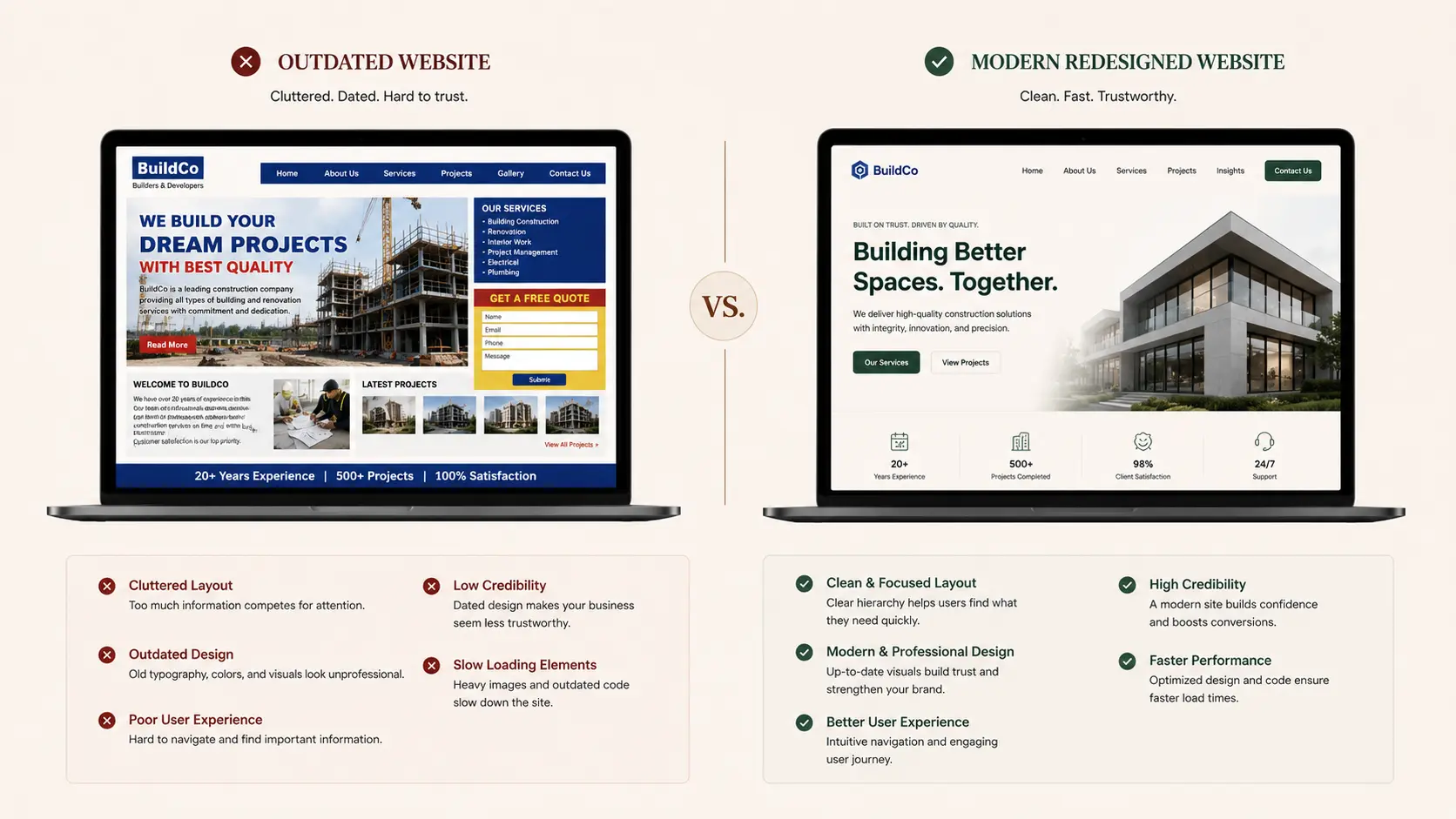
An outdated website design, one that looks like it was built five or more years ago, doesn't just fail to impress. It actively signals that the business isn't current. That you haven't invested in your presence. That other priorities were more important.
When you're embarrassed by your own website, that's one of the clearest signs that a website redesign isn't optional anymore.
Sign 6: Your SEO Rankings Have Stagnated or Dropped
If you track your search rankings and they've been flat or declining for 12+ months, your website is a likely contributor. A lot of businesses attribute SEO stagnation to content or backlinks and miss the technical and design factors that are equally important.
Technical Issues That Kill Rankings
Slow page speed (Core Web Vitals, covered above)
Non-HTTPS, Google treats non-secure sites as a trust signal failure
Duplicate content from poor CMS architecture
No structured data markup, missing rich snippets for products, articles, or services
Broken links and 404 errors accumulated over years
Non-mobile-friendly design (indexed under mobile-first)
Design Issues That Kill Rankings
High bounce rate, signals poor user experience to Google
Short time-on-site, visitors leaving immediately reads as a relevance failure
No clear page hierarchy, confusing navigation increases pbounce and reduces crawl efficiency
A website redesign that addresses these technical and structural issues often produces meaningful SEO improvements within 60–90 days of launch. The site starts performing better on exactly the signals Google uses to rank it.
Sign 7: Your Competitors' Websites Look Significantly Better Than Yours
Go look at your three closest competitors' websites right now. Be honest about what you see. Do they communicate more clearly? Load faster? Look more professional? Have better case studies and social proof?
If a potential customer is evaluating you against a competitor and both sites come up in the same search, which site makes a stronger first impression? First impressions are decisive, most visitors won't stick around to look past them.
This isn't about keeping up with design trends for their own sake. It's about whether your digital presence is competitive in your market. A business that invests in its website is signalling investment, seriousness, and stability. One that hasn't updated its site in five years is signalling the opposite, whether that's accurate or not.
The Score Sheet: How Many Apply to You?
Here's a quick self-assessment. Count how many of these are true for your website right now:
Sign | Is This Your Website? |
Bounce rate above 65% with low conversions | Yes / No |
Looks broken or cramped on mobile | Yes / No |
PageSpeed score below 60 on mobile | Yes / No |
Doesn't reflect your current business | Yes / No |
You hesitate before sharing it with prospects | Yes / No |
SEO rankings flat or declining for 12+ months | Yes / No |
Competitors' sites look noticeably better | Yes / No |
1–2 signs: Your site may need targeted fixes rather than a full redesign.
3–4 signs: A redesign is warranted and the business impact is likely meaningful.
5+ signs: This is already costing you leads, credibility, and rankings. A redesign is overdue.
How Createxp Approaches Website Redesigns
A website redesign is an investment decision, and it should be treated like one. Createxp approaches every redesign project by starting with what's actually wrong with the current site, not with what looks newest or most impressive in a portfolio.
Here's what the process looks like in practice:
Audit First, Design Second
Before any wireframe is drawn, the team runs a full performance audit: bounce rate data, PageSpeed scores, Core Web Vitals, heatmaps and session recordings, keyword rankings, and conversion funnel analysis. This tells us exactly where the current site is failing and what the redesign needs to fix.
Conversion Architecture Before Visual Design
The most beautiful website in the world doesn't help if the structure doesn't guide visitors toward a decision. Createxp maps the conversion architecture first, what does a visitor need to understand, believe, and do at each stage of their journey? Then design expresses that structure.
Performance Targets as Deliverables
PageSpeed scores, Core Web Vitals targets, and mobile experience standards are defined in the brief and measured at launch. A redesign that looks great but loads slowly or performs poorly on mobile hasn't solved the problems that drove the redesign decision.
Content and Messaging Alignment
If your current site is describing a version of your business that no longer exists, the redesign is the right moment to fix that. Createxp works with clients to refresh positioning, rewrite key pages, and ensure the site tells the right story to the right audience.
Post-Launch Monitoring
The first 30–60 days after a redesign are critical. Createxp monitors traffic patterns, conversion rates, and search performance after launch and makes adjustments based on real user behaviour, not assumptions made in a design meeting.
Whether the issue is a three-second load time, a 78% mobile bounce rate, or a site that simply doesn't match what the business has become, the same principle applies: fix the problem first, then make it beautiful.
Every Day You Wait Is a Day You're Losing Ground
Your website is either working for your business or it isn't. There's no neutral. Every visitor who lands on a slow, outdated, or confusing site is a missed opportunity. Some of those missed opportunities go to your competitors.
The good news: every one of the seven signs above is fixable. A well-executed redesign addresses them systematically and produces measurable improvements in traffic, conversions, and credibility.
Key Takeaways
The clearest signs that a website needs a redesign are: high bounce rate, poor mobile experience, slow page speed, outdated messaging, embarrassment before sharing it, declining SEO, and falling behind competitors.
75% of people judge a business's credibility based on website design alone. First impressions happen in under 3 seconds.
A site that loads slowly, isn't mobile-friendly, or has high bounce rates is actively suppressing your Google rankings through Core Web Vitals signals.
If your website no longer reflects your current business, your positioning, services, or team, it's communicating a credibility gap to potential customers and sending the wrong traffic from search engines.
The self-assessment table is a useful litmus test: 3+ signs means a redesign is warranted; 5+ means it's already costing you meaningful business.
A website redesign should begin with a performance audit, not a design direction. Fix what's broken first, then make it visually compelling.
Most businesses should plan for a meaningful website redesign every 3–5 years, but the real trigger is when the site stops working, not a calendar date.
Frequently Asked Questions
How do I know if my website needs a redesign?
The clearest signals are: a high bounce rate (above 65–70%), poor performance on mobile devices, low PageSpeed scores (below 60 on mobile), outdated messaging that doesn't match your current business, declining or stagnant search rankings, and a gut feeling of embarrassment when sharing the site with prospects. If three or more of these apply, a redesign is warranted.
How often should you redesign a website?
Most businesses find themselves due for a meaningful redesign every 3–5 years, but the real trigger should be performance, not a fixed schedule. If your site stops converting visitors, ranks poorly, or no longer reflects your business accurately, those are the real reasons to redesign, regardless of when it was last updated.
What are the signs of an outdated website?
An outdated website typically has: non-mobile-responsive design, slow page load times, outdated visual design (pre-2020 aesthetic), no SSL certificate, stale content that doesn't reflect the current business, broken links, and Core Web Vitals failures. These issues compound over time and increasingly affect both user experience and search rankings.
Does a website redesign improve SEO?
Yes, if it's done correctly. A redesign that fixes page speed, improves mobile experience, cleans up technical issues (broken links, duplicate content, missing structured data), and reduces bounce rate will have a measurable positive impact on search rankings. Most well-executed redesigns see SEO improvements within 60–90 days of launch.
How long does a website redesign take?
For a typical business website (5–15 pages), a well-executed redesign takes 4–8 weeks with an experienced team. Larger sites with significant content, e-commerce functionality, or custom features take longer. The timeline is heavily influenced by how quickly content decisions and approvals happen on the client side.
What is the cost of a website redesign?
Website redesign costs range from $5,000–$15,000 for a standard small business site to $20,000–$60,000+ for a custom-built site with advanced functionality. The range reflects differences in scope, complexity, team experience, and whether the project includes strategy, content, and post-launch optimisation. The ROI calculation for most businesses makes a quality redesign one of the highest-return digital investments available.
Should I redesign my website or just update it?
It depends on how many things need to change. If the issues are cosmetic, new photos, updated copy, a colour refresh, an update may suffice. If the site has structural problems (poor mobile experience, slow load times, outdated CMS, broken conversion architecture), a full redesign is usually more effective than trying to patch individual problems on a compromised foundation.
Warning: Working With Us May Trigger Unstoppable Momentum