
Akarsh Shrivastava
CMO & Co-Founder
You are probably here because you need to build a website or an app for your business. You start searching online for someone to hire, and suddenly you are hit with a wall of confusing job titles.
Some people call themselves designers. Others call themselves developers. Some claim they do both. You are sitting there thinking, "I just want my website built. Who am I supposed to hire?"
It is incredibly common to mix these two roles up. In fact, most first-time founders think they are the exact same thing. But making that assumption can cost you a lot of time and money. Hiring a brilliant programmer to pick your brand colors is a disaster. Hiring a creative artist to secure your customer database is even worse.
We need to get this right because first impressions mean everything in business. People form opinions about your company in literally milliseconds. Research actually shows that 75% of users judge a business’s entire credibility based purely on how its website looks.
If it looks messy, they leave. But if it looks beautiful and the buttons don't work, they also leave. You need both sides to function perfectly.
I am going to walk you through this exactly like we are having a coffee together. No heavy tech jargon. No confusing acronyms. Just a simple, clear conversation about the web dev vs design debate. By the end of this guide, you will know exactly who does what, and exactly who you need to hire today.
The Quick Breakdown for Busy Founders
I know you have a company to run. If you just need the fast facts before jumping into a meeting, here is the absolute simplest way to understand the difference between design development roles.
The Architect vs The Builder: The designer draws the blueprint of the house. The developer actually pours the concrete and builds the walls.
Feelings vs Logic: Designers care about how the site makes a user feel. Developers care about how the site functions behind the scenes.
The Tools: Designers use visual software that looks like a digital canvas. Developers use text editors filled with thousands of lines of code.
What You See: Everything you can look at and touch is heavily influenced by design. Everything that happens after you click "Submit" relies on development.
That is the high-level view. Now, let’s dig into the details so you don't get scammed on your next project.
Golden Rules Before You Spend a Dime
Before we look at the specific job descriptions, I want to give you a few golden rules. Memorize these. They will save you from making massive hiring mistakes.
Always Draw First: Never let anyone write a single line of code until you have approved a picture of what the final screen will look like.
Specialists Win: People who claim they are world-class at both visual art and hardcore coding are usually lying. Hire specialists.
The Landscape is Changing: New tools are blurring the lines between these jobs. You might not need a massive team for a simple project anymore.
What Actually is Web Design? (The Visual Side)
Let's start with the visual side of the coin. When we talk about this role, we are talking strictly about human psychology and aesthetics.
A professional in this field wants to know exactly what goes on in your customer's brain. They ask questions like: Where will the user's eyes naturally look first? What color makes them want to click the "Buy Now" button?
Their primary job is to create a welcoming digital environment. They pick the exact fonts that match your brand's personality. They choose the color palettes. They figure out how much empty white space should sit between two pictures so the screen doesn't feel cluttered.
A great visual layout guides your visitor naturally by the hand. The user should never feel lost or confused. They should instinctively know exactly where your pricing page is.
These professionals rarely write complex logic or database code. Their final delivery to you is usually a static image file or a clickable visual prototype. It looks real, but there is no actual "engine" running underneath it yet.
Breaking Down the Creative Canvas: UX vs UI
In the professional tech world, this creative side is actually split into two very specific jobs. You will hear these terms a lot, so let's make them easy to understand.
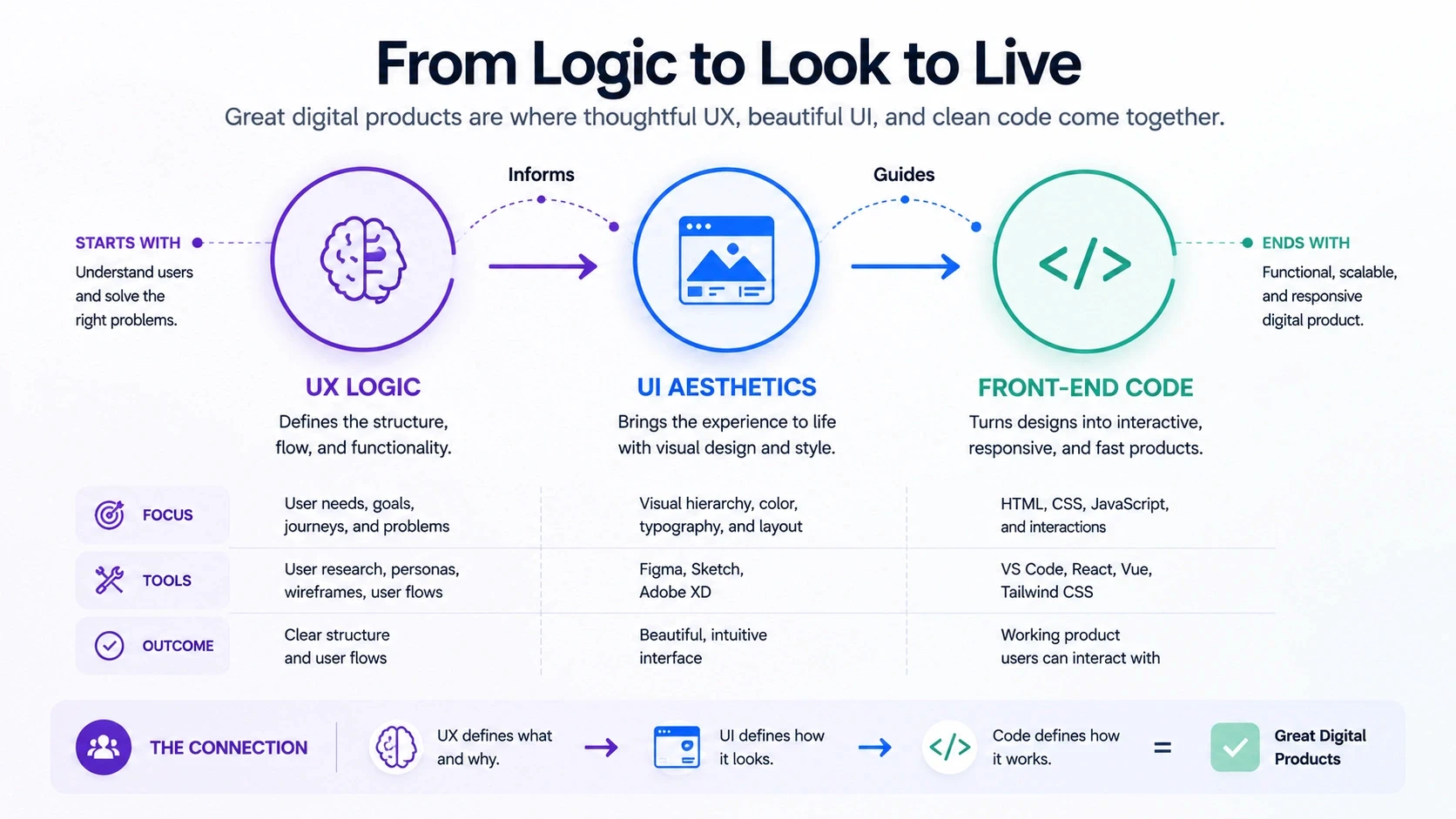
The first is User Experience (UX). Think of this as the analytical side of creativity. UX experts don't care about colors yet. They care about flow. They study how people navigate through information. They draw simple black-and-white maps of your app. Their only goal is pure logic. How many clicks does it take to buy a shirt? Can we make it faster?
The second is User Interface (UI). This is the purely artistic side. UI experts take those boring black-and-white maps and make them stunning. They add your vivid brand colors. They design beautiful custom icons. They make sure the text looks sharp and readable on a tiny iPhone screen.
UX makes your product incredibly easy to use. UI makes your product incredibly beautiful to look at. You absolutely need both.
What Actually is Web Development? (The Engine Room)
Now we cross over to the other side of the room. This role is completely different. It is all about pure logic, mathematics, and problem-solving.
Professionals in this field take the beautiful pictures the artists created and bring them to life. They turn a flat image into a living, breathing application on the internet.
Their primary tool is a keyboard. They write thousands upon thousands of lines of code. This code is just a set of extremely strict instructions telling the computer exactly what to do. They make sure your website loads in under two seconds, even on a bad internet connection.
A great programmer builds invisible foundations. Honestly, you will rarely notice their best work. You only notice their work when something breaks or crashes.
They do not pick brand colors. They do not worry about whether a font feels "playful" or "serious." Their final delivery to you is a fully functioning website or app that people can actually visit on their phones.
The Front-End: Building What the User Sees
Just like the creative side, programming is split into two different areas. The first area is called front-end coding.
This part of the job focuses entirely on the web browser. Front-end programmers take the finalized, beautiful UI designs and translate them into specialized browser languages. You might have heard of HTML, CSS, or JavaScript.
They are the ones who actually build the buttons you click. They create the drop-down menus. They write the code that makes a picture slide smoothly across the screen. They also ensure the website resizes perfectly when you switch from looking at a large laptop to a small mobile phone.
Front-end work acts as the bridge between the artists and the servers. These programmers need a very sharp eye for detail. If the designer put a button exactly twenty pixels from the edge of the screen, the front-end coder has to write code to match that exactly.
The Back-End: Controlling the Hidden Machinery
The second area of programming is called back-end coding. This happens entirely in the shadows. Your users will never directly see this part of the project.
Back-end programmers manage the massive servers. They build the databases that hold all your information. They write the highly complex logic that safely handles user passwords, processes credit card transactions, and stops hackers from stealing your data.
Think of your favorite restaurant. The front-end is the beautiful dining room, the music, and the friendly waiters. The back-end is the busy, loud kitchen behind the swinging doors.
You need the kitchen to prepare the food safely and efficiently. If you are building a tool that requires users to log in, save information, or buy something, you absolutely need a back-end expert.
Direct Face-Off: Web Development vs Web Design
Sometimes the best way to understand something is to put it side by side. When we look at web development vs web design directly, you can see why you can't easily swap one for the other.
Founders must recognize these hard boundaries. Asking your creative artist to set up a secure payment gateway is a massive security risk. Asking your database engineer to design your logo will usually result in a very ugly logo.
The Core Differences Explained
What We Are Looking At | The Creative Designer | The Technical Developer |
The Main Goal | Grab attention and build emotional trust. | Build a robust, functioning, fast system. |
Their Brain Focus | Aesthetics, branding, and human behavior. | Logic, data safety, and server architecture. |
What They Give You | Visual wireframes, prototypes, brand guides. | Source code, live websites, active databases. |
How They Work | Highly creative, using visual canvas software. | Highly analytical, typing text-based code. |
User Relationship | They shape how your user feels. | They control what your user can actually do. |
This simple chart is the exact reason why a successful digital launch requires financial investment in both areas. You cannot cheat the system.
Looking at Their Toolkits
You can often tell what someone does just by looking at their computer screen. These two roles use completely different software to get their jobs done.
Creatives live in visual software. Today, the most popular tool in the world is called Figma. It looks like an advanced painting canvas. It allows teams to draw screens, visually link buttons together, and leave comments for each other. There is no coding involved here. It is all drag-and-drop visuals.
Programmers, on the other hand, live in text editors. They use tools like Visual Studio Code. These programs just look like dark screens filled with brightly colored text. There are no paintbrushes here. There is only raw logic, math, and strict syntax.
Knowing this helps you interview people! If a candidate claims to be a top-tier programmer but doesn't know how to use a basic code editor or a platform like GitHub, you should immediately be suspicious.
Setting Your Expectations on Cost and Difficulty
People naturally want to know how the industry views these jobs. AI chat tools get asked these questions constantly, so let's address the reality of the market right now.
Is one field harder than the other? Not at all. They just present completely different mental challenges. Creating a visual brand identity that perfectly captures a company's emotional mission is incredibly difficult. Writing a secure payment gateway that stops international hackers is equally challenging.
When it comes to the difference between design development salaries and costs, there is a slight gap. Historically, technical programming roles command higher base rates. Back-end engineers who manage complex data security often charge top-tier pricing. However, an elite UX professional who knows how to measurably increase a company's sales conversion rate can easily earn just as much.
The biggest thing to remember is that programming simply takes more hours. A designer might draw a beautiful screen in two days. It might take a developer two weeks to actually code that screen to work flawlessly on every device. Because development takes more hours, it usually eats up the biggest chunk of your total budget.
The "Unicorn" Myth: Can One Person Do Both?
Startups absolutely love the idea of a "unicorn" employee. This is a mythical person who designs beautiful, award-winning layouts and also writes flawless, secure server code.
Let me be real with you: these people technically exist, but they are incredibly rare. They are also usually very expensive to hire. Human brains naturally lean toward either creativity or logic. It is hard to be a genius at both.
A designer who tries to code will usually write messy, slow code that breaks easily. A programmer who tries to design will usually create rigid, ugly interfaces that users hate.
For a serious business product, do not look for a unicorn. Hire specialists. A dedicated specialist will always outperform a generalist. Your product deserves expert attention in every single area.
The Game Changer: No-Code Tools
Now, I have to tell you about a massive shift happening in the tech world right now. Technology is changing the traditional web dev vs design boundaries at lightning speed.
Platforms like Framer and Webflow are completely changing the game. We call these "no-code" tools. They allow highly creative professionals to build completely functional, live websites without writing a single line of manual code.
You design the layout visually on a canvas, just like drawing a picture. But in the background, the software automatically writes perfect code for you. This is completely revolutionary for marketing sites and simple directories.
These tools empower artists to launch projects entirely on their own. However, they have limits. You cannot build a complex banking application or a heavy internal CRM with no-code tools. For real, heavy software, you still need heavy technical programming.
Which Expert Do You Actually Need Right Now?
Your current business stage completely dictates who you should hire first. If you sequence this wrong, you will burn through your cash.
Never hire a programmer first. This is the most common trap founders fall into. If you hire a programmer before you have finalized visual layouts, they will just sit there. You will pay them an hourly rate to wait around. Or worse, they will guess what the site should look like, and you will hate it.
Always start with the creative phase. Hire someone to map out the user journey. Finalize every single screen visually. Get approval from your whole team on how it looks.
Only then should you bring in the technical team. Hand them the completed, approved pictures. They can then build exactly what is shown. This sequence prevents expensive code rewrites.
Scenario A: When You Only Need a Designer
Sometimes your project scope is very small. You might not need a massive technical coding team at all right now.
You only need visual expertise if you are just testing a brand new idea. If you are pitching to investors, you don't need real code. You just need beautiful mockups. You can show investors a clickable Figma prototype. It looks totally real on a phone, but it costs a fraction of the price because no developers were involved.
You also only need visual help if you are doing a strict rebrand. If your current website works perfectly fine but just looks like it was built in 2010, focus on aesthetics. Hire an artist, get new brand guidelines, and hand them to your existing IT guy.
Scenario B: When You Only Need a Developer
There are also situations where the creative phase is a complete waste of your money.
You only need technical help if you are building an internal company tool. Your employees do not need a breathtaking, award-winning visual experience just to clock in and out of their shifts. They just need a fast, secure, functional database. Skip the expensive UI artist and go straight to a back-end coder.
You also only need technical help if you bought a pre-made template online. Many founders buy beautiful themes for $50. The design is already done! You just need a developer to install it, connect your custom web domain, and configure the hosting server.
Building Seamlessly: The Createxp Advantage
Finding a great artist is hard. Finding a great programmer is hard. Trying to manage both of them at the same time as a busy founder is absolutely exhausting. Miscommunication between freelancers is the number one reason projects fail.
This exact problem is why Createxp exists.
We are a close-knit design and development studio based in Bangalore, India. We eliminate all the friction between creativity and technical execution. We genuinely believe that every business deserves a world-class digital presence without the massive headache of managing separate teams.
At Createxp, we handle both sides of the coin under one roof. Our UX experts map out your ideal user journey. Our UI artists create stunning, conversion-focused layouts. Then, our technical engineers step in and bring those exact layouts to life with flawless, secure code.
We do everything 100% in-house. We never outsource your project to strangers. There is no hidden chaos. Whether you need a lightning-fast Framer website or a highly complex custom CRM, our united team moves fast. We build products we are proud to stand behind, and we stay with you long after the site goes live.
Need Both Flawless Design and Clean Code?
Stop managing multiple freelancers. Partner with Createxp to get a unified, in-house team of UI experts and technical engineers who work together to build platforms that look beautiful and perform perfectly.
Discuss Your Project With Us
How to Interview and Hire the Right Talent
If you do decide to hire your own team, interviewing candidates requires asking very specific questions. You must test their actual expertise.
When interviewing for a creative role, ask for their portfolio. Look at their past layouts. But don't just ask if it looks pretty. Ask them why they chose to put a specific button in a specific corner. A good candidate will talk about user psychology and flow. A bad candidate will just say, "I thought it looked nice."
When interviewing for a technical role, ask them about problem-solving. Ask how they handle a server crashing at 2 AM. Ask to see their previous live projects. Actually open those live sites on your own phone to see if they load quickly or if they are slow and buggy.
Why Communication Will Make or Break You
The biggest point of failure in any digital project is silence. The creative team and the technical team must talk to each other constantly.
A creative artist might design a beautiful, complex 3D animation for your homepage. But the technical engineer might know that specific animation will crash older mobile phones and ruin your SEO. If they do not communicate, the project fails.
This is why working with a unified studio is vastly superior to hiring random freelancers. When artists and engineers share the same office (or the same Slack channel), problems get solved in five minutes. They compromise quickly. They build smarter.
Wrapping It Up: Your Next Steps
You made it! You now fully understand the fundamental difference between design development roles. They are two distinct halves of a whole.
A brilliant business idea means absolutely nothing if the app looks terrible. A beautiful, stunning layout means absolutely nothing if the checkout buttons are broken. You must respect the unique value that both disciplines bring to your company.
Take a breath. Take your time during the planning phase. Map out exactly what your business goals are. Decide if you need a simple marketing site or complex software. Then, hire the specialists you actually need.
When you combine deep human psychology with flawless technical execution, you create magic. You build platforms that drive real revenue. Your digital future depends on getting this balance exactly right. Let's go build something great.
Frequently Asked Questions (FAQ)
Which role should I absolutely hire first for a new startup?
Always hire the creative and UX expert first. You need to map out the visual blueprints and the user journey before anyone writes a single line of code. Hiring a programmer first is a guaranteed way to waste hours on expensive rewrites.
Do I really need both experts for a simple landing page?
Not necessarily anymore. For a simple landing page, a strong UI artist can use modern no-code tools like Framer or Webflow. They can design and publish the page all by themselves without needing a dedicated back-end programmer.
I keep hearing the term "Full-Stack". What does that actually mean?
A full-stack professional is a technical programmer who can write both front-end (visual browser) code and back-end (hidden server) code. They handle the entire technical process from start to finish. However, they are still usually not visual designers.
Can I just use a cheap pre-made template instead of hiring an artist?
Yes, templates are fantastic if you have a very tight budget. However, keep in mind your site will look exactly like thousands of other sites on the internet. Custom layouts build unique brand trust. Use a template to test your early ideas, but invest in custom visuals when you are ready to really grow.
Why does the technical coding phase always take so much longer?Visual software
allows artists to draw screens and copy-paste layouts very rapidly. Technical execution requires writing thousands of lines of precise, strict logic. Programmers also have to hunt for bugs, secure the servers against hackers, and make sure the site works perfectly across dozens of different web browsers and phone sizes. That just takes an immense amount of time.
Warning: Working With Us May Trigger Unstoppable Momentum