
Website Redesign
Trehan Sangpriya
CEO & Co-Founder
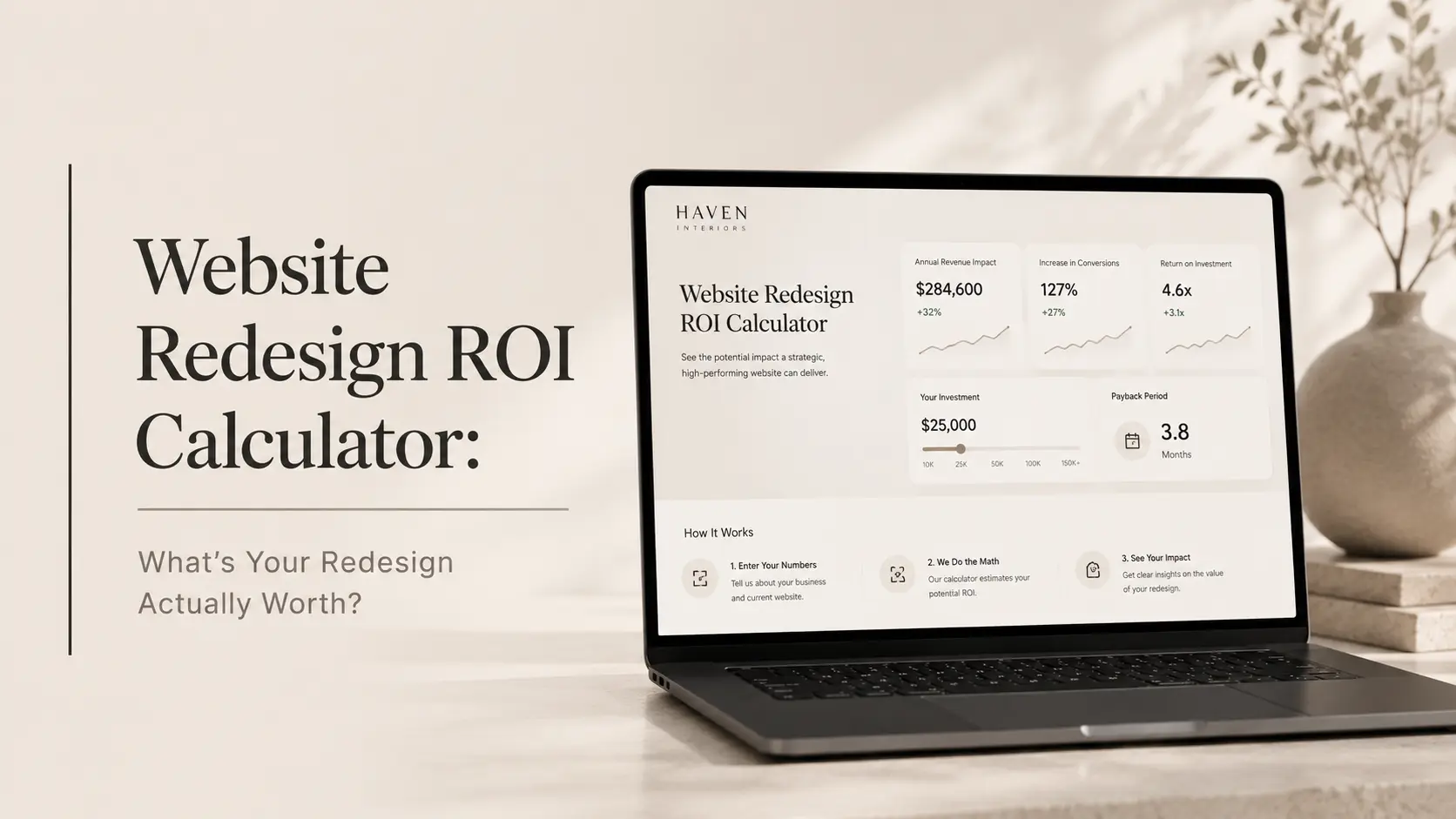
Someone on your team just asked the question you’ve been avoiding: “Are we sure this redesign is worth the money?” And honestly, that’s a fair challenge. A website redesign isn’t cheap. Depending on scope, you’re looking at anywhere from $8,000 to $80,000+. So before you sign off, you want some kind of confidence that this investment makes sense. Not hope, actual numbers.
That’s exactly what this guide is for.
Here’s the thing most businesses miss: a website isn’t a cost. It’s a revenue engine, or it should be. Research from Forrester shows that every $1 invested in UX design returns $100 on average, representing an ROI of 9,900%. That sounds extreme until you realise how much money leaks out of a poorly designed website every single day. Slow load times, confusing navigation, weak CTAs, outdated trust signals, every one of those issues is quietly costing you leads, conversions, and revenue.
This article walks through the website redesign ROI framework used by smart marketing leaders and founders. By the end, you’ll be able to calculate a realistic ROI estimate for your own redesign, and make the case internally with actual numbers, not gut feel.
Why Most People Can’t Calculate Their Redesign ROI (And What to Do About It)
The reason website redesign ROI feels hard to measure is because most businesses don’t have a baseline. They know their site exists. They know it gets traffic. But they don’t know their conversion rate, their average lead value, or how much revenue is tied to web-driven enquiries.
Fix that first. Before any ROI calculation, you need four numbers:
Monthly website visitors (from Google Analytics or similar)
Current conversion rate, what % of visitors take your desired action (enquiry, purchase, sign-up)
Average value per conversion, how much is a lead or sale worth, on average
Monthly revenue from website, visitors × conversion rate × average value
These four numbers are your starting point. If you don’t have them, get them. Everything else builds from here.
The Website Redesign ROI Formula
Here’s the core formula. It’s simple, direct, and more useful than any complicated model.
|
Let’s run through a real example so this becomes concrete.
Example: B2B Service Business
Input | Current | Post-Redesign |
Monthly visitors | 3,000 | 3,000 |
Conversion rate | 1.2% | 2.4% |
Avg. lead value | $800 | $800 |
Monthly leads | 36 | 72 |
Monthly revenue contribution | $28,800 | $57,600 |
Monthly increase: $28,800
Annual increase: $345,600
Redesign cost: $25,000
ROI: 1,282%
That’s not a typo. A conversion rate that goes from 1.2% to 2.4%, a realistic, conservative improvement from a well-executed redesign, generates more than twelve times the cost of the redesign in its first year.
What Factors Actually Move Conversion Rate After a Redesign?
This is the question that separates a productive redesign from a cosmetic one. Not every redesign improves conversion rate. Redesigns that focus purely on aesthetics without addressing the conversion architecture often see little measurable impact.
Here’s what actually moves the needle:
Page Speed
Google found that a 1-second delay in page load time reduces conversions by 7%. A site that loads in 5 seconds instead of 2 seconds isn’t just frustrating, it’s bleeding money. A redesign that takes your PageSpeed score from 45 to 90 isn’t just an SEO win. It’s a direct revenue improvement.
Above-the-Fold Clarity
If a visitor can’t immediately understand what you do, who it’s for, and what they should do next, they leave. The hero section of your homepage is doing more work than any other element. A redesign that tightens this message can lift conversions dramatically without changing anything else.
Trust Signals
Testimonials, case studies, client logos, certifications, security badges. These aren’t decoration. Research from Nielsen Norman Group shows that perceived credibility is one of the top drivers of conversion for business websites. A redesign that properly positions social proof can improve conversion rate by 20–30% on its own.
Mobile Experience
Over 60% of web traffic globally is on mobile devices. A site that isn’t optimised for mobile isn’t losing some visitors, it’s losing the majority. A redesign that rebuilds the mobile experience from the ground up is often the single highest-impact change you can make.
CTA Design and Placement
The right call-to-action, in the right place, with the right copy can double conversion rates. Most websites have CTAs that are generic (“Contact Us”), poorly positioned, or visually buried. A redesign is the opportunity to fix all three.
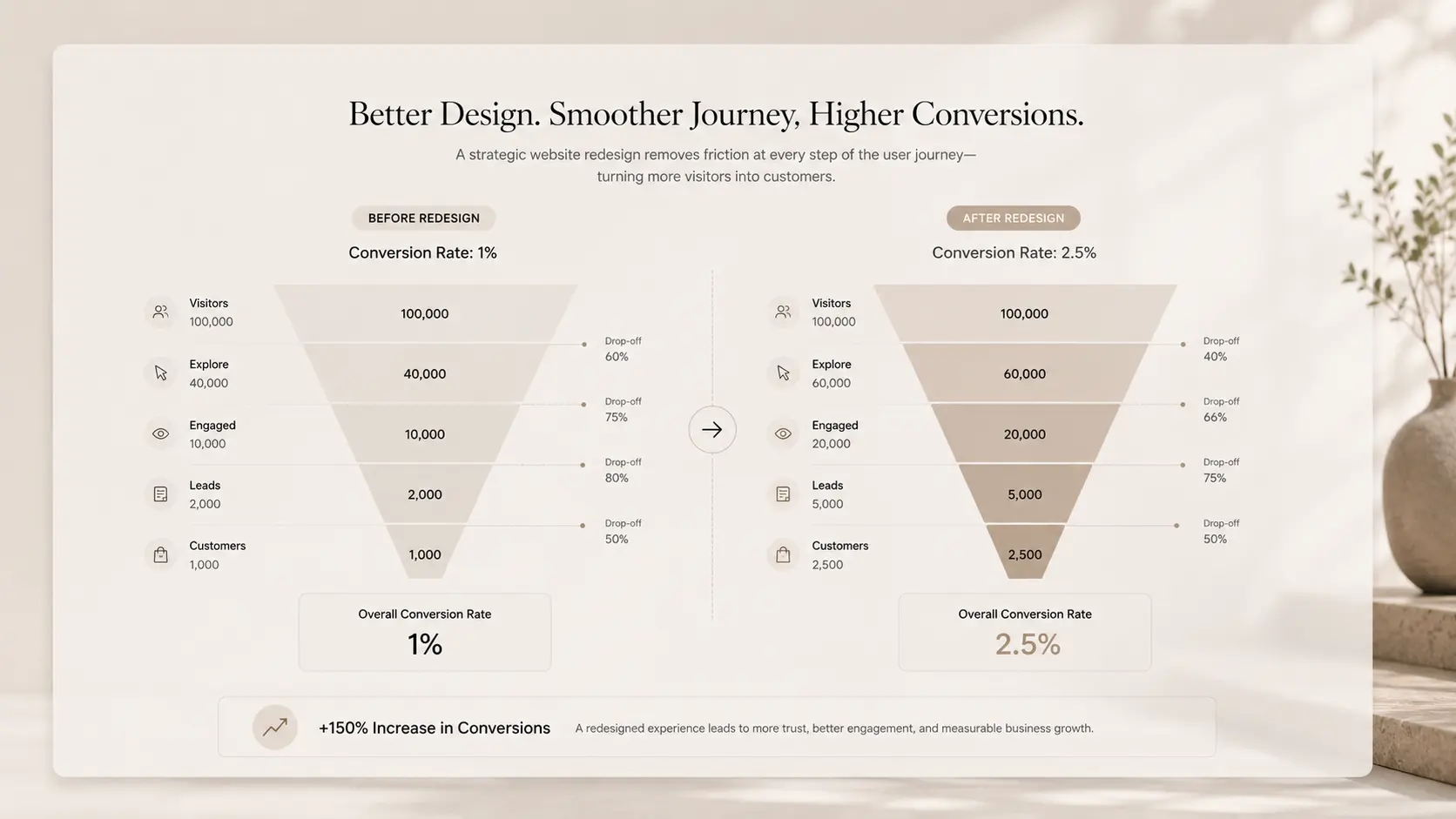
The Full ROI Picture: Beyond Conversion Rate
Conversion rate is the most direct ROI lever, but it’s not the only one. A complete website redesign ROI calculation includes several other value streams.
SEO Value
A redesign built on clean architecture, proper heading structure, optimised Core Web Vitals, and mobile-first design directly improves search rankings. Better rankings mean more organic traffic. More organic traffic means more potential conversions, without additional ad spend.
How much is that worth? If your current organic traffic is 3,000 visitors/month and a redesign increases that by 30% (900 additional visitors) at a 2% conversion rate and $800 average lead value, that’s an additional $14,400/month in pipeline from SEO alone.
Reduced Bounce Rate
A high bounce rate is expensive. Every visitor who bounces is a visitor you paid to acquire, through ads, SEO effort, or content, who left without taking action. Reducing bounce rate by 10–15% through better UX and clearer messaging can meaningfully increase the effective return on your entire marketing budget.
Brand Perception and Sales Cycle
This one is harder to quantify but very real. A website that looks credible, modern, and professional shortens the sales cycle. Prospects who trust your website arrive to sales calls better informed and more pre-sold. That means shorter deal cycles, less time per close, and higher close rates. A 10% improvement in close rate for a business closing $500,000/year from web leads is worth $50,000.
Reduced Support Load
Better UX reduces confusion. Clearer information architecture means fewer support enquiries. A well-structured FAQ, product page, or help section can meaningfully reduce inbound support volume, which has a measurable cost saving.
The Website Redesign ROI Calculator: Step by Step
Here’s a working framework you can complete right now. Fill in your own numbers.
Step 1 Baseline Revenue Calculation |
Monthly website visitors: _______ Current conversion rate (%): _______ Average value per conversion ($): _______ Monthly baseline revenue: = Visitors × CVR × Value |
Step 2 Conservative Post-Redesign Projection |
Projected new conversion rate (%): = Current CVR × 1.5 (50% improvement) Projected monthly revenue: = Visitors × New CVR × Value Monthly revenue increase: = New Monthly − Baseline |
Step 3 Annual ROI Calculation |
Annual revenue increase: = Monthly Increase × 12 Redesign investment ($): _______ Net annual gain: = Annual Increase − Redesign Cost ROI (%): = Net Gain ÷ Redesign Cost × 100 |
Step 4 Payback Period |
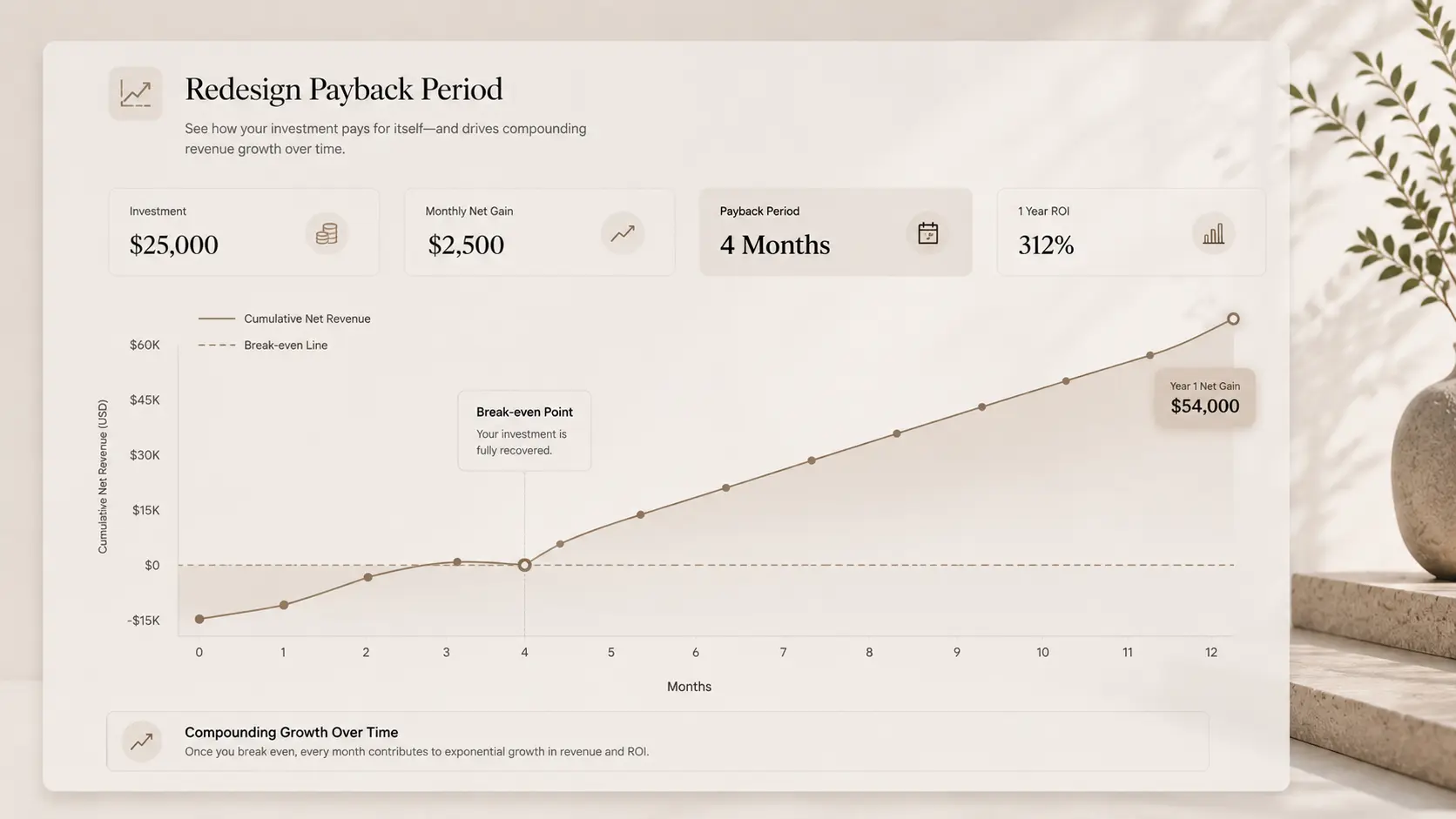
Payback Period (months): = Redesign Cost ÷ Monthly Revenue Increase Example: $20,000 redesign ÷ $5,000/month = 4 months to break even |
A $20,000 redesign generating $5,000/month in additional revenue pays back in 4 months. From month 5 onward, it’s pure return.
What Does a “Good” Website Redesign ROI Look Like?
There’s no industry standard, but here are reasonable benchmarks:
Business Type | Typical Redesign Cost | Conservative Annual ROI |
Small business / local service | $5,000 – $15,000 | 300% – 600% |
B2B professional services | $15,000 – $40,000 | 400% – 1,000% |
SaaS / tech startup | $20,000 – $60,000 | 200% – 800% |
E-commerce (mid-scale) | $20,000 – $80,000 | 150% – 500% |
Enterprise / large brand | $50,000 – $200,000+ | 100% – 400% |
These are conservative estimates based on a single conversion rate improvement. Add SEO uplift, brand perception value, and reduced bounce rate, and the true ROI of a well-executed website redesign is significantly higher.
The Redesigns That Don’t Deliver ROI
Not every redesign earns its cost back. Here’s what causes redesigns to underperform:
Redesigning for aesthetics, not conversion. A beautiful website that doesn’t address the structural reasons visitors weren’t converting is still a website that doesn’t convert.
No baseline data. If you can’t measure conversion rate before the redesign, you can’t prove improvement after. Set up proper tracking before the project starts.
Scope creep killing the timeline. Every week of delay is a week of lost improvement. Redesigns that run 3 months over schedule lose months of ROI.
Changing messaging mid-project. A redesign should start with a clear positioning brief. Changing the message after design has started restarts significant work.
Not testing after launch. A redesign is a starting point, not a destination. A/B testing CTAs, headlines, and page layouts after launch continuously compounds your ROI over time.
How Createxp Approaches Website Redesigns
A website redesign is an investment decision. Createxp treats it that way.
The team starts every redesign engagement with a performance audit of the existing site, not just the visual design, but the conversion architecture, the SEO structure, the page speed profile, and the analytics data. The goal is to identify exactly where revenue is leaking and build the redesign around fixing it.
Conversion Audit Before Design
Before any wireframe is drawn, the team reviews heatmaps, session recordings, bounce rate data, and conversion funnel analytics. This reveals the actual reasons visitors aren’t converting, not assumptions about it.
Messaging-Led Structure
The content hierarchy of the redesigned site is built around the customer’s decision journey. What do they need to understand first? What builds trust? What removes friction? The design expresses a strategy, not just a visual preference.
Performance as a Deliverable
PageSpeed scores, Core Web Vitals, and mobile experience are built into the brief, not retrofitted after launch. A redesign from Createxp is expected to perform measurably better than what it replaces, not just look better.
Post-Launch Tracking Setup
Every redesign launches with properly configured conversion tracking, goal funnels, and baseline reporting. You’ll know within 30 days whether the redesign is moving the right numbers.
Ongoing Optimisation Path
The first launch is the beginning, not the end. Createxp provides a post-launch optimisation roadmap, identifying the next A/B tests, content improvements, and UX iterations that will continue compounding the return on the redesign investment over time.
The result is a website that can be measured, improved, and justified, not just admired.
Your Redesign Should Pay for Itself The question isn’t whether you can afford a redesign. It’s whether you can afford to keep running one that’s underperforming. |
Key Takeaways
Website redesign ROI is measurable, use the formula: (New CVR − Old CVR) × Monthly Visitors × Avg. Value × 12, then divide by redesign cost.
Most well-executed redesigns improve conversion rate by 50–100%. Even a 50% improvement on modest traffic generates significant annual returns.
The ROI of a website redesign goes beyond conversion rate, SEO uplift, reduced bounce rate, brand credibility, and shortened sales cycles all add measurable value.
Redesigns fail to deliver ROI when they focus on aesthetics over conversion architecture, lack baseline data, or run over schedule.
The payback period for most business website redesigns is 3–6 months. After that point, every month of improved conversion is pure return.
Set up conversion tracking before the redesign starts. You can’t prove ROI on a metric you weren’t measuring.
A redesign is a starting point. Continuous testing and optimisation after launch compounds the return significantly over 12–24 months.
Frequently Asked Questions
What is the average ROI of a website redesign?
It varies widely by business type and execution quality. For B2B service businesses, a well-executed redesign typically delivers 400–1,000% ROI in year one. E-commerce redesigns tend to fall between 150–500%. The key variable is how much your conversion rate improves, and how much revenue each conversion is worth.
How do you calculate website redesign ROI?
Use this formula: [(Annual Revenue Increase from improved conversions − Redesign Cost) ÷ Redesign Cost] × 100. The annual revenue increase is calculated as: (New Conversion Rate − Old Conversion Rate) × Monthly Visitors × Average Conversion Value × 12.
How long does it take to see ROI from a website redesign?
Most businesses start seeing measurable ROI within 30–90 days of launch. The full payback period, where the redesign cost is fully recovered, typically happens within 3–6 months for businesses with consistent web traffic.
Does a website redesign improve SEO?
Yes, if it’s done correctly. A redesign that improves Core Web Vitals, page load speed, mobile experience, and content structure will improve organic rankings. Better rankings mean more organic traffic, which compounds the ROI over time. A redesign that changes URL structure without proper redirects, however, can temporarily hurt SEO, making proper technical execution critical.
What conversion rate improvement can I expect from a website redesign?
Conservative estimates suggest a 30–50% improvement in conversion rate from a well-executed redesign. Significant improvements to page speed, clarity, trust signals, and CTA design can deliver 100%+ improvements. The actual result depends heavily on how much room for improvement exists in the current site.
Is a website redesign worth the cost for small businesses?
Generally yes, especially for service businesses where each lead has significant value. A small business with 1,000 monthly visitors, a 1% conversion rate, and $500 average lead value generates $5,000/month from the website. Improving that conversion rate to 2% generates $10,000/month, a $60,000 annual gain. At a $10,000 redesign cost, the ROI is 500%.
What’s the difference between a website refresh and a full redesign?
A website refresh updates visual design, copy, and imagery while keeping the existing structure. A full redesign reconsiders the information architecture, conversion flow, technical foundation, and messaging strategy. A refresh costs less but delivers less measurable ROI. A full redesign costs more upfront but typically delivers significantly higher return over 12–24 months.
Warning: Working With Us May Trigger Unstoppable Momentum