
E-commerce Development
Trehan Sangpriya
CEO & Co-Founder
You might be planning to sell something online. Could be a product, a service, or a full brand experience. And right now, you’re sitting there wondering: “Okay, but what’s this actually going to cost me?” A totally fair question. It’s also one of the most googled things in the entire digital business space, because the answer varies wildly, and most articles either give you a number so vague it’s useless or a quote so high it sends you running.
So let’s just talk through it honestly.
The global e-commerce market crossed $6.3 trillion in 2024 and is on track to hit $8 trillion by 2027. That growth means more competition, more platform choices, and honestly, more pricing confusion than ever. What one agency quotes you for a Shopify store, another will quote at three times the price. Same brief. Completely different numbers. That’s not random, there are real reasons for it, and once you understand them, the numbers start making sense.
This guide breaks down ecommerce development cost by platform, scope, and team type. By the end, you’ll know exactly what you’re paying for, where the price goes up, and what a fair price looks like in 2026.
Why Ecommerce Cost Varies So Much
Before we get into numbers, you need to understand one thing: an “e-commerce” is not one thing. It’s a spectrum. A Shopify store selling three products is not the same project as a multi-vendor marketplace with custom inventory logic. Both are “e-commerce.” The cost difference between the two can be $3,000 versus $300,000.
Here’s what actually drives the price:
Platform choice, Shopify, WooCommerce, custom-built, or headless
Number of products, 10 products vs. 10,000 products changes everything
Design complexity, template-based or fully custom
Integrations, payment gateways, ERP systems, shipping APIs, loyalty programs
Team type, freelancer, local agency, offshore team, or specialist studio
Geographic location, development rates vary significantly by country
Timeline, faster always costs more
The person asking “how much does an ecommerce website cost?” almost never has the full picture yet. Let’s build it together.
E-commerce Development Cost by Platform (2026)
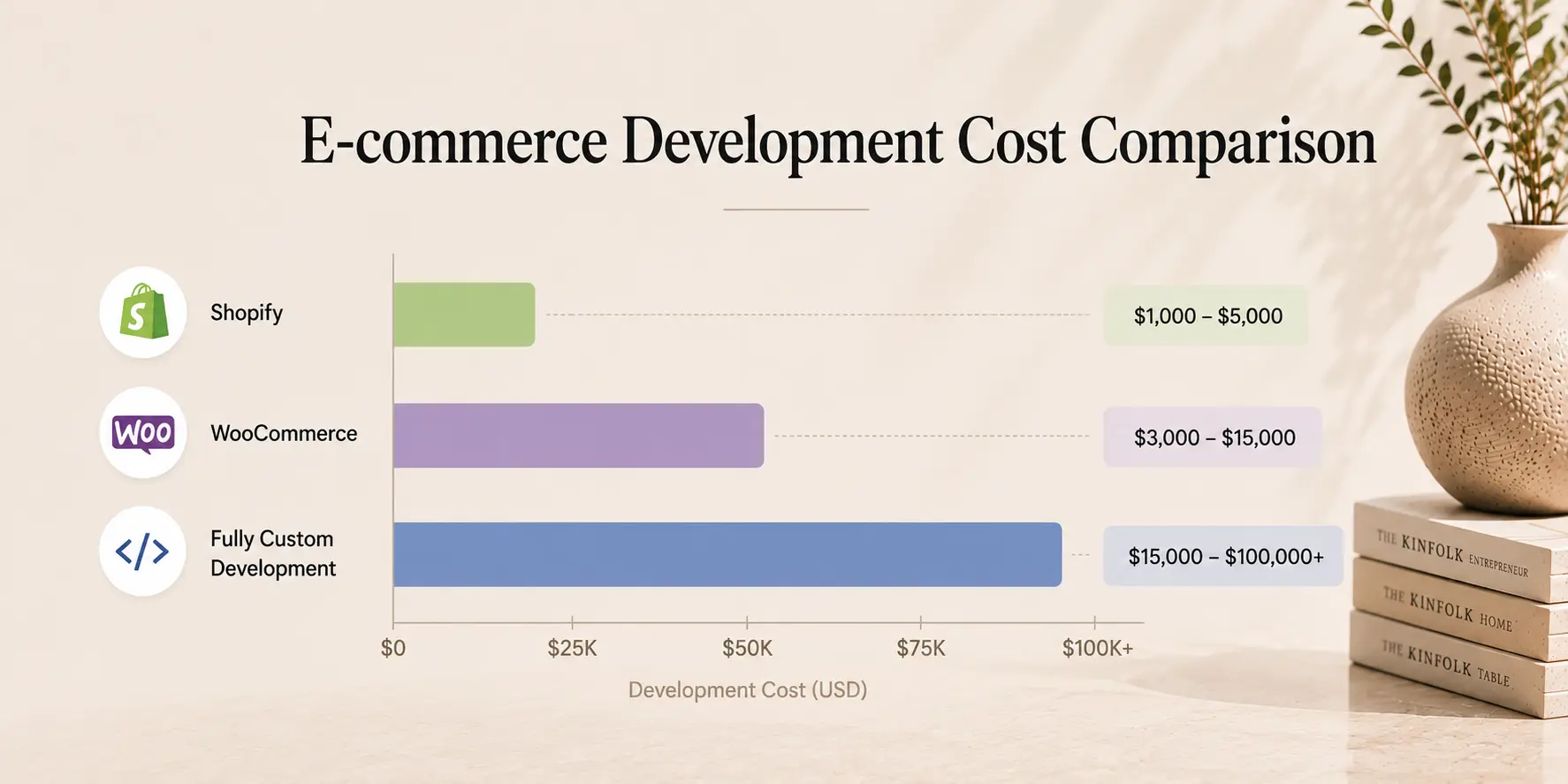
Shopify Development Cost
Shopify is the most popular e-commerce platform in the world, used by over 5 million merchants. It’s fast to set up, reliable, and has a massive ecosystem of apps and themes.
What does Shopify development actually cost?
Shopify Build Type | Cost Range |
Template-based Shopify store | $1,500 – $5,000 |
Custom theme Shopify store | $5,000 – $15,000 |
Shopify Plus (enterprise) | $15,000 – $60,000+ |
Shopify headless (custom frontend) | $25,000 – $100,000+ |
On top of development, factor in Shopify’s monthly fees: Basic ($29/mo), Shopify ($79/mo), Advanced ($299/mo), and Shopify Plus starting at $2,300/mo for high-volume stores.
Shopify development cost also includes apps. Most Shopify stores need 5–15 paid apps for reviews, upsells, email flows, loyalty programs, and analytics. Budget $100–$500/month for apps on top of the platform fee.
WooCommerce Development Cost
WooCommerce is WordPress’s e-commerce plugin, free to install, but the “free” part stops there quickly.
WooCommerce Build Type | Cost Range |
Basic WooCommerce setup (template) | $2,000 – $6,000 |
Custom WooCommerce store | $6,000 – $20,000 |
Large catalogue WooCommerce | $15,000 – $50,000 |
WooCommerce hosting, security, plugins, and ongoing maintenance add $200–$600/month on average. The platform is flexible and powerful, but it comes with a technical overhead that Shopify doesn’t have.
Custom E-commerce Development Cost
Custom e-commerce means building from scratch, no platform constraints, no template ceilings. This is the right choice when your business model doesn’t fit neatly into a Shopify or WooCommerce structure.
Custom Build Type | Cost Range |
Custom e-commerce (simple) | $20,000 – $50,000 |
Custom e-commerce (mid-complexity) | $50,000 – $150,000 |
Enterprise / multi-vendor marketplace | $100,000 – $500,000+ |
Custom builds take longer, cost more upfront, and require ongoing developer support. But for businesses with unique requirements, subscription models, multi-vendor setups, complex pricing logic, or tight integration with proprietary systems, they’re often the only viable path.
Online Store Pricing by Project Type
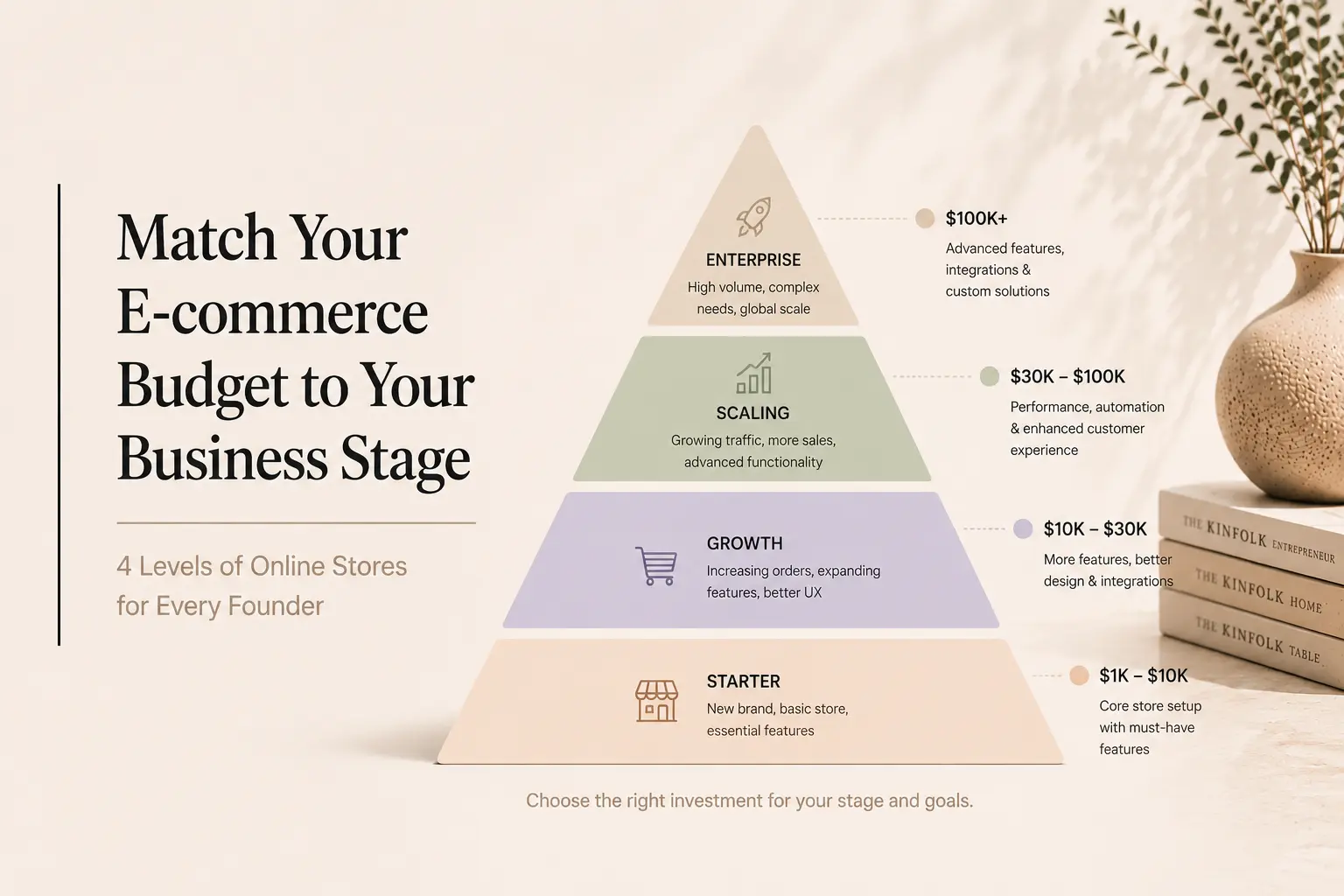
Let’s look at this from a different angle, what kind of store are you actually building?
Starter Store Budget: Under $5,000 • Shopify Basic or WooCommerce setup • 1 purchased theme (not custom) • Up to 50 products set up • Payment gateway integration (Stripe or PayPal) • Basic SEO settings • Mobile-responsive layout • Who it’s for: Side hustles, early-stage DTC brands, local businesses testing e-commerce |
Growth Store Budget: $5,000 – $20,000 • Custom or heavily customised theme • Full product catalogue setup • Multiple payment options • Shipping carrier integrations (FedEx, UPS, DHL) • Email marketing integration (Klaviyo, Mailchimp) • Basic loyalty or referral program • SEO-optimised structure • Analytics and conversion tracking • Who it’s for: Growing DTC brands, established small businesses, niche retailers |
Scaling Store Budget: $20,000 – $80,000 • Custom design system • Advanced product filtering and search (like Algolia) • Custom checkout flow • ERP or inventory management integration • Subscription billing setup • Multi-currency and international shipping • Performance optimisation • Who it’s for: Mid-market retailers, subscription businesses, brands scaling past $1M in annual revenue |
Enterprise Store Budget: $80,000+ • Headless frontend (Next.js or similar) • Custom backend or composable commerce setup • Advanced personalisation • B2B functionality (quotes, purchase orders, account-based pricing) • Multi-storefront management • Full security and compliance setup • Who it’s for: Large retailers, B2B companies, brands with $10M+ in annual e-commerce revenue |
Where the Budget Actually Goes
Here’s something most people don’t realise: in a typical e-commerce build, only about 40–50% of the total cost goes to design and development. The rest breaks down like this:
Cost Category | Typical % of Budget |
Design & development | 40–50% |
Project management | 10–15% |
QA & testing | 8–12% |
Content & product setup | 10–15% |
Integrations & apps | 10–20% |
Launch & post-launch support | 5–10% |
Understanding this breakdown stops you from getting surprised. When an agency quotes you $25,000 for an e-commerce build, they’re not charging $25,000 to write code. That number covers a full team, a full process, and everything that makes the store actually launch and work.
Freelancer vs. Agency vs. Specialist Studio: What’s the Difference?
This is the choice that often determines your actual outcome, more than the platform, more than the budget.
Freelancer
Cost: $15 – $75/hr (varies by region and experience)
Best for: Small, well-scoped projects with a clear brief
Risk: No backup if they get sick or disappear. Limited specialisation.
General Web Agency
Cost: $75 – $150/hr | $10,000 – $100,000 per project
Best for: Medium businesses that want a one-stop shop
Risk: E-commerce may not be their core strength. Jack of all trades.
Specialist E-commerce Studio
Cost: $100 – $200/hr | $15,000 – $200,000+ per project
Best for: Businesses where e-commerce performance is critical to growth
Risk: Higher upfront cost, but significantly lower risk of expensive mistakes
The real question isn’t “who’s cheapest?” It’s “who’s done this before for businesses like mine?” E-commerce mistakes are expensive. A bad checkout flow, a slow product page, or a broken inventory sync costs real money every day it exists.
Hidden Costs That Catch People Off Guard
Let’s talk about the costs nobody puts in the headline.
Platform fees: Shopify charges 0.5–2% transaction fees unless you use Shopify Payments. On $50,000/month in sales, that’s $250–$1,000/month going to fees.
App subscriptions: Most Shopify stores need paid apps. Budget $100–$500/month minimum.
Hosting and security (WooCommerce): Managed WooCommerce hosting runs $50–$300/month depending on traffic.
SEO and content: Getting found is a separate investment from getting built. Budget at least $500–$2,000/month for ongoing SEO if organic traffic is part of your strategy.
Payment gateway fees: Stripe charges 2.9% + $0.30 per transaction. On high volume, these add up fast.
Photography and product content: Quality product photos cost $20–$100 per product. For a 200-product store, that’s $4,000–$20,000 in content alone.
Maintenance and updates: After launch, budget 10–20% of development cost per year for ongoing maintenance.
How Createxp Approaches E-commerce Development
There’s a common pattern in how e-commerce projects go wrong: the brief is vague, the scope expands during development, and the final cost bears no resemblance to the original quote. By the end, the client has spent twice what they planned and got a store that still isn’t performing.
Createxp has worked with brands across retail, fashion, health, and consumer goods, and the process is built specifically to avoid that outcome.
Here’s what the Createxp approach looks like in practice:
Scoping first, always
Before any design or development starts, the team maps out every feature, integration, and requirement. A fixed scope means a fixed price. No surprises at invoice time.
Platform-agnostic recommendations
The team doesn’t push Shopify because it’s easy or custom development because it’s lucrative. The recommendation comes from what your business actually needs. A $5M fashion brand and a $50K lifestyle brand need fundamentally different setups.
Conversion-led design
E-commerce design isn’t about looking good, it’s about selling. Product page layouts, checkout flow, mobile experience, and load speed are all built around conversion, not aesthetics. The two aren’t mutually exclusive, but conversion comes first.
Full handover and training
When the store launches, your team knows how to run it. Product uploads, order management, discount codes, analytics, all covered in a proper handover. You shouldn’t need to call your developer to add a product.
Post-launch support included
The first 30 days after launch are when things surface. Createxp stays available through that window as standard, not as a paid extra.
Whether you’re building a new store from scratch, migrating from an existing platform, or scaling a store that’s outgrown its current setup, the outcome is the same: a store that works, converts, and doesn’t fall apart six months later.
Don’t Let Budget Confusion Delay Your Store Every build is different. Get a quote built around what you actually need. |
Key Takeaways
E-commerce development cost in 2026 ranges from under $5,000 for a basic Shopify template store to $500,000+ for a full enterprise custom build.
Shopify development cost for a custom theme store typically runs $5,000–$15,000. Shopify Plus builds start at $15,000 and scale significantly.
Platform choice (Shopify vs. WooCommerce vs. custom) should be driven by your business model and growth plans, not by what’s cheapest upfront.
Hidden costs, apps, hosting, transaction fees, content, SEO, can add $500–$3,000/month to your ongoing operational costs.
Only 40–50% of a typical e-commerce budget goes to design and development. The rest covers project management, QA, content, integrations, and support.
Choosing a specialist e-commerce studio costs more upfront but dramatically reduces the risk of expensive post-launch problems.
Budget 10–20% of your development cost annually for maintenance and updates after launch.
Frequently Asked Questions
How much does ecommerce development cost in 2026?
It depends on scope and platform. A basic Shopify store using a template runs $1,500–$5,000. A custom Shopify store is $5,000–$15,000. A mid-complexity custom e-commerce build is $50,000–$150,000. Enterprise platforms can reach $500,000 or more. Most growing businesses land in the $10,000–$50,000 range for a properly built store.
What is the cheapest way to build an e-commerce website?
The cheapest functional option is a Shopify Basic plan ($29/month) with a purchased theme ($100–$350) and basic setup. You can be live for under $2,000. It won’t be custom, but it works for early-stage businesses testing product-market fit.
How much does Shopify development cost?
Shopify development cost ranges widely. A template setup by a freelancer might cost $1,500–$3,000. A custom theme build by an agency runs $5,000–$15,000. A Shopify Plus enterprise build typically starts at $15,000 and can easily exceed $60,000 for complex requirements.
Is custom e-commerce development worth the cost?
For businesses with unique requirements, subscription models, multi-vendor setups, complex B2B pricing, or deep integration with internal systems, custom development is often the only viable option. For straightforward product catalogues, Shopify or WooCommerce is almost always the smarter investment.
What are the ongoing costs of running an e-commerce website?
Plan for $300–$3,000/month in operational costs depending on platform and scale. This includes hosting or platform fees ($29–$300/month), paid apps ($100–$500/month), payment processing fees (2.9%+ per transaction), and maintenance/updates (10–20% of development cost annually).
How long does it take to build an e-commerce website?
A template-based Shopify store can launch in 2–4 weeks. A custom e-commerce build typically takes 6–16 weeks depending on complexity. Enterprise builds can run 6–12 months. Timeline and budget are directly linked, faster always costs more.
What’s the difference between Shopify and WooCommerce in terms of cost?
Shopify has a predictable monthly fee structure and lower technical overhead. WooCommerce is free to install but requires paid hosting, plugins, and ongoing maintenance, which adds up. For most small-to-medium stores, total cost of ownership over two years is roughly similar. Shopify wins on reliability and ease of use. WooCommerce wins on flexibility and content management.
Warning: Working With Us May Trigger Unstoppable Momentum