
UI UX Design
Neeha Fathima
CDO & Co-Founder

You're staring at a budget line that says "design" and trying to figure out whether to hire someone full-time or bring in an agency. It sounds like a simple call. In practice, it's one of the most misunderstood decisions a growing company makes.
The debate around in-house vs agency UX comes down to more than just hourly rates. Hidden costs, opportunity costs, skill gaps, timing, these are the things that blow up a decision that looked straightforward on a spreadsheet.
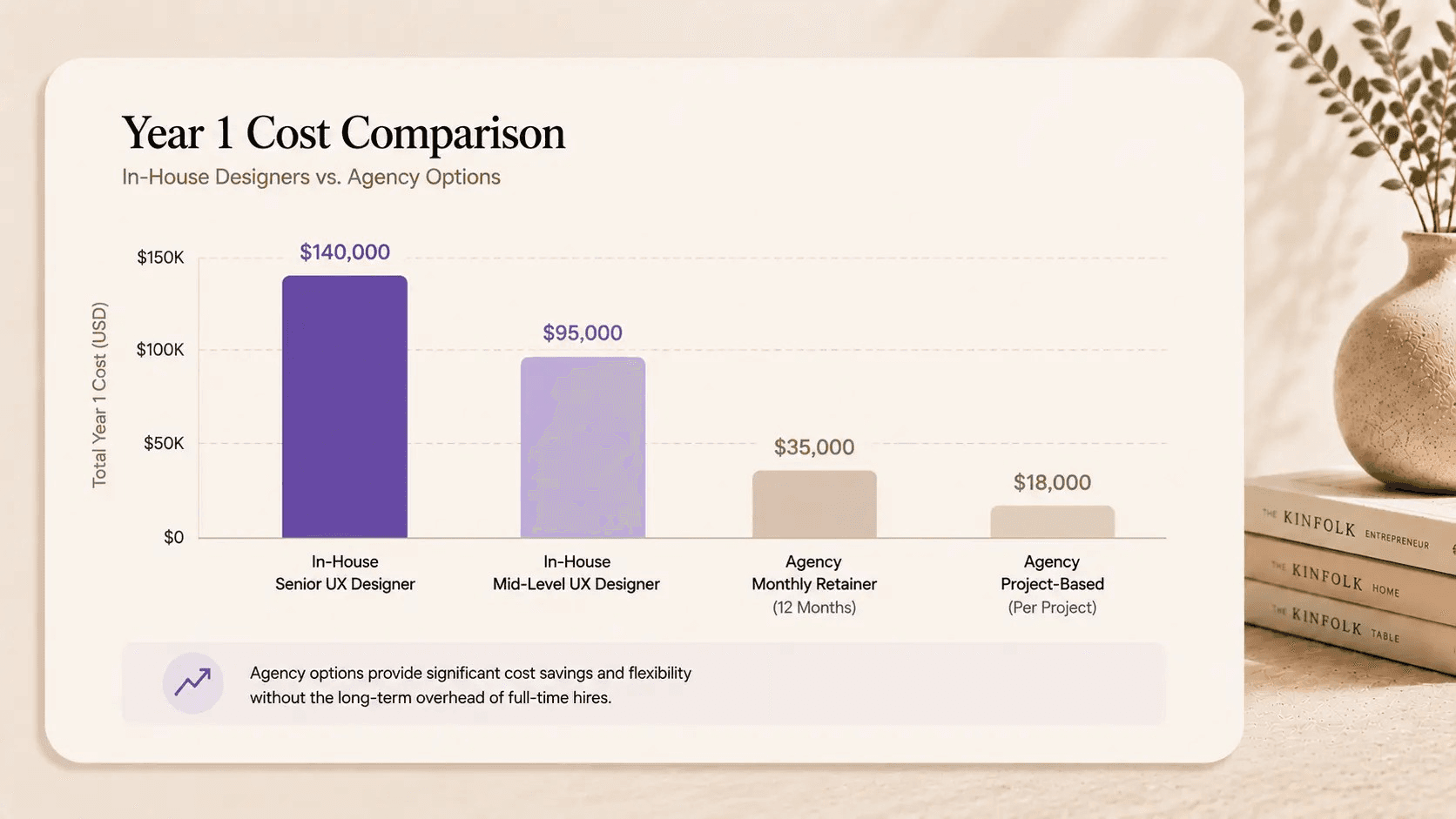
Here's a number that tends to shift the conversation fast. According to the US Bureau of Labor Statistics, the median annual salary for a UX designer in the US in 2025 sits at around $95,000–$115,000. But the real cost of an in-house hire, once you factor in benefits, taxes, equipment, recruitment, and onboarding, lands somewhere between $130,000 and $230,000 in year one alone. That's a very different number from what most hiring managers put in a budget proposal.
This post lays it all out. Real numbers, real trade-offs, and a clear framework to help you decide which path actually makes sense for your business right now.
The Headline Summary (If You're Short on Time)
Both options can work. Neither is universally cheaper. The right answer depends entirely on your volume of design work, your stage of growth, and how fast you need to move.
In-house design is worth it when you have consistent, high-volume design needs that justify a full-time hire. An agency makes more sense when you need quality fast, want specialist skills, or don't have steady work to fill a full role.
The mistake most companies make is comparing a designer's salary to an agency's project fee. That's not an apples-to-apples comparison. You need the full picture, and that's exactly what this breakdown gives you.
The True Cost of Hiring an In-House UX Designer in 2026
Most hiring conversations start and end with base salary. That's the first mistake. When you're evaluating the real cost of an internal design team, the salary is just the floor.
What the Numbers Actually Look Like
Here's a full breakdown of what hiring a UX designer in the US actually costs in year one, including every line item that rarely makes it into a job offer conversation.
Year 1 True Cost: In-House UX Designer (US Market)
Cost Item | Mid-Level Designer (US) | Senior Designer (US) |
Base salary | $85,000 – $100,000 | $120,000 – $150,000 |
Employer payroll taxes (~8%) | $6,800 – $8,000 | $9,600 – $12,000 |
Health & dental benefits | $6,000 – $10,000 | $6,000 – $10,000 |
Paid leave (15–20 days) | $4,900 – $5,800 | $6,900 – $8,700 |
Equipment & software licences | $3,000 – $5,000 | $3,000 – $5,000 |
Recruitment cost (one-time) | $8,500 – $15,000 | $12,000 – $22,500 |
Onboarding & training | $2,000 – $4,000 | $2,000 – $4,000 |
Management overhead (~10%) | $8,500 – $10,000 | $12,000 – $15,000 |
TOTAL YEAR 1 (approx.) | $124,700 – $157,800 | $171,500 – $227,200 |
These numbers are conservative. Some companies spend more on recruitment, especially if they use a specialist recruiter, which typically charges 15–25% of annual salary as a placement fee. Add relocation packages or signing bonuses and year one gets even more expensive.
The Costs That Don't Show Up on a Spreadsheet
Beyond the hard numbers, there are costs that are harder to measure but very real.
Ramp-up time
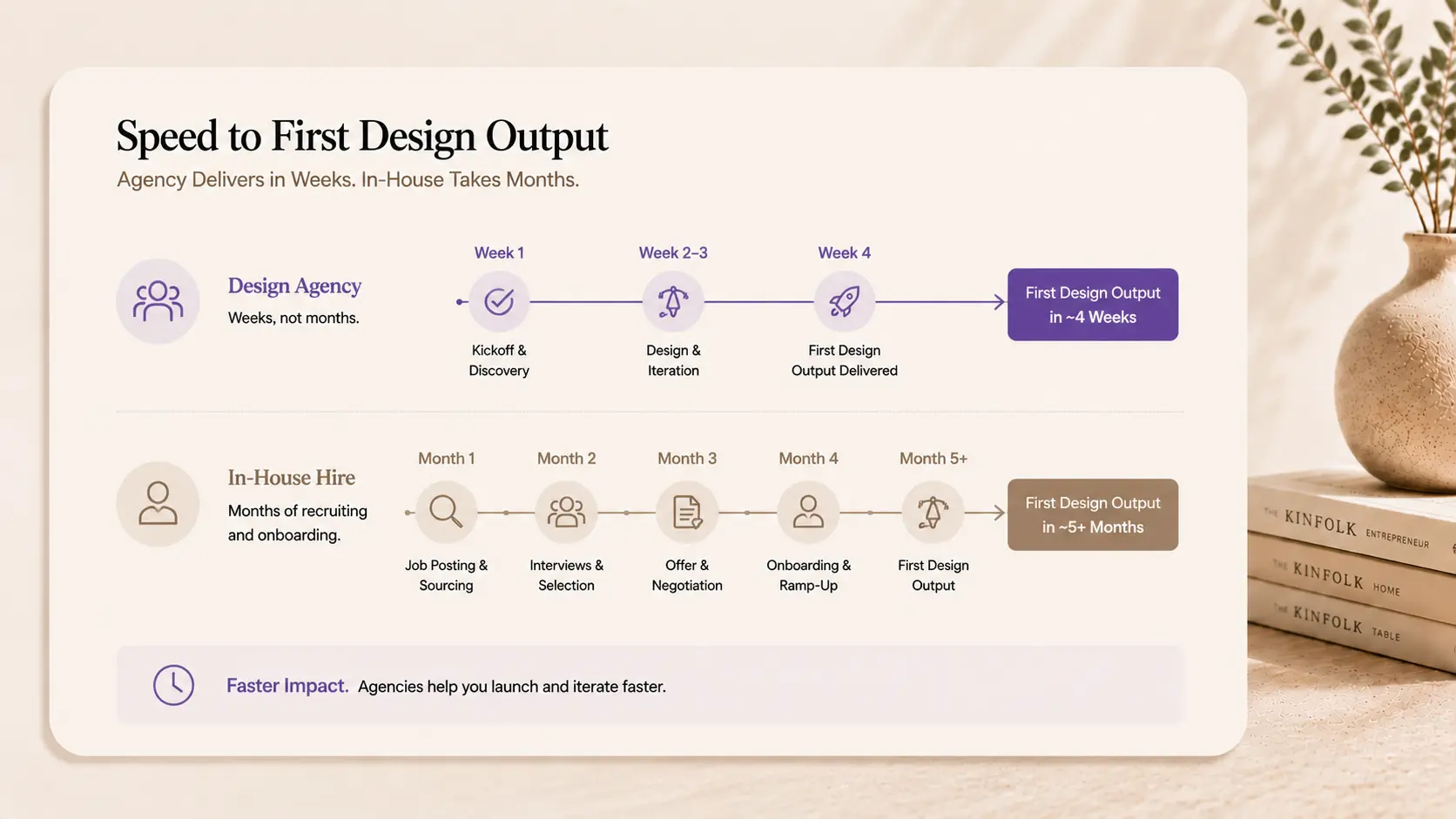
A new in-house hire rarely operates at full productivity in month one. Realistically, it takes 60–90 days before someone is genuinely adding full value. You're paying a full salary during that period regardless.
Single point of failure
One designer means one set of skills, one perspective, and one person's availability. When they're sick, on leave, or stuck on one project, everything else waits. That's a cost that doesn't appear in a budget but shows up in missed deadlines.
Skill gaps
A solid UX designer might not be a strong visual designer. A great UI designer might struggle with strategy or research. Most startups need a range of skills, and one hire rarely covers all of them.
The True Cost of Working With a Design Agency
Agency pricing can look intimidating at first glance. A $50,000 project fee hits differently than a monthly salary line. But the comparison needs to be honest.
What Agencies Typically Charge
Pricing varies significantly based on geography, agency size, and project scope. Here's a realistic range for the US market in 2026.
Agency Design Cost Ranges (US, 2026)
Project Type | Typical Agency Range (US) | Timeline |
UX audit / research sprint | $3,000 – $8,000 | 1–2 weeks |
Landing page / marketing site | $5,000 – $20,000 | 2–4 weeks |
Full product UI/UX (MVP) | $15,000 – $50,000 | 4–10 weeks |
Design system creation | $10,000 – $30,000 | 3–8 weeks |
Ongoing design retainer | $3,000 – $8,000/mo | Rolling |
App redesign (end-to-end) | $20,000 – $80,000 | 6–14 weeks |
Global agencies in markets like India or Eastern Europe often deliver comparable quality at 30–60% lower cost. For context, a full MVP design engagement that costs $40,000 with a US agency might run $12,000–$20,000 with a high-quality international studio.
What You're Actually Getting With an Agency
The fee covers more than one designer's time. You're typically getting a team, a UX lead, a visual designer, sometimes a strategist or copywriter, all coordinated for you. That's a capability that would cost three to five times more to replicate in-house.
What a good agency engagement includes
• A cross-functional team, not a single contributor
• Established processes, tooling, and design systems already in place
• Speed, agencies can start within days, not months
• Built-in accountability through contracts and deliverables
• No HR overhead, no benefits, no recruitment risk
The flip side is that an agency doesn't live inside your company. You need to invest in briefing, communication, and feedback cycles to get the best out of the relationship.
Head to Head: The Full Picture
In-House vs Agency: Full Comparison
Factor | In-House Designer | Design Agency |
Year 1 total cost | $125K – $228K | $15K – $80K (project-based) |
Speed to start | 2–3 months (hiring) | 1–2 weeks |
Skill breadth | One person's range | Full team: UX, UI, strategy |
Availability | Full-time, dedicated | Project-scoped or retainer |
Institutional knowledge | Builds over time | Requires onboarding |
Flexibility to scale | Hard to adjust quickly | Easy to scale up/down |
Accountability | Direct, internal | Contract-based |
Best for | Large teams, constant work | Startups, projects, bursts |
When In-House Actually Wins
There are clear situations where building an internal design team is the right call. It's not about preference, it's about volume and continuity.
The case for going in-house
• You have 40+ hours per week of consistent design work, every week, indefinitely
• Your product is complex and requires deep institutional knowledge that takes months to build
• You're at Series B or beyond with the budget to build a full design function properly
• Design is a core competitive differentiator and you need it tightly integrated with product and engineering
The internal design team cost only makes financial sense when you have sustained, predictable demand. If your design needs are project-based or fluctuate seasonally, you'll be paying a full salary for part-time output.
The hidden advantage of in-house
One genuine advantage that agencies can't replicate is depth of context over time. An in-house designer learns your brand, your users, and your product's history. That knowledge compounds and becomes genuinely valuable.
The catch is it takes 6–12 months to fully develop. And during that ramp period, you're paying full price for partial value.
When an Agency Is the Smarter Call
For most startups, especially in the first three years, the answer to the hiring UX designer vs agency question leans toward the agency, for one very practical reason.
You don't have full-time, consistent design work yet. Or if you do, you need more speed and breadth than one hire can provide.
The agency wins when
• You're pre-Series A and capital efficiency matters
• You need to launch something in 30–90 days and can't wait to hire
• Your project needs a team, strategy, UX, and visual design, not just one role
• Your design needs are project-heavy but not constant
• You've tried hiring and struggled to find the right person at your budget
Working with a quality agency also de-risks the design investment. A bad hire costs you 6–12 months and $100K+. A project engagement that doesn't work out is scoped, time-boxed, and limited in damage.
The retainer model: a middle ground
A lot of growing companies end up on a design retainer with an agency. You get a set number of hours per month, usually 40–80, for a fixed monthly fee. You get consistent access to a team without committing to a full-time salary.
This model is particularly effective for companies that have ongoing design needs but not enough volume to justify a full in-house function. At $4,000–$8,000 per month, a retainer typically costs less than half of what an in-house designer costs when you account for all associated expenses.
How CREATEXP Works With Businesses on This Decision
At CREATEXP, this specific conversation, in-house vs agency UI/UX, comes up more than almost any other topic in early calls with new clients. And honestly, the studio's position is straightforward: the right answer depends on where your business actually is.
For startups in the early stages, the agency model almost always delivers more value per dollar. You get a full team, designers, strategists, sometimes developers, from day one. There's no onboarding lag, no recruitment risk, and no salary commitment that outlasts the project.
For companies that already have an internal design team but are facing a capacity gap or a specialised project, a design system overhaul, a product redesign, an MVP sprint, CREATEXP often works alongside in-house teams rather than replacing them. The studio handles the intensive design work while the internal team stays focused on the ongoing product.
What makes this model work is the way the team is structured. No outsourcing, no junior designers billed at senior rates, no account manager sitting between the client and the actual work. The people doing the strategy are the same people doing the design. That tightness is what makes fast, high-quality output possible.
The studio has delivered full product design engagements in 30 days and multi-phase design systems over several months. The scope varies, the commitment to quality doesn't. For businesses doing this comparison right now, the honest advice is: don't default to in-house just because it feels more controlled. Think about what you actually need, when you need it, and what the real cost of each path looks like.
Not Sure Which Option Is Right for Your Business? Get a straight answer from the CREATEXP team, no pitch, just clarity. |
Numbers Worth Remembering
Here's the condensed version for quick reference:
1. The true year-one cost of an in-house UX designer in the US is $125K–$228K, not just their salary.
2. Agency projects typically run $15K–$80K depending on scope, with retainers at $3K–$8K per month.
3. In-house wins when you have consistent, full-time design demand and the budget to hire properly.
4. Agencies win when you need speed, breadth, or project-based work without the overhead of a full hire.
5. Hiring a UX designer vs agency isn't an either/or, retainer models offer a practical middle ground.
6. The ramp-up time for a new in-house hire is 60–90 days. Agencies can start in under two weeks.
7. A bad in-house hire costs 6–12 months and $100K+. A scoped agency engagement limits that risk.
8. Internal design team cost only makes sense at scale, when the volume of work justifies a dedicated role.
The Questions People Ask Most
Is it cheaper to hire a UX designer in-house or use an agency?
For most startups and mid-size companies, an agency is cheaper when you account for the full cost of an in-house hire. A mid-level UX designer in the US costs $125K–$160K in year one including salary, taxes, benefits, equipment, and recruitment. A comparable agency engagement for a defined project typically runs $15K–$50K. However, for companies with ongoing, high-volume design needs, in-house can become cost-effective over a 2–3 year horizon.
When should a startup hire an in-house UX designer?
A startup should consider an in-house hire when it has consistent, full-time design work that fills at least 40 hours per week on an ongoing basis. That usually becomes relevant around Series B, when the product is mature enough to require deep institutional knowledge and the team size justifies dedicated design headcount.
What does a UX design agency charge per hour?
US-based UX agencies typically charge $100–$200 per hour for individual designer time. Full-service agencies with strategy, UX, and visual design capabilities often work on project or retainer pricing rather than hourly. Global studios offering comparable quality in markets like India tend to charge $30–$75 per hour.
Can an agency replace an in-house designer?
For project-based work, yes. For work that requires daily integration with product, engineering, and leadership, an agency is more effective as a complement rather than a replacement. The strongest engagements tend to be agencies that work closely alongside internal teams rather than in isolation.
What is a design retainer and is it worth it?
A design retainer is a monthly arrangement where you pay a set fee for a fixed block of agency hours. It gives you consistent access to a design team without committing to a full-time hire. For companies that have ongoing but not full-time design needs, retainers typically offer the best value, usually 30–50% cheaper than the equivalent in-house cost.
How long does it take to onboard an in-house UX designer?
Most companies find it takes 60–90 days for a new in-house designer to be operating at full effectiveness. The first few weeks involve process onboarding, tool setup, and learning the product. Full context and productive output at speed usually comes around the 90-day mark.
What are the hidden costs of an in-house design team?
The main hidden costs are employer payroll taxes (6–8% of salary), health benefits ($6K–$10K per year), paid leave (which still costs salary), equipment and software licences ($3K–$5K upfront), recruitment fees ($8K–$22K), and ongoing management overhead. Together, these typically add 35–55% on top of base salary in year one.
Warning: Working With Us May Trigger Unstoppable Momentum