
SAAS Development
Trehan Sangpriya
CEO & Co-Founder
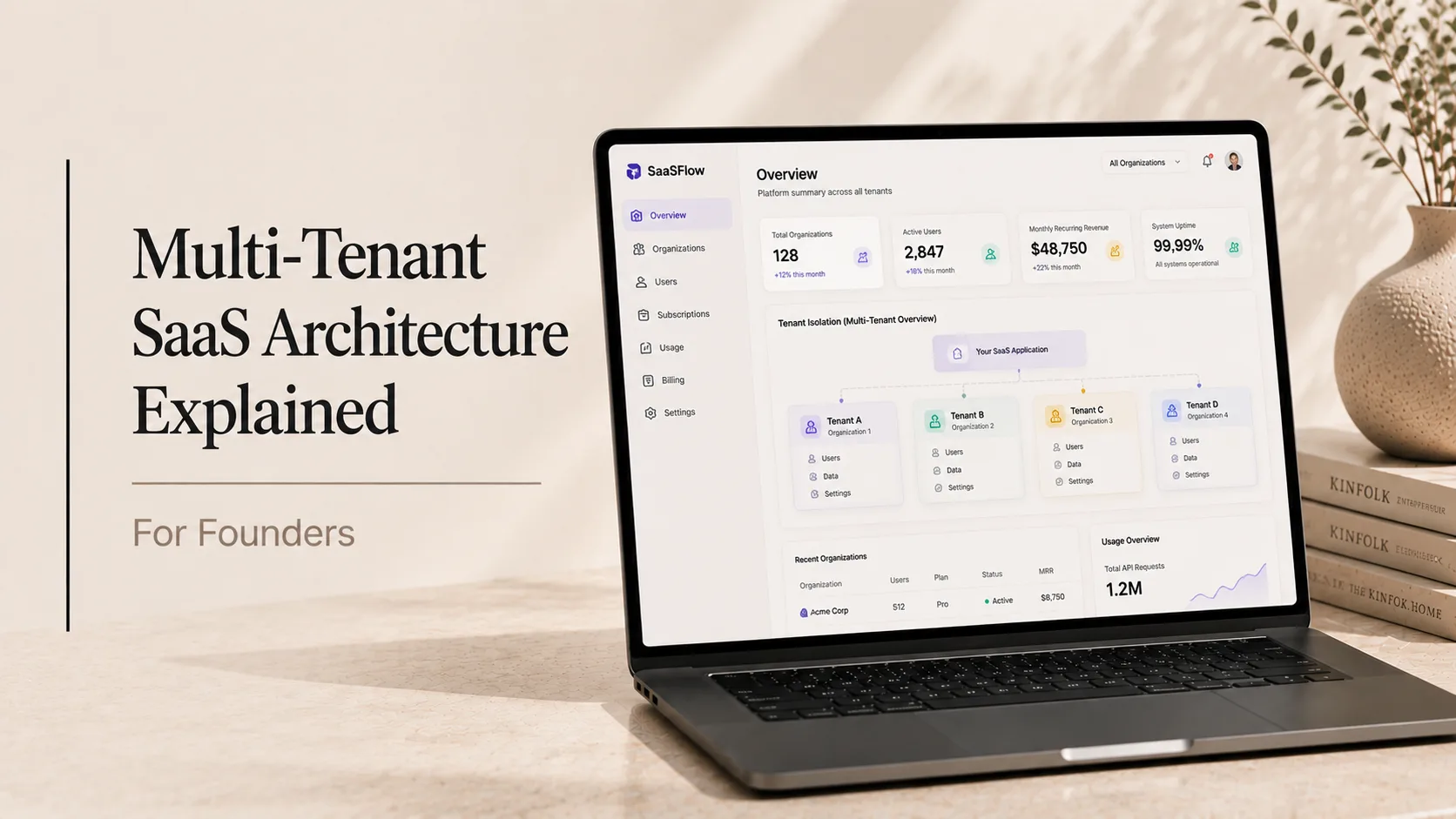
If you're building a SaaS product, you've probably heard the term "multi-tenancy" thrown around. Maybe in a technical conversation, maybe from an investor who asked about your architecture. And you nodded along thinking, "I'll look this up later." This is that moment.
Multi-tenancy is one of those concepts that sounds more complex than it actually is. But get it wrong in your architecture, or skip it entirely, and you'll pay for it later. Either through scaling problems, security nightmares, or a codebase that becomes impossible to maintain as your customer count grows.
Here's the thing: the majority of the SaaS products you've used today, Slack, Salesforce, HubSpot, Notion, are all multi-tenant systems. The global SaaS market runs on this model because it makes economic sense. Multi-tenant architectures can reduce infrastructure costs by up to 80% compared to running a separate deployment for every customer. That's why it's the backbone of virtually every scalable SaaS business.
This guide breaks down what multi-tenant SaaS architecture actually means, how it works, the different models you can implement, and the real trade-offs between each. If you're building a SaaS product right now, or planning to, this is required reading.
What Does Multi-Tenancy Actually Mean?
Let's start simple. A "tenant" in SaaS terms is a customer, usually a company or organisation that's using your product. Multi-tenancy means multiple customers (tenants) are using the same application and infrastructure simultaneously, while their data remains completely separate and secure.
Think of it like an apartment building. Many residents share the same building infrastructure, foundation, plumbing, elevators, but each apartment is private. No one can walk into your neighbour's unit. Multi-tenant SaaS works exactly the same way: shared infrastructure, isolated data.
The alternative, where every customer gets their own separate deployment, is called single-tenancy. Think of that as every customer having their own detached house. More private by default, more expensive to build and maintain, and much harder to scale.
Multi-tenancy means: one application serving many customers, with each customer's data kept completely isolated.
Why Multi-Tenancy Is the Standard for SaaS
The economics of multi-tenancy make it the default choice for almost every SaaS business. Here's why it wins:
Cost Efficiency
Running a single shared infrastructure for 1,000 customers is dramatically cheaper than running 1,000 separate deployments. Server costs, maintenance overhead, monitoring, and DevOps effort all scale far more efficiently in a multi-tenant model.
Easier Updates and Maintenance
When you push a bug fix or a new feature in a multi-tenant system, all your customers get it simultaneously. No version sprawl. No "customer A is on v2.1, customer B is still on v1.8" headaches. One codebase, one deployment, everyone benefits.
Faster Onboarding
Adding a new tenant in a multi-tenant system is typically a matter of creating a new record in a database. In a single-tenant model, you'd need to spin up new infrastructure. The difference between seconds and hours.
Resource Optimisation
Not every customer uses your product at the same time or with the same intensity. A multi-tenant system can allocate resources dynamically, when one customer's workload is low, those resources serve other customers who need them at that moment.
The Trade-Off
Multi-tenancy adds complexity. You're responsible for ensuring that tenant data isolation is airtight. A bug that allows one customer to see another's data is a catastrophic security incident. Getting the architecture right from the beginning matters enormously.
The Three Models of Multi-Tenancy
Here's where it gets interesting. Multi-tenancy isn't a single approach, it's a spectrum. There are three main architectural models, and each one makes different trade-offs between cost, isolation, and complexity.
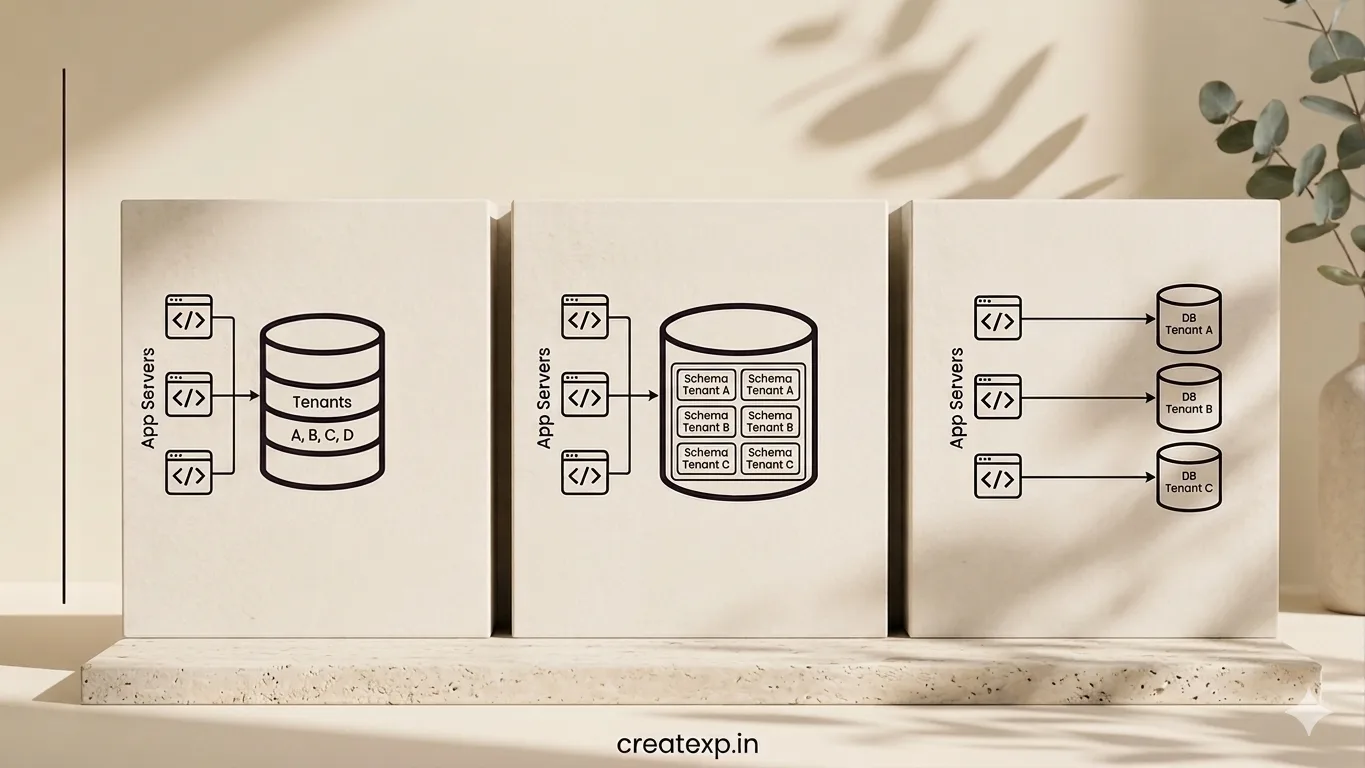
Model 1, Shared Database, Shared Schema
All tenants share the same database and the same tables. A tenant_id column on every table identifies which records belong to which customer.
How it works: Every query includes a WHERE tenant_id = 'X' filter. The application layer enforces this. Every row in every table is tagged to a specific tenant.
Advantages:
Lowest infrastructure cost
Simplest to build and maintain
Easiest to add new tenants
Best resource utilisation
Disadvantages:
Requires rigorous application-level enforcement of isolation
One missing
tenant_idfilter in a query = data leak between tenantsHarder to customise per tenant (schema changes affect everyone)
Can create noisy neighbour problems, one heavy tenant can slow queries for others
Best for: Early-stage SaaS products, products with many small tenants, cost-sensitive architectures where tenants have similar requirements
Model 2, Shared Database, Separate Schemas
All tenants share the same database server, but each tenant gets their own schema (or namespace). Tables like users, orders, and products exist in every schema but are completely separate.
How it works: When a tenant logs in, the application points to their schema. tenant_a.users, tenant_b.users, separate tables, same database server.
Advantages:
Better isolation than shared schema
Easier to customise per tenant
Simpler backup and restore per tenant
Good balance of cost and isolation
Disadvantages:
More complex database management as tenant count grows
Still shares a database server, a database-level incident affects all tenants
Schema migrations need to run across all tenant schemas
Best for: Mid-market SaaS products, applications where per-tenant customisation is important, regulated industries with stricter data requirements
Model 3, Separate Databases
Each tenant gets their own dedicated database. The application routes connections to the correct database based on the tenant.
How it works: A routing layer identifies the tenant, looks up their database connection string, and directs all queries to their isolated database.
Advantages:
Maximum data isolation
Easiest compliance with data residency requirements
Complete performance isolation, no noisy neighbour problem
Simpler disaster recovery per tenant
Disadvantages:
Significantly higher infrastructure cost
Much more complex operations (managing hundreds or thousands of databases)
Slower tenant onboarding (provisioning a new database takes time)
Cross-tenant analytics and reporting become harder
Best for: Enterprise SaaS products, healthcare and fintech where regulatory requirements demand it, products selling to large enterprise customers who require strict isolation
Multi-Tenant vs Single-Tenant: The Full Comparison
The decision isn't always clear-cut. Here's how the two models compare across the dimensions that matter most.
Factor | Multi-Tenant | Single-Tenant |
Infrastructure cost | Low (shared) | High (per customer) |
Onboarding speed | Seconds to minutes | Hours to days |
Data isolation | Application/DB enforced | Physical separation |
Customisation per client | Limited (shared code) | Unlimited |
Maintenance overhead | Low (single deployment) | High (per deployment) |
Compliance flexibility | Harder | Easier |
Scalability | Excellent | Complex |
Best for | Most SaaS products | Enterprise, regulated industries |
The honest answer is that most SaaS businesses should start with multi-tenancy and add single-tenant options only when a specific large customer requires it and the revenue justifies the operational overhead.
The Key Technical Components of a Multi-Tenant SaaS Architecture
Building multi-tenancy properly requires getting several pieces right. These are the components that matter most.
Tenant Identification
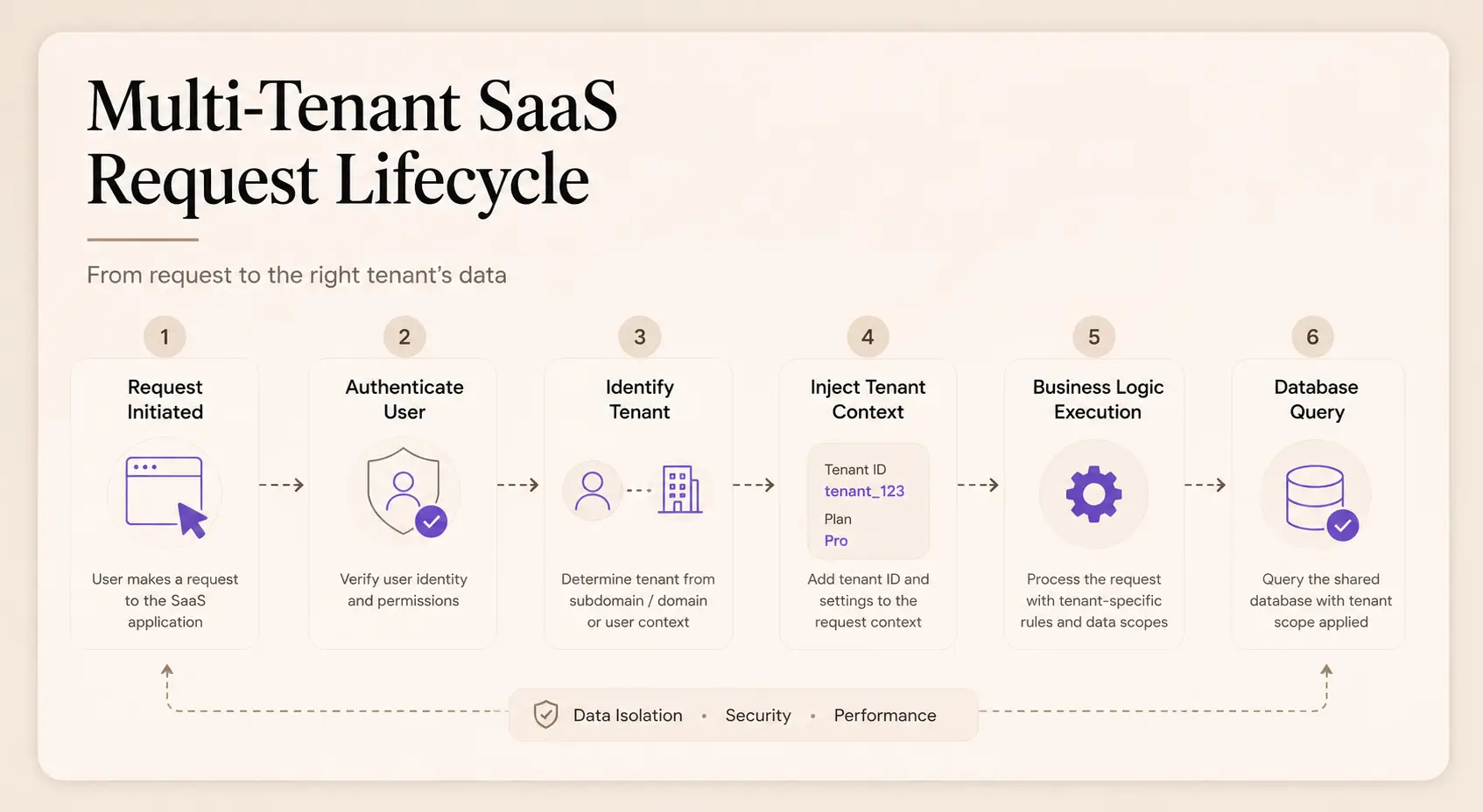
The system needs to know which tenant is making every request. The most common methods:
Subdomain routing,
acmecorp.yourapp.comresolves to acmecorp's tenantCustom domain,
app.acmecorp.compoints to your infrastructure via DNSJWT claims, the auth token contains the tenant identifier
URL parameter,
yourapp.com/app?tenant=acmecorp(less elegant, less common)
Subdomain routing is the most common approach for modern SaaS products. It's clean, it supports custom domains, and it makes tenant identification obvious at the infrastructure level.
Tenant Context Propagation
Once the tenant is identified, that context needs to flow through every layer of the application, API layer, service layer, database layer. Losing tenant context at any point in the stack is how data leaks happen.
Most implementations use middleware or a request context object that carries the tenant ID through the entire request lifecycle. In Node.js, this is often handled with AsyncLocalStorage. In Python, it's commonly managed with context variables or middleware.
Data Isolation Enforcement
This is the most critical piece and the most dangerous if implemented incorrectly.
For shared schema architectures, Row Level Security (RLS) in PostgreSQL is increasingly the recommended approach. RLS enforces isolation at the database level, even if a developer writes a query without a tenant filter, the database itself will enforce it. This is significantly safer than relying purely on application-level filtering.
For separate schema or separate database models, connection routing handles isolation, the application simply connects to the right database or schema per tenant.
Authentication and Authorisation
Multi-tenant SaaS requires a layered auth model:
Platform auth, is this user who they say they are?
Tenant auth, does this user belong to this tenant?
Role-based access, what can this user do within their tenant?
Users shouldn't be able to authenticate into one tenant and access another. The tenant context must be validated at the auth layer, not just at the query layer.
The Noisy Neighbour Problem
One of the practical challenges in multi-tenant SaaS is what engineers call the "noisy neighbour" problem. One tenant suddenly running a heavy workload, a large data export, a computationally expensive operation, a traffic spike, can degrade performance for other tenants on the same infrastructure.
How to mitigate it:
Rate limiting per tenant, limit how many API requests or operations a tenant can run per minute
Queue-based processing, move heavy operations to background queues so they don't block real-time requests
Resource quotas, set limits on database connection usage, storage, or compute per tenant at the plan level
Tenant tiers, give higher-tier (paid) customers dedicated resources or priority queue placement
Building noisy neighbour protections in from the beginning is much easier than retrofitting them after you have active customers complaining about performance.
Common Mistakes When Building Multi-Tenant Architecture
These are the mistakes that cost teams weeks of rework.
Skipping tenant context on background jobs. It's easy to add tenant context to API requests but forget to propagate it to scheduled jobs, webhooks, and async processors. A background job that queries the database without a tenant filter can access data across all tenants.
No row-level security. Relying entirely on application-level filtering puts all responsibility on developers to write every query correctly. One missed filter in one query is a breach.
Shared cache keys. If two tenants happen to get the same cache key, they could end up seeing each other's cached data. Cache keys must always include the tenant ID.
Tenant data in logs. Logging full request payloads without filtering tenant data creates a cross-tenant data exposure risk at the logging layer.
Not planning for tenant offboarding. Adding a tenant is easy. Deleting all their data cleanly when they cancel is harder. Build this from the beginning.
Building for one tenant type. If your initial architecture assumes all tenants are individuals and you later need to support organisations with multiple users and roles, you'll face significant schema changes. Design for the real data model early.
How Createxp Builds Multi-Tenant SaaS Products
Multi-tenancy is not something you bolt onto a SaaS product after launch. It's an architectural decision that touches the database schema, the authentication layer, the API design, the caching strategy, and the deployment model. Getting it right requires making the right decisions at the beginning of the project, not six months in when you're trying to onboard your hundredth customer.
Createxp has built multi-tenant SaaS products across fintech, edtech, logistics, and B2B productivity. The team's approach is built around one principle: multi-tenancy should be invisible to the end user and bulletproof at the data layer.
Here's how the architecture work actually happens:
Tenant Model Design First Before any code is written, the team maps out the tenant data model. Who are the tenants? Are they individuals, teams, or organisations? What does the hierarchy look like, organisations with multiple workspaces, workspaces with multiple users, users with multiple roles? Getting this model right at the schema level prevents expensive migrations later.
Database Strategy by Use Case Not every SaaS product needs the same isolation model. Createxp recommends the shared database, separate schema model for most early-to-mid stage products, it provides meaningful isolation without the operational overhead of separate databases, and it's easier to migrate to full database-per-tenant for specific enterprise customers when the need arises.
Row-Level Security as Standard For PostgreSQL-backed products, Createxp implements Row Level Security as the default isolation mechanism. This means the database itself enforces tenant data isolation, not just the application. It's not a nice-to-have, it's a non-negotiable safety net.
Tenant Context Propagation Every request, background job, webhook handler, and async task receives and propagates tenant context. This is tested explicitly, not assumed. The team runs integration tests that specifically verify tenant isolation by attempting cross-tenant data access and confirming it's blocked.
Built for Day 1,000 Not Just Day 1 The tenant onboarding flow, data deletion flow, role management system, and audit logging are built from the beginning of the project, not deferred to "when we need them." Building these after launch while managing active customers is significantly more painful.
PostgreSQL Row Level Security documentation and implementation guide
Multi-Tenancy Is an Investment That Pays Back
Building multi-tenancy correctly at the start feels like overhead. And honestly, it is, compared to just building a single-user application. But the payback comes fast. Lower infrastructure costs, easier onboarding, simpler maintenance, and the ability to add customers without adding proportional operational burden, these advantages compound as your product grows.
The question isn't whether to build multi-tenant. For almost every SaaS product, the answer is yes. The question is which model to use and how to implement it safely from the start.
Key Takeaways
Multi-tenancy means multiple customers sharing the same infrastructure while their data remains completely isolated. It's the architectural foundation of virtually every scalable SaaS product.
There are three main models: shared database shared schema (lowest cost, highest risk), shared database separate schemas (good balance), and separate databases (maximum isolation, highest cost).
Multi-tenant architectures reduce infrastructure costs by up to 80% compared to single-tenant deployments and dramatically reduce operational overhead as you scale.
The noisy neighbour problem is real, mitigate it with rate limiting, background queues, and resource quotas per tenant from day one.
Row Level Security in PostgreSQL is the safest way to enforce data isolation, it prevents cross-tenant data leaks even when application code has bugs.
Tenant context must propagate through every layer: API requests, background jobs, webhooks, caching, and logging.
The six most dangerous multi-tenancy mistakes are: skipping tenant context on background jobs, no row-level security, shared cache keys, tenant data in logs, no offboarding plan, and designing for one tenant type.
Most SaaS products should start with shared database separate schemas and add single-tenant deployments only when enterprise customers require it.
Frequently Asked Questions
What is multi-tenant SaaS?
Multi-tenant SaaS is a software architecture where multiple customers (tenants) use the same application and infrastructure simultaneously, with each customer's data kept completely separate and secure. It's the model used by Slack, Salesforce, HubSpot, and virtually every scalable SaaS product because it reduces infrastructure costs and operational complexity significantly.
What is the difference between multi-tenant and single-tenant SaaS?
In a multi-tenant SaaS system, multiple customers share the same application infrastructure with isolated data. In a single-tenant system, each customer gets a dedicated deployment of the application. Multi-tenant is cheaper and easier to maintain. Single-tenant offers stronger physical isolation and is often required by enterprise customers in regulated industries.
Which multi-tenancy model should I use for my SaaS?
For most early-stage SaaS products, the shared database with separate schemas model offers the best balance of isolation, cost, and manageability. Shared database shared schema is appropriate when cost is critical and tenants are small. Separate databases are best for enterprise or compliance-heavy products. Start with separate schemas and add separate databases only when specific customers require it.
How do you ensure data isolation in a multi-tenant system?
Data isolation in a multi-tenant system is enforced at multiple layers: the application layer (tenant context propagated through every request), the database layer (Row Level Security policies in PostgreSQL that filter data by tenant at query execution), and the caching layer (tenant-scoped cache keys). The database layer is the most critical safety net, application code can have bugs, but the database should enforce isolation regardless.
What is the noisy neighbour problem in SaaS?
The noisy neighbour problem occurs when one tenant's heavy workload degrades performance for other tenants on the same infrastructure. For example, a tenant running a large data export might slow database queries for other tenants sharing the same database server. It's mitigated through rate limiting, background job queues, resource quotas per tenant, and separating high-intensity operations from the main request path.
Is multi-tenancy secure?
Multi-tenancy is secure when implemented correctly. The risks arise from implementation mistakes, missing tenant filters in queries, shared cache keys, or background jobs without tenant context. Using Row Level Security at the database level, rigorously propagating tenant context, and running explicit cross-tenant isolation tests significantly reduces these risks. When done properly, multi-tenant SaaS can be as secure as single-tenant.
When should I use single-tenant instead of multi-tenant?
Use single-tenant deployments when a specific customer requires it, typically large enterprises in regulated industries (healthcare, finance, government) with data residency requirements, compliance mandates, or contractual requirements for physical isolation. Offer single-tenant as a premium tier when the customer's contract value justifies the additional operational overhead of managing a dedicated deployment.
Warning: Working With Us May Trigger Unstoppable Momentum