
MVP Development
Akarsh Shrivastava
CMO & Co-Founder

You've got your idea validated, your budget lined up, and now you're talking to agencies about building your MVP. The calls feel promising. The decks look polished. Everyone says they've done this before. And then six months later, you're either sitting on a half-built product, burning cash on endless revisions, or worse, you've launched something that simply doesn't work.
This happens more than founders like to admit. The problem usually isn't the idea. It's the agency. Specifically, it's choosing an MVP development company that looks right on paper but lacks the process, the honesty, or the experience to actually deliver.
The stakes here are real. CB Insights data shows that 29% of startups fail because they run out of cash, and a significant chunk of that is tied to blown product development budgets. A bad agency engagement doesn't just waste money, it can waste the window. Timing matters enormously in early-stage startups, and months lost to the wrong development team can be the difference between raising a round and running out of runway.
So before you sign anything, read this. These are the seven clearest warning signs that you're talking to the wrong team, and what to look for instead.
Before the Red Flags: What a Good MVP Agency Actually Looks Like
It's worth being clear on the baseline first. When you're hiring for MVP development, you're not just looking for people who can write code. You want a team that understands the purpose of an MVP, which is to validate a core hypothesis with real users as quickly and cost-effectively as possible.
A good MVP development company asks hard questions before they start building. They push back on features that don't belong in v1. They have a documented process, they can show you real examples of MVPs they've launched, and they give you a timeline that's ambitious but honest.
Green flags to look for upfront
• They ask more questions than they answer in the first call
• They can name specific MVPs they've built and talk about what those clients learned from launch
• They introduce the actual team, not just the account manager
• They have a clear, phased process for scoping, building, and testing
• They're honest about what's in and out of scope for your budget
Now let's get into the red flags. These are the patterns that show up again and again when an MVP engagement goes wrong.
Red Flag 1: They Quote You Before Understanding Your Product
This one is so common, and it's such a clear tell. You get on a first call, spend 20 minutes explaining your idea, and within 24 hours you have a detailed proposal in your inbox with a fixed price and a timeline. It feels efficient. It's actually a warning sign.
A legitimate MVP development company can't quote you accurately without understanding who your users are, what the core problem is, how many screens you need, what integrations you're building against, and what "done" actually looks like. A quote that comes before all of that is either wildly inaccurate or padded with enough buffer to cover the unknowns.
What this leads to
You sign at a number that feels reasonable. Scope starts expanding. The team asks about requirements that weren't in the original brief. Costs go up. Timelines slip. You end up paying significantly more than the original quote and wondering why.
What to ask instead
Ask them how they scope a project before pricing it. A good agency will describe a discovery phase, even a short one, before locking a number. That conversation reveals whether they're genuinely trying to understand your product or just trying to close a deal.
Red Flag 2: They Promise an Unrealistic Timeline
"We can build your MVP in two weeks" is not a confidence booster. It should be a concern. A real MVP, one that has actual UX thought behind it, works reliably, and is ready for real users, takes time to design and build properly.
A realistic MVP timeline for a mobile or web product is four to ten weeks for design and development combined, depending on complexity. Less than four weeks almost always means one of two things: they're building something with far less depth than you think, or they're cutting corners on quality that will surface as bugs, UX issues, or scaling problems after launch.
Why this happens
Some agencies overpromise on timelines to win the contract. They figure they'll manage the expectation later, once you're already committed. By the time the deadline slips, you've already paid a deposit and getting out is painful.
What to ask
Ask them to break the timeline down phase by phase. Discovery, design, development, testing, QA, handoff. If they can't articulate what happens at each stage and why each stage takes what it takes, the timeline is a number they invented to win your business, not a plan.
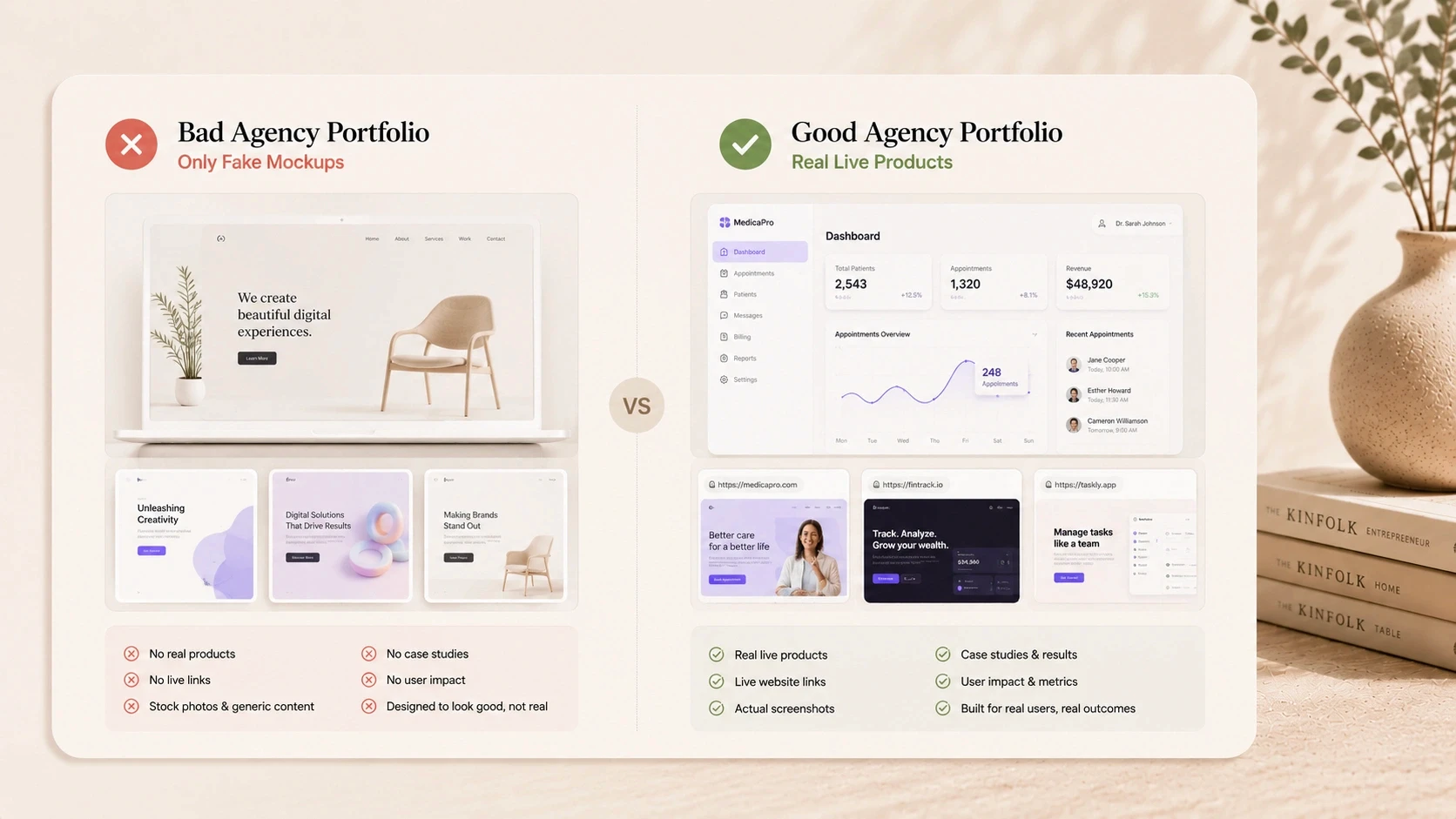
Red Flag 3: Their Portfolio Is All Design Mockups, No Real Products
A portfolio full of beautiful Dribbble shots and Figma screenshots is not the same as a track record of shipped products. Design mockups and live, working software are very different things.
When you're evaluating an MVP development company, you want to see products that were actually built, launched, and used by real people. Not concepts. Not redesign concepts for brands that didn't hire them. Real work, with real clients, that you can click on or see in an app store.
How to vet their actual track record
• Ask for links to live products they've built
• Ask what the client's outcome was post-launch, did users engage? Did the client raise funding?
• Ask if you can speak to a past client directly
• Look for the agency on Clutch or G2, verified client reviews are far more reliable than a polished portfolio
If they hesitate on any of these, that's information. Good agencies are proud of their work and happy to put you in touch with clients who'll vouch for them.
Red Flag 4: Their 'Process' Is Generic and Vague
Every agency website has a process section. Discovery. Design. Build. Launch. The problem is when that's where the description ends.
A real process for MVP development has specifics inside each phase. What does discovery actually involve? How many UX rounds are there? What happens during QA? Who signs off at each stage? How are feedback rounds structured?
Why process depth matters so much
When things go sideways mid-project, and on some level, something always does, a well-defined process is what protects both you and the agency. It defines who owns what, how decisions get made, and what happens if scope changes.
A vague process isn't just a communication gap. It's a structural risk. It means when disagreements happen, there's no agreed framework to resolve them.
What to probe
Ask them to walk you through your specific project using their process. "If we were working together on my MVP, what would the first two weeks look like, day by day?" A confident, experienced team will answer this fluently. An agency winging it will get vague fast.
Red Flag 5: You Don't Know Who's Actually Building It
You spoke to a polished salesperson. Maybe a senior project manager. But do you know who's writing the code? Do you know where they're based, what their experience level is, whether they're full-time employees or contractors hired per project?
Outsourcing is extremely common in the agency world, and it's not inherently wrong. But undisclosed outsourcing is a red flag. It means the team you evaluated isn't the team building your product. Quality control, communication, and accountability all get harder when the actual developers are a subcontracting chain away from the agency you hired.
What to ask directly
• Is your development team in-house or do you outsource?
• Can I meet the designer and developer who'll work on my project?
• Where is the team based?
• What's the ratio of senior to junior developers on my project?
A startup development team that won't answer these questions clearly is telling you something. The best agencies are transparent about their team because their team is genuinely good.
Red Flag 6: Post-Launch Support Is an Afterthought
Launch is not the finish line. It's the starting gun. After your MVP goes live, you'll need bug fixes, small iterations based on user feedback, performance monitoring, and in many cases, integration support. What does the agency plan to do then?
A lot of agencies treat the handoff as the end of the relationship. They deliver the code, close the project, and move on. That's fine if you have an in-house technical team ready to take over. Most early-stage startups don't.
Why this matters more than founders expect
The weeks immediately after launch are often the most critical for a startup. This is when real users expose issues that testing didn't catch. This is when investor demo prep happens. This is when you're iterating fastest. Losing your development team's support right at this moment is genuinely risky.
What a good engagement looks like
• A defined post-launch support period, even 30 to 60 days, built into the contract
• Clear escalation process for critical bugs after handoff
• An honest conversation about what ongoing support looks like if you want to continue the relationship
Ask before you sign: "What does support look like in the 30 days after launch?" The answer tells you a lot about how invested they are in your success beyond the invoice.
Red Flag 7: They're Pushing You to Sign Right Now
Urgency tactics in the hiring process, limited spots, prices going up next week, another client about to take your slot, are manipulation, not business. And they're a clear signal about how this agency operates.
A good MVP development company wants you to make the right decision. They know that a client who felt pressured into signing will be a difficult client to work with. Rushed decisions lead to misaligned expectations, which lead to messy projects. Good agencies don't want that any more than you do.
What healthy sales behaviour looks like
They give you time to think. They answer follow-up questions without creating urgency. They might tell you their honest capacity situation, "we have availability starting in three weeks", but they don't manufacture pressure.
Trust your gut here. If the sales process felt pushy, the project management probably will too.
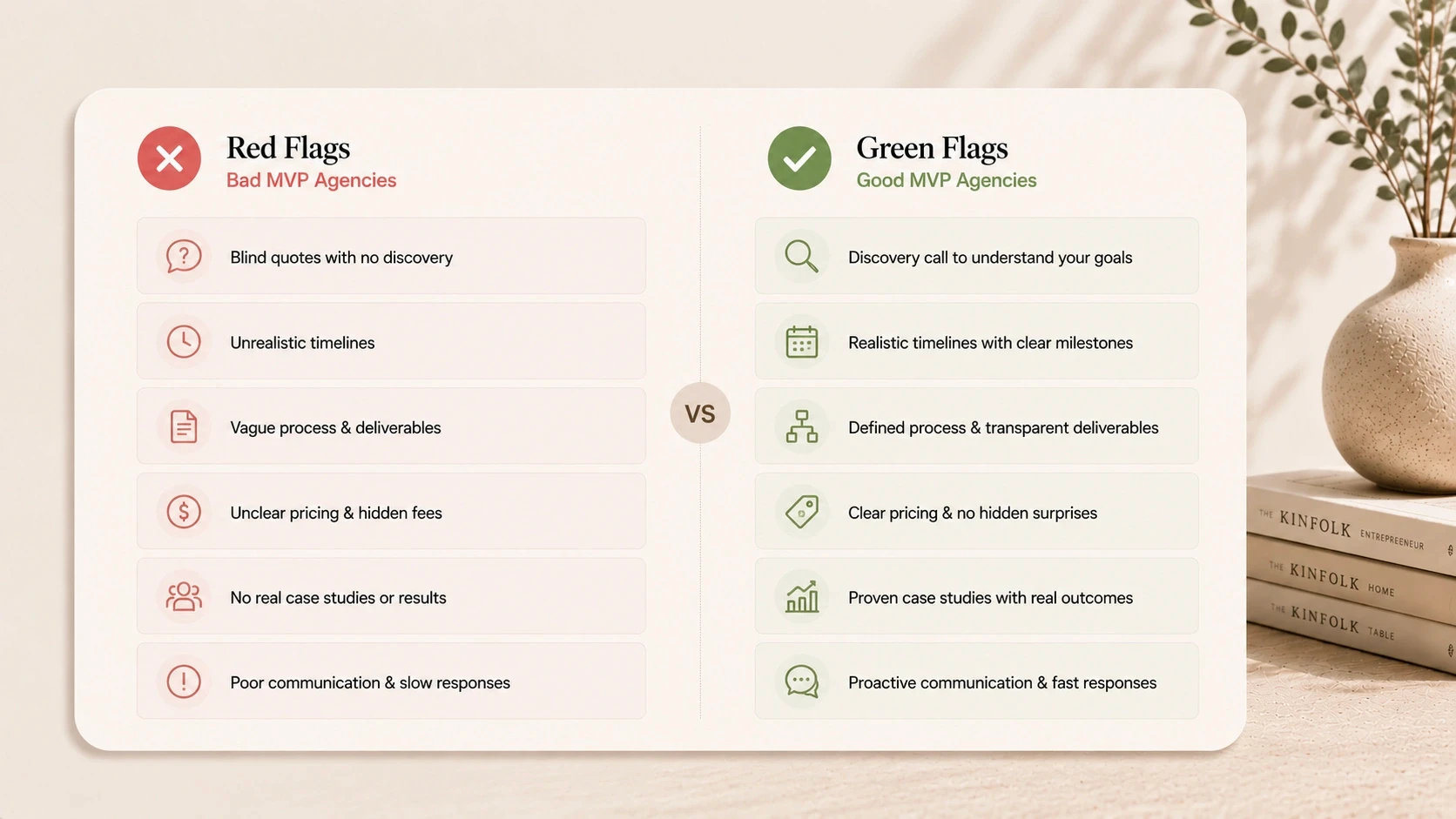
The Full Side-by-Side: Red Flag vs Green Flag
MVP Agency: Red Flag vs Green Flag Comparison
Red Flag # | What a Bad Agency Does | What a Good Agency Does |
1 | Gives a fixed quote without asking about your users or goals | Asks discovery questions before quoting |
2 | Promises an MVP in one or two weeks | Sets a realistic 4–10 week timeline with milestones |
3 | Can't show live, working MVP case studies | Has documented case studies with real client outcomes |
4 | Shows you a generic template as 'our process' | Walks you through their specific process for your project |
5 | Outsources to a team you've never met | Introduces the actual team doing the work |
6 | Doesn't mention post-launch support | Clearly defines what happens after go-live |
7 | Pushes you to sign before you're ready | Gives you time, answers questions, earns the yes |
The Questions to Ask Before You Hire Anyone
Print this out. Use it on every call. These are the eight questions that separate a solid MVP development company from one that will cost you more than just money.
MVP Agency Due Diligence Checklist
Question to Ask the Agency | What You're Testing For |
Can you show me 2–3 MVPs you've launched? | Proof of actual delivery, not just design mockups |
Who specifically will work on my project? | Whether work is done in-house or outsourced |
What does your MVP process look like, step by step? | Whether they have a real process or wing it |
What's a realistic timeline for what I'm building? | Whether they're honest or just trying to close the deal |
What happens if we're not happy mid-project? | How they handle conflict and accountability |
Do you have experience in my industry? | Relevant context, not a dealbreaker but worth knowing |
What's included in post-launch support? | Whether they disappear after handoff or stay invested |
Can I speak to a past client? | Whether they're confident enough to offer real references |
If an agency stumbles on more than two of these questions, walk away. There are good teams out there. You don't need to settle.
How CREATEXP Approaches MVP Development
At CREATEXP, MVP development conversations usually start with a very direct question: what are you trying to learn from this launch? Not what do you want to build, what do you want to know. That reframe changes everything about how the scope gets defined.
The studio's MVP approach is built around a fixed 30-day launch model for most projects. That doesn't mean 30 days of rushed code, it means 30 days of focused, scoped, disciplined execution on the features that actually matter for validation. Non-core features get documented and deferred. The team isn't trying to build everything, it's trying to build the right thing fast.
The entire process is in-house. The designer who ran the discovery session is the designer who produces the UI. The developer who reviewed the brief is the developer writing the code. There's no handoff chain, no account manager buffering communication between you and the team, and no outsourcing happening in the background.
Post-launch support is built into every engagement, not treated as a separate upsell. The studio stays available for the first 30 days after launch to handle the inevitable small issues that surface with real users. For founders who want to continue the relationship, iterating, expanding, or redesigning based on what they learned, the team is already fully contextualised in the product.
CREATEXP has worked with 50+ founders across five continents. The most consistent feedback from that work: the best projects are the ones where both sides were honest about what the MVP was actually trying to prove, and what it wasn't.
Talking to Agencies and Not Sure Who to Trust? Run your shortlist by the CREATEXP team. We'll tell you what to look for and what to watch out for. |
Seven Things to Remember Before You Sign
1. Any agency that quotes you before asking about your users and goals is guessing, and you'll pay for the guess later.
2. An MVP that's ready for real users takes four to ten weeks minimum. Anything faster is a red flag, not a bonus.
3. A portfolio of mockups is not a track record. Ask for live products and real client outcomes before you commit.
4. A process that can't be described in specifics isn't a process, it's a slide deck. Push for the detail.
5. If you don't know who's actually building your product, find out before you sign. Undisclosed outsourcing is a structural risk.
6. Post-launch support should be written into the contract, not treated as a conversation for later.
7. Pressure tactics in the sales process are a preview of the project management style. Trust your instincts.
Questions Founders Usually Have at This Stage
How do I choose the right MVP development company?
Start by looking for agencies that have built and launched real MVPs, not just designed them. Ask for live product examples, client references, and a detailed walkthrough of their process. The right MVP development company will ask more questions than they answer in the first call. They're trying to understand your product, not just win the contract.
What should an MVP cost to develop?
A realistic MVP development budget typically falls between $15,000 and $60,000 depending on the complexity of the product, the team's location, and whether design is included. Be cautious of quotes below $8,000 for anything beyond a basic landing page, they usually reflect either very junior work or a scope that's far smaller than you think it is.
How long should it take to build an MVP?
A well-built MVP typically takes four to ten weeks from kickoff to launch. This includes design, development, QA, and handoff. Simpler products with a narrow feature set can hit the lower end of that range. Complex apps with multiple user types, third-party integrations, or custom logic usually sit in the six to twelve week range.
What questions should I ask a startup developer or agency before hiring?
Ask to see live products they've built, not just design portfolios. Ask who specifically will work on your project and whether development is done in-house. Ask them to describe their process phase by phase for your specific project. Ask what post-launch support looks like. And ask if you can speak to a past client. Strong agencies answer all of these confidently.
What are the most common mistakes founders make when choosing an MVP agency?
The most common mistakes are: choosing based on price alone, not vetting whether they've actually launched products versus just designed them, not meeting the development team before signing, and not clarifying post-launch support. Another big one is not defining a clear scope before engaging, ambiguity at the start almost always leads to cost overruns.
Is it better to hire a startup developer in-house or use an agency for an MVP?
For most early-stage startups, an agency is the better choice for MVP development. Hiring in-house takes two to three months and comes with significant overhead. An agency can start in days, brings a cross-functional team, and doesn't require you to manage headcount. In-house development makes more sense once the product is validated and you need full-time, ongoing engineering capacity.
How do I know if an agency is outsourcing my project?
Ask directly. A transparent agency will tell you whether their development team is in-house or contracted. You can also ask to meet the actual developers during the proposal stage, not just the sales or project management contact. If they're reluctant to make that introduction, it's usually because the team you'd meet isn't the team they want you evaluating.
Warning: Working With Us May Trigger Unstoppable Momentum